What Is a Mesh Wi-Fi System?
A mesh network replaces your ISP's router with two or more nodes that communicate with each other over a dedicated wireless backhaul or wired Ethernet. Your devices roam automatically between nodes as you move around the house — the same network name, no manual switching. Unlike Wi-Fi extenders, which create a separate network and cut bandwidth in half, mesh systems are designed to work as a single unified network from the outset.
The technology matters most in UK housing stock: Victorian terraces with thick brick walls, 1930s semis with solid internal walls, and long narrow floor plans all absorb 5 GHz signals aggressively. A well-placed pair of mesh nodes routinely delivers three to four times the coverage of a single router in the same position.
Mesh Wi-Fi Standards Explained
Wi-Fi 6 (802.11ax): The current mainstream standard. Supports up to 9.6 Gbps theoretically, with real-world gains from OFDMA and BSS Colouring that reduce congestion in device-dense homes. Available in affordable systems from £80 upwards.
Wi-Fi 6E: Adds a third radio band at 6 GHz, providing a clean, uncongested lane for backhaul traffic or the fastest client devices. This is the sweet spot in 2026 — mature hardware, reasonable pricing, and genuine performance benefits for homes with 30+ connected devices.
Wi-Fi 7 (802.11be): The latest standard, with multi-link operation (MLO) that bonds multiple bands simultaneously. Theoretical speeds reach 46 Gbps. In practice, the benefit in UK homes is stability and lower latency rather than raw speed — most UK broadband connections top out at 1 Gbps regardless — see our guide to broadband for a smart home for how much speed you actually need. Wi-Fi 7 systems are now available from around £300 for a two-pack. If a single high-end router covers your home without needing multiple mesh nodes, see our best WiFi 7 router UK guide for standalone picks.
Best Mesh Wi-Fi Systems UK: At a Glance
| System | Best for | Wi-Fi standard | Coverage | UK price |
|---|---|---|---|---|
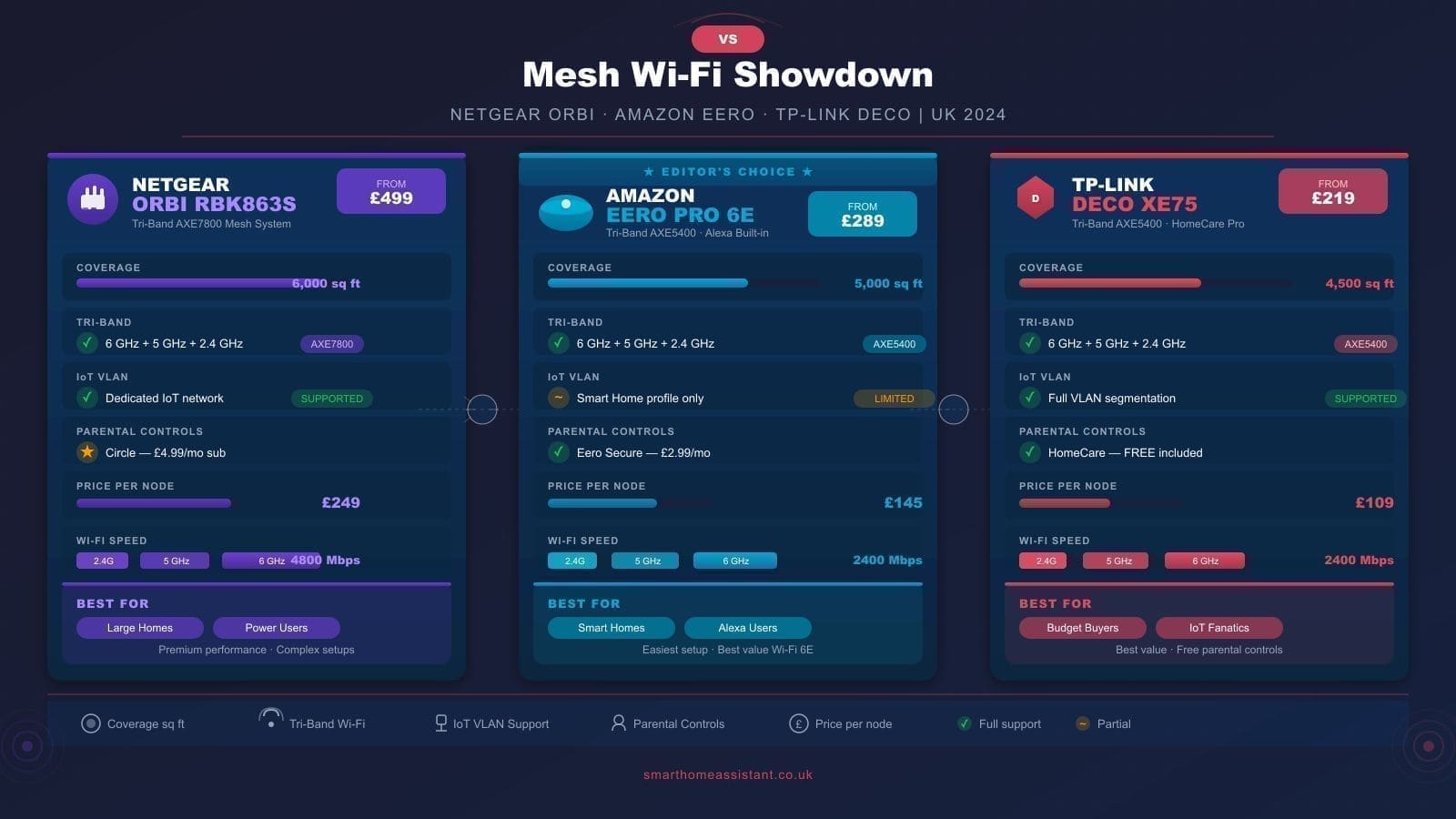
| TP-Link Deco XE75 | Best mid-range overall | Wi-Fi 6E (AXE5400) | Up to 650 m² (3-pack) | £330–£350 (3-pack) |
| Amazon eero Pro 6E | Best for smart home integration | Wi-Fi 6E (AX5400) | Up to 380 m² (2-pack) | £320–£360 (2-pack) |
| Google Nest Wifi Pro | Best for Google Home users | Wi-Fi 6E (AX5400) | Up to 360 m² (3-pack) | £340–£380 (3-pack) |
| Netgear Orbi 770 | Best for large UK properties | Wi-Fi 7 (BE18000) | Up to 510 m² (2-pack) | £320 (2-pack) / £760 (3-pack) |
| TP-Link Deco BE65 | Best premium Wi-Fi 7 | Wi-Fi 7 (BE9300) | Whole-home (3-pack) | ~£500 |
The Best Mesh Wi-Fi Systems for UK Buyers (2026)
1. TP-Link Deco XE75 — Best Mid-Range Wi-Fi 6E
Standard: Wi-Fi 6E (AXE5400) | Bands: Tri-band 2.4 GHz + 5 GHz + 6 GHz | Coverage: Up to 650 m² (3-pack)
The TP-Link Deco XE75 is the system we recommend to most UK buyers who want Wi-Fi 6E performance without paying Wi-Fi 7 prices. Its tri-band design dedicates the 6 GHz channel entirely to backhaul between nodes, leaving the 2.4 GHz and 5 GHz bands free for client devices — a configuration that sustains consistent throughput across all nodes rather than just the one nearest your router.
TP-Link's Deco app is among the cleanest in the category. Parental controls, QoS, and guest network management all surface clearly without needing a web interface. The system is available on Amazon.co.uk and at Currys; prices vary by retailer and pack size, but it sits comfortably in the mid-range. If you run Home Assistant, the Deco XE75 works well as a wired backhaul for your smart home hub — particularly if you follow the advice in our Home Assistant UK setup guide. For maximum security, pair the Deco XE75 with an IoT VLAN — our guide to IoT VLAN setup with Home Assistant explains exactly how.
Ideal for: Three- to four-bedroom UK homes, buyers wanting Wi-Fi 6E at a reasonable price, Home Assistant users who want a stable wired-backhaul network.
2. Amazon eero Pro 6E — Best for Smart Home Integration
Standard: Wi-Fi 6E (AX5400) | Bands: Tri-band 2.4 GHz + 5 GHz + 6 GHz | Coverage: Up to 380 m² (2-pack)
Amazon's eero Pro 6E launched in the UK in 2022 and remains a strong choice in 2026 thanks to its built-in Zigbee hub. Each eero Pro 6E node can act as a Zigbee coordinator, meaning smart home devices — sensors, smart plugs, smart bulbs — can pair directly to the eero system without a separate hub. It also includes a 2.5 Gbps Ethernet port for future-proofed wired connections and supports Thread as a border router, making it compatible with Matter-over-Thread devices.
For smart home buyers, the eero Pro 6E's Zigbee capability is a genuine differentiator. It is available directly from Amazon.co.uk and at Currys. If you use Alexa as your voice assistant and want Zigbee without buying a separate coordinator, this is the system to choose. Zigbee devices purchased alongside it — such as the smart bulbs covered in our best smart light bulbs UK guide — pair seamlessly. For a deeper look at the full eero line-up including the eero 6, 6+, and Max 7, see our full eero mesh Wi-Fi review UK.
Ideal for: Alexa households, smart home beginners who want Zigbee built in, UK buyers upgrading from an ISP router to a proper mesh system.
3. Google Nest Wifi Pro — Best for Google Home Users
Standard: Wi-Fi 6E (AX5400) | Bands: Tri-band 2.4 GHz + 5 GHz + 6 GHz | Coverage: Up to 360 m² (3-pack, UK)
The Google Nest Wifi Pro is Google's first Wi-Fi 6E mesh system and the first to include native Matter support, enabling seamless setup of compatible smart home devices via the Google Home app. One important UK-specific caveat: OFCOM regulations restrict Wi-Fi 6E in the UK to 80 MHz channels rather than the 160 MHz channels permitted in the US, which reduces peak 6 GHz throughput compared to international reviews. In real-world UK use this rarely matters, because the bottleneck is almost always the broadband connection, not the wireless link.
The Nest Wifi Pro integrates tightly with Google Assistant, Nest cameras, and Nest thermostats. If your household already uses Google Home as its control layer, the management experience is cohesive in a way that third-party mesh systems cannot match. Note that the Nest Wifi Pro is incompatible with previous Google Wifi or Nest Wifi generations, so buyers upgrading from an older Google system will need to replace all nodes.
Ideal for: Google Home households, buyers who prioritise Matter support and Nest device integration.
4. Netgear Orbi 770 — Best for Large UK Properties
Standard: Wi-Fi 7 (BE18000) | Bands: Tri-band | Coverage: Up to 510 m² (2-pack)
For large UK homes — detached houses, converted farmhouses, properties with a detached garden office or annexe — the Netgear Orbi 770 is the standout choice in 2026. It is a Wi-Fi 7 system with multi-link operation (MLO), which bonds the 5 GHz and 6 GHz bands simultaneously for a more stable connection at longer range and through thicker walls. The two-pack covers up to 510 m² and the three-pack extends to 750 m².
UK pricing is available directly from Netgear and major UK retailers, with the two-pack at around £320 and the three-pack around £760; prices vary by retailer. The Orbi 770 includes four Ethernet ports on each node, making it an excellent backbone for a wired smart home installation. It handles mixed device environments — older 2.4 GHz sensors alongside the latest Wi-Fi 7 laptops — without requiring manual band steering.
Ideal for: Large UK properties, buyers who need both long-range coverage and maximum wired-port density, homes with a mix of old and new devices.
5. TP-Link Deco BE65 — Best Premium Wi-Fi 7
Standard: Wi-Fi 7 (BE9300) | Bands: Tri-band 2.4 GHz + 5 GHz + 6 GHz | Ports: 4× 2.5 Gbps Ethernet per node
The Deco BE65 is TP-Link's flagship Wi-Fi 7 mesh system and the choice for buyers who want to future-proof their home network for the next five or more years. It uses a Qualcomm quad-core 2.2 GHz processor, supports 320 MHz channel width on the 6 GHz band, and delivers combined speeds of up to 9.3 Gbps. Each node includes four 2.5 Gbps Ethernet ports — more than enough to wire in a NAS, a smart home hub, and a TV while still leaving ports free for future expansion.
At around £500 for the UK retail version, the Deco BE65 is a premium purchase. It is worth the investment if you have a multi-gigabit broadband connection (such as a full-fibre 2 Gbps or 10 Gbps service) or a large number of high-bandwidth devices. For most UK households on a standard 900 Mbps or 1 Gbps full-fibre tariff, the Deco XE75 or Orbi 770 will deliver equivalent real-world performance at a lower price.
Ideal for: Power users, households with multi-gigabit fibre, buyers who want to invest once and not upgrade again for several years.
How Many Nodes Do You Need?
A rough guide for UK housing types:
- Flat or one-bed: A single node is usually sufficient.
- Two- to three-bedroom terrace or semi: A two-pack covers most layouts, especially if the router node sits in the centre of the home.
- Four-bedroom detached or older property with solid walls: A three-pack is recommended. Consider wired Ethernet backhaul between nodes if cable runs are possible.
- Large detached, barn conversion, or home with outbuildings: Three or more nodes plus wired backhaul. Consider the Orbi 770 three-pack.
Energy Consumption: UK Running Costs
Mesh Wi-Fi nodes typically consume 8–12 watts each when operating at full capacity, according to independent measurements. A two-node system running at around 20 watts consumes approximately 175 kWh per year. At the Ofgem electricity unit rate of 24.5p per kWh (Q2 2026 price cap), that works out to roughly £43 per year to run — comparable to leaving a small LED lamp on permanently. Newer Wi-Fi 7 systems often include automatic power-saving modes that reduce consumption during low-traffic periods.
UK Availability and Where to Buy
All five systems in this guide are available in the UK. The eero Pro 6E is sold exclusively through Amazon.co.uk. TP-Link Deco systems are stocked at Currys, Amazon UK, and Box. Google Nest Wifi Pro is available from Google's own UK store, John Lewis, and Currys. Netgear Orbi systems are sold direct from Netgear's UK site and through Amazon UK. Prices vary by retailer and promotional periods — always compare across at least two retailers before purchasing. Not sure whether a mesh system or a single standalone router is right for your home? Our guide to the best routers for smart homes in the UK covers standalone Wi-Fi 6 picks that suit smaller properties and tighter budgets. If you want a deeper look at TP-Link's range specifically, our TP-Link Deco review UK compares the X20, X50, XE75, and BE65 head to head.