What is Hive Thermostat and who makes it?
Hive is owned by British Gas's parent company, Centrica. Launched in 2013, it was one of the first mainstream smart heating brands sold in the UK and remains one of the most recognisable, partly because British Gas can install and service it directly through its own engineer network. The Hive range has expanded well beyond thermostats to include smart plugs, cameras, sensors and lighting, but heating control — replacing or working alongside your existing central heating programmer — remains its core product. Unlike some rivals, Hive doesn't require an ongoing British Gas energy contract; anyone in the UK can buy and install it regardless of who supplies their gas or electricity.
What's the difference between the Hive Thermostat and Hive Mini?
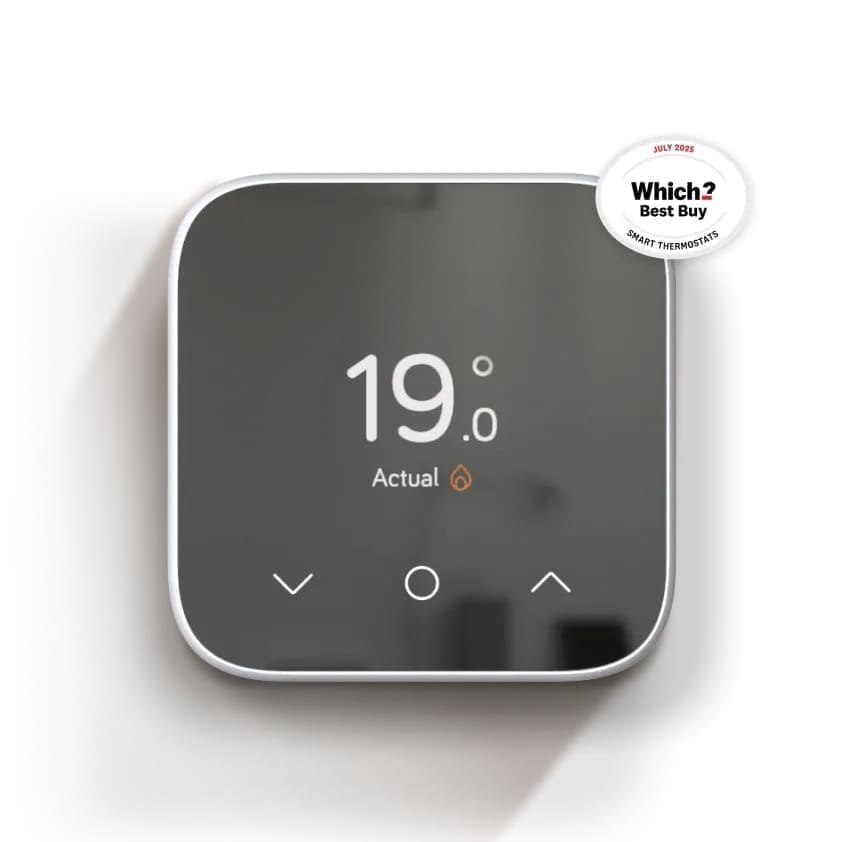
The main Hive Thermostat has an on-device screen and dial, while the Hive Mini is controlled entirely through the app. The full-size Hive Thermostat (£119, or £107.10 for Hive+ members) lets you check the temperature, boost the heating, or adjust the schedule directly from the wall unit, and includes a receiver, four AA batteries and a user guide in the box. The Hive Mini (£79, or £71.10 for Hive+ members) is a smaller, screen-free unit powered by four AAA batteries, designed for people who are happy to control heating from their phone and want a cheaper, less obtrusive device on the wall. Both models offer the same core smart features — remote control, scheduling, geolocation alerts, frost protection, holiday mode and a one-hour heating boost — and both support voice control through Alexa, Google Assistant and Apple HomeKit. Buyers who want a system that a non-tech-savvy household member can still operate from the wall, without opening an app, generally lean towards the full Hive Thermostat; those who mainly want the it-just-works background functionality tend to choose the Mini and pocket the £40 difference.
How much does Hive Thermostat cost to install?
A full installation typically costs between £100 and £300, depending on whether you fit it yourself or pay for a professional visit. Buying the Hive Thermostat or Hive Mini outright and self-installing (suitable for anyone comfortable working on low-voltage heating wiring) is the cheapest route, at £79–£119 for the unit alone. British Gas offers professional installation through its own engineers, which typically costs around £200 on top of the device price and includes a complimentary year of Hive+ membership. Self-installation isn't recommended for anyone unfamiliar with boiler wiring, and Hive's receiver does need to be wired into the existing heating system rather than simply plugged in, which is why many buyers opt for a professional fit. Prices vary by installer and region — Home Counties and London quotes tend to run toward the higher end of that range.
| Model | Price (RRP) | Control | Power | Best for |
|---|---|---|---|---|
| Hive Thermostat | £119 | On-device dial + app | 4x AA batteries | Households wanting wall-unit control |
| Hive Mini | £79 | App only | 4x AAA batteries | Budget-conscious, app-first users |
| Professional install (either model) | +£175–£300 | — | — | Anyone not confident with boiler wiring |
What does Hive+ membership add?
Hive+ is an optional subscription, priced at £3.99 a month or £39.90 a year, that layers extra features on top of the free Hive app. It includes budget tracking against your energy bills, a Saver Mode that nudges heating schedules toward efficiency, and extended product warranty cover. The core smart heating functions — remote control, scheduling, geolocation, frost protection and holiday mode — all work without a subscription, so Hive+ is worth evaluating only if you specifically want the budgeting tools or extended warranty. Buyers who choose British Gas professional installation get one year of Hive+ included free, which is a reasonable way to trial it before deciding whether to keep paying.
Does Hive Thermostat work with Home Assistant?
Yes, but only through a community-maintained integration rather than an official one. Hive doesn't publish a local API, so Home Assistant users rely on the Hive custom integration (available via HACS or as a core integration in recent releases), which authenticates against Hive's cloud service. This means automations depend on an internet connection and Hive's servers staying online — there's no fully local control path, unlike some Zigbee-based thermostats. For anyone building a Home Assistant setup from scratch and prioritising local-only reliability, a Zigbee thermostat such as the radiator valves reviewed in our Home Assistant compatibility guide may be a better fit than Hive's cloud-dependent hardware.
Which boilers is Hive Thermostat compatible with?
Hive works with the vast majority of UK gas, oil and LPG boilers, including combi, system and heat-only (regular) setups, and its official compatibility checker covers the great majority of boiler models sold in Britain. Newer Hive Thermostat units also support OpenTherm, a modulating protocol that lets compatible boilers run at variable output rather than simply switching on and off, which Hive states can add up to 12% extra efficiency on top of the roughly £167 typical annual saving quoted for smart heating control generally. OpenTherm support depends on your specific boiler model having an OpenTherm-enabled control board, so it's worth checking compatibility before assuming you'll get the extra saving. Hive does not currently support heat pumps in the way it does gas boilers, so anyone with (or planning) an air source heat pump should check our heat pump buying guide for thermostats built specifically for that technology.
How does Hive compare with tado and Nest?
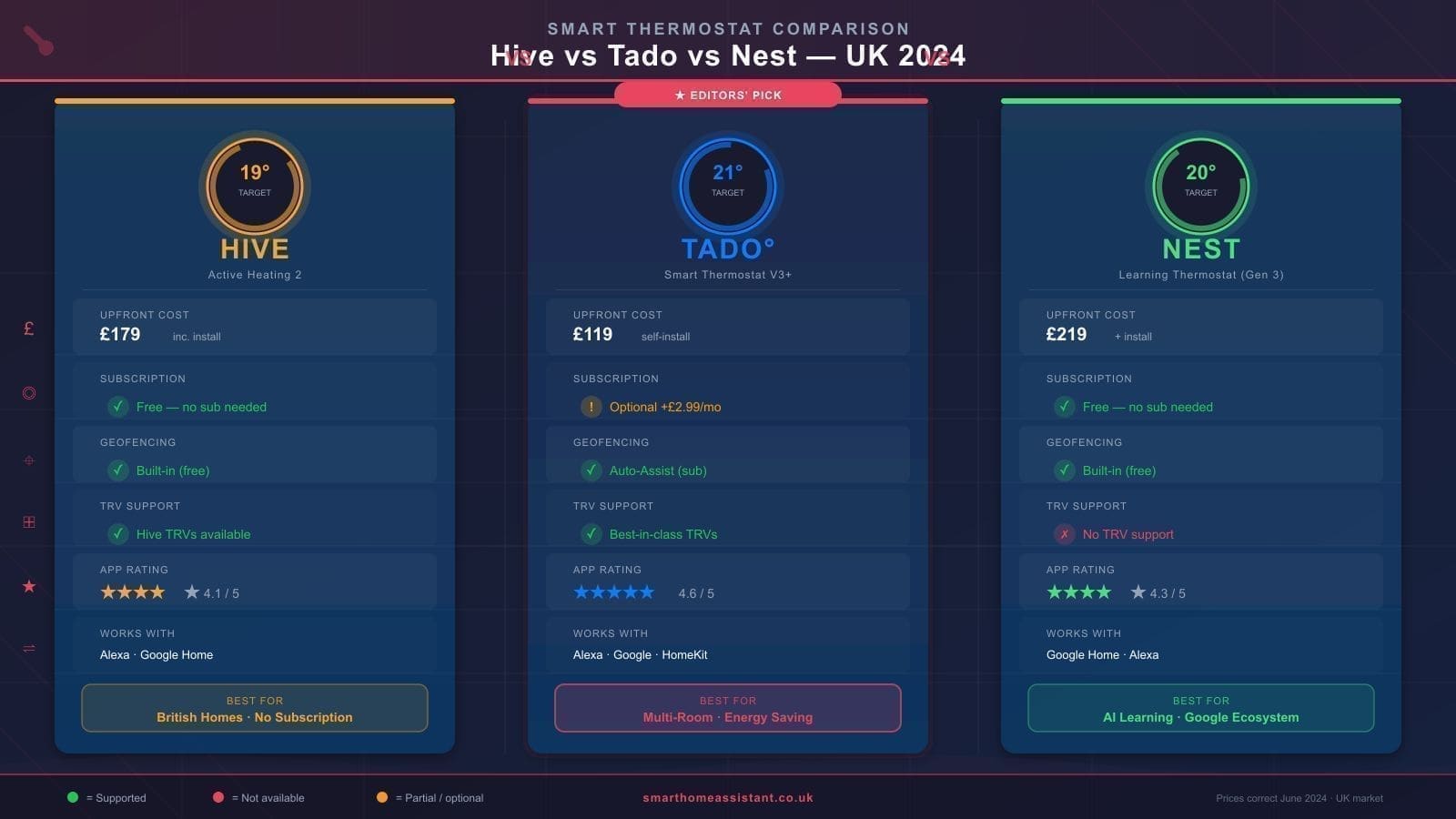
Hive, tado° and the Google Nest Thermostat are the three most widely bought smart thermostats in the UK, and they differ mainly in ecosystem and subscription structure rather than core function. Hive's advantage is British Gas-backed installation and a large existing user base; tado leans on more granular room-by-room control (with additional smart radiator valves) and a similarly optional premium tier; Nest integrates most tightly with Google Home. None of the three offers full local control for Home Assistant users. For a detailed side-by-side including pricing, features and third-party integration, see our full Hive vs tado vs Nest comparison.
Is Hive Thermostat worth it in 2026?
For most UK households already comfortable with an app-based smart home, Hive Thermostat is a solid, low-risk choice: it's widely stocked, professionally installable through a major energy-adjacent brand, and covers the core smart heating features most people actually use — remote control, scheduling and away-from-home alerts — without requiring a subscription. It's a weaker pick for anyone building a fully local Home Assistant setup, since Hive depends on cloud connectivity for both the app and any automation integration. Buyers deciding between the two current models should weigh the £40 price gap against how much they value a physical wall display versus phone-only control.