What is the Dyson Nurovi robot vacuum range?
Nurovi is Dyson's new three-tier robot vacuum family, replacing its previous 360 Vis Nav-branded robots. The entry-level R1 Nurovi Dry is vacuum-only, with 21,000Pa of suction and a redesigned, angled side-sweeper system aimed at pulling in dust and hair closer to walls and corners. The mid-tier R2 Nurovi Wash+Dry adds wet mopping via Reuleaux triangle-shaped pads that keep a constant width for cleaning into corners, plus a twin-capture system that separates fine dust from coarse debris, and a dock that heats water to around 75°C for the mop pads. Both the R1 (£499) and R2 (£750) are already available in the UK, according to Expert Reviews' hands-on coverage of the launch, roughly matching US pricing of $549 and $699.
What makes the R3 Nurovi Spot+Scrub UV different?
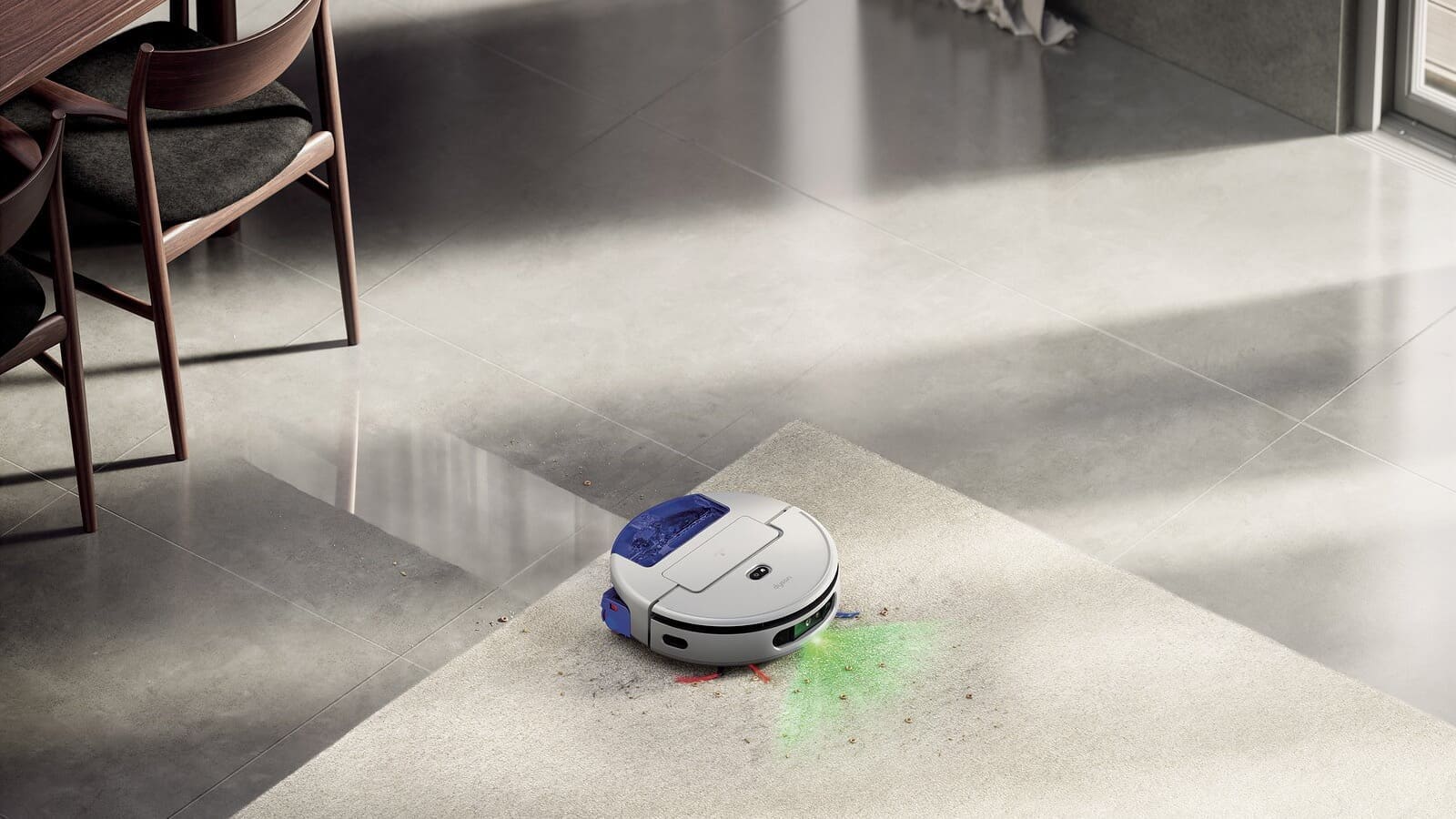
The flagship R3 is the first Dyson robot vacuum to combine UV light, green laser illumination and computer vision specifically to hunt for stains rather than just dirt. Dyson says the R3 can identify close to 200 household substances — the kind of ground-in marks a standard robot vacuum's cameras would miss — and then treat them with a self-cleaning wet roller fed by a 12-point hydration system using water heated to about 70°C (158°F), spanning the roller's full 40mm width out to the edges. It also steps suction up to 30,000Pa, which Dyson describes as 65% more than its previous Spot+Scrub AI model. In the US, the R3 launches on 15 September 2026 at $1,199 (VacuumWars); UK buyers face a longer wait, with Expert Reviews reporting an "early 2027" UK release window and no confirmed UK price yet. Dyson also refreshed its W1 PencilWash wet-floor stick cleaner alongside the robots, with a more absorbent roller, an upgraded waste system, and a self-cleaning dock.
How do the new HushJet air purifiers work?
HushJet is Dyson's air-purifier and fan platform built around a forward-facing nozzle designed to project filtered air further into a room while keeping noise down, rather than just circulating it locally. The range-topping HushJet Big+Quiet Cool Pure+ is sold in three sizes and pairs a three-stage filtration system — targeting dust, particulates and gases, including formaldehyde destruction — with a directional nozzle Dyson says can push purified air across large rooms rather than only the space immediately around the machine. Dyson's US pricing lists the Big+Quiet Cool Pure+ at $1,099, with a smaller Pure Cool+ Formaldehyde and a 3-in-1 Hot Cool Pure+ model also announced for around $599 each (Dyson press release via PR Newswire). UK pricing and release dates for this specific HushJet generation haven't been published yet — treat the US figures as a guide to positioning, not a confirmed UK price.
Does the Dyson Nurovi work with Home Assistant?
No — Dyson controls the Nurovi range entirely through its own MyDyson app, with no Matter, Zigbee or documented local API support announced at launch. That puts it behind rivals like the models compared in this site's Dreame vs Roborock Home Assistant comparison, several of which expose local control or cloud integrations that Home Assistant can hook into. If cross-platform automation matters more to you than Dyson's stain-detection tech, it's worth reading our Matter smart home devices UK guide before buying into a closed ecosystem. Dyson isn't alone in launching vacuum hardware at IFA 2026 without confirmed Home Assistant hooks either — see our coverage of Roborock's IFA 2026 lineup for a contrasting approach from a brand that does lean into open integrations.