Best WiFi 7 Routers UK: At a Glance
| Router | UK price | Bands | Best for |
|---|---|---|---|
| TP-Link Archer BE550 | £160–£180 | Tri-band (BE9300) | Best overall value |
| ASUS RT-BE58U | £85–£110 | Dual-band (BE3600) | Cheapest genuine WiFi 7 |
| ASUS ZenWiFi BQ16 | ~£400 per node | Quad-band (BE25600) | Premium mesh performance |
| TP-Link Deco BE85 | £700–£1,100 (2-pack) | Tri-band (BE19000) | Balanced premium mesh |
| Amazon eero Max 7 | ~£600 (single node) | Tri-band | Alexa/Amazon households |
| Netgear Orbi 970 | £1,500+ (2-pack) | Quad-band (27 Gbps) | Very large homes |
How We Selected These Routers
Each router above is evaluated on four factors that matter most for a UK home: real-world 6 GHz throughput reported by independent reviewers (Expert Reviews, Tom's Guide, RTINGS), current UK retail pricing checked across major retailers rather than list price alone, port speed relative to typical UK multi-gig broadband tiers, and mesh/roaming support for larger properties. We favour tri-band and quad-band models with a working 6 GHz radio over dual-band-only WiFi 7 routers, because the 6 GHz band is where the bulk of WiFi 7's real-world speed and latency gains come from.
Best WiFi 7 Routers UK: Our Picks
1. TP-Link Archer BE550 — best overall
£160–£180 · Tri-band · BE9300. The Archer BE550 is the best-value WiFi 7 router available in the UK. It covers all three bands — 2.4 GHz, 5 GHz, and 6 GHz — supports Multi-Link Operation (MLO) and 4K-QAM, and connects via five 2.5 GbE ports. For most homes on FTTP broadband up to 900 Mbps, it is all the router you need. Real-world speeds on the 6 GHz band exceed 1.5 Gbps at short range, and HomeShield provides basic network security and parental controls. It is also EasyMesh compatible, so you can add a second unit later if coverage becomes an issue.
2. ASUS RT-BE58U — best budget WiFi 7
£85–£110 · Dual-band · BE3600. The RT-BE58U is the most affordable genuine WiFi 7 router in the UK, with UK retail pricing now dipping under £90 at some resellers. It includes MLO and 4K-QAM, and supports AiMesh so you can pair it with other ASUS routers for whole-home coverage. The catch: this is a dual-band model — it has no 6 GHz radio, which is where most of WiFi 7's speed improvements reside. If budget is your primary constraint and you are on standard broadband (up to 500 Mbps), the RT-BE58U makes sense. For multi-gig broadband or a dense device environment, step up to a tri-band model.
3. ASUS ZenWiFi BQ16 — best premium mesh
Around £400 per node · Quad-band · BE25600. The ZenWiFi BQ16 is one of the best-performing WiFi 7 mesh systems available in the UK. Its quad-band design — 2.4 GHz, two 5 GHz bands, and 6 GHz — means the second 5 GHz radio can handle backhaul between nodes without sacrificing client bandwidth. Each node has two 10 GbE ports, ideal for multi-gig internet connections or wired backhaul. Setup via the ASUS app is straightforward, and AiMesh handles roaming seamlessly across a large home. Pairs well with a whole-home mesh Wi-Fi setup where blanket coverage matters as much as peak speed.
4. TP-Link Deco BE85 — best balanced premium mesh
£700–£1,100 (2-pack) · Tri-band · BE19000. The Deco BE85 is the most balanced premium WiFi 7 mesh system available in the UK, with UK retailer pricing for the 2-pack ranging from around £700 at the lower end up to the £1,000+ RRP depending on stock and promotions. Each node delivers up to 19 Gbps combined across three bands, with two 10 GbE ports enabling either multi-gig WAN or wired backhaul. HomeShield Pro provides deep packet inspection, malware protection, and QoS. In real-world testing, sustained throughput exceeds 2 Gbps on the 6 GHz band. Its tri-band design means the 6 GHz band handles both backhaul and high-speed clients — an acceptable trade-off for most homes and considerably more affordable than quad-band alternatives.
5. Amazon eero Max 7 — best for Amazon/Alexa homes
Around £600 (single node) · Tri-band · WiFi 7. The eero Max 7 is the natural choice for households already invested in the Amazon ecosystem. Each node connects up to 250+ devices and features two 10 GbE ports for wired backhaul or multi-gig internet. Setup through the eero app is the simplest of any router on this list. The trade-off is that the eero system depends on Amazon's cloud and requires an eero Plus subscription (around £9.99/month) for advanced security features. If you use Alexa heavily and want a router that integrates natively with your smart home network, the Max 7 is hard to beat.
6. Netgear Orbi 970 — ultra-premium pick
£1,500+ (2-pack) · Quad-band · 27 Gbps combined. The Orbi 970 is technically impressive — quad-band, dedicated wireless backhaul, and coverage for homes up to approximately 930 m² (three-pack, priced from around £2,200). In practice, it is significantly more expensive than competitors that offer comparable real-world performance. Unless you are equipping a very large property and price is not a concern, the ASUS ZenWiFi BQ16 or TP-Link Deco BE85 deliver equal or better value per pound.
What Is WiFi 7?
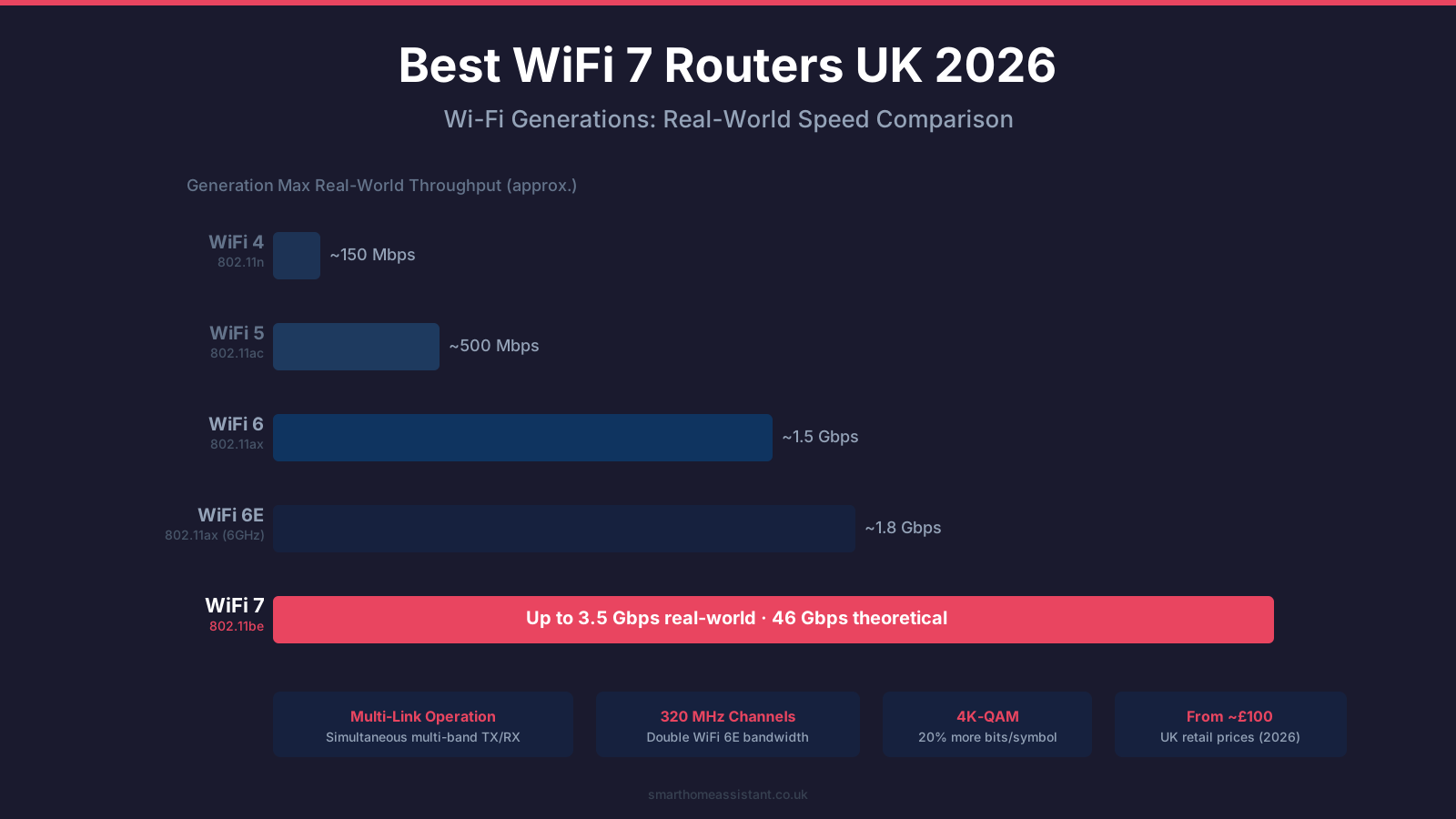
WiFi 7 is the latest generation of the Wi-Fi standard, formally known as IEEE 802.11be. The Wi-Fi Alliance finalised the specification in July 2025. Three features set it apart from WiFi 6E:
- Multi-Link Operation (MLO) — allows a router and a compatible device to transmit and receive simultaneously across multiple frequency bands (for example, 5 GHz and 6 GHz at the same time). This reduces latency and increases throughput, particularly in congested environments with many active devices.
- 320 MHz channels — doubles the maximum channel width on the 6 GHz band (up from 160 MHz in WiFi 6E), enabling peak throughput exceeding 5 Gbps on a single stream under ideal conditions.
- 4K-QAM modulation — each wireless symbol carries 12 bits instead of 10 bits (as used in WiFi 6's 1024-QAM), giving around 20% more data per transmission at close range where signal quality is high.
In independent testing, the best WiFi 7 routers achieve sustained throughput of 1.5–3.5 Gbps on the 6 GHz band at close range (around 5 metres). That represents a 25–40% improvement over WiFi 6 in comparable conditions.
Who should skip a WiFi 7 upgrade in 2026?
WiFi 7 is a future-proof upgrade for most UK homes rather than an immediate necessity. Here is how to decide:
- You have multi-gig broadband — services from Toob (2.3 Gbps), Community Fibre, Hyperoptic, and Virgin Media Gig1 (1.1 Gbps) can exceed the capacity of a WiFi 6E router on wireless. A good WiFi 7 router will saturate these connections wirelessly.
- You have 50+ smart home or IoT devices — WiFi 7's improved channel management and MLO reduce congestion in dense device environments, where smart plugs, cameras, speakers, and sensors all compete for airtime.
- You own WiFi 7 client devices — Samsung Galaxy S24 series and later, Google Pixel 9, Intel Core Ultra and Qualcomm X Elite laptops, and many 2025–2026 PCs include WiFi 7 chipsets. MLO only activates when both the router and the connecting device support WiFi 7.
- You are on standard FTTP (up to 900 Mbps) — in this case a quality WiFi 6E router performs identically for everyday use. WiFi 7 is worth considering for longevity, but upgrading is not urgent.
From December 2025, EE includes a WiFi 7 router with all its Full Fibre broadband plans, making WiFi 7 the default standard for new EE fibre customers and accelerating client device adoption across the UK. If you're weighing WiFi 7 against a cheaper, still-capable WiFi 6E router, see our dedicated WiFi 6E router review for a direct standard-by-standard comparison.
Buying Checklist
- Avoid dual-band-only WiFi 7. Without a 6 GHz radio, you lose the most significant speed and capacity gains WiFi 7 offers. Only accept dual-band if budget is the overriding constraint.
- Check the WAN port speed. Ensure the internet-facing port matches or exceeds your broadband connection. Most sub-£200 routers cap at 2.5 GbE; premium models offer 10 GbE.
- UK 6 GHz power limits. Ofcom regulates maximum 6 GHz transmit power, which is lower than in the US. UK WiFi 7 6 GHz range is somewhat shorter than US reviews suggest — factor this in for larger properties.
- Mesh vs. single unit. For homes over approximately 120 m² or with multiple storeys, a mesh system provides more reliable whole-home coverage than a single router placed centrally. If only one room is a dead zone, a cheaper Wi-Fi extender can often fix it without a full mesh upgrade.
- Check the warranty and UK stock. Buy from a UK-registered retailer or the manufacturer's UK store so you get a UK warranty and straightforward returns — grey-import units sold through third-party marketplace listings often carry a shorter or non-UK warranty.
Still deciding between a router upgrade and a broadband upgrade? Our best broadband for smart home UK guide covers how much download and upload speed a device-heavy household actually needs before you spend on premium hardware.