Display and design
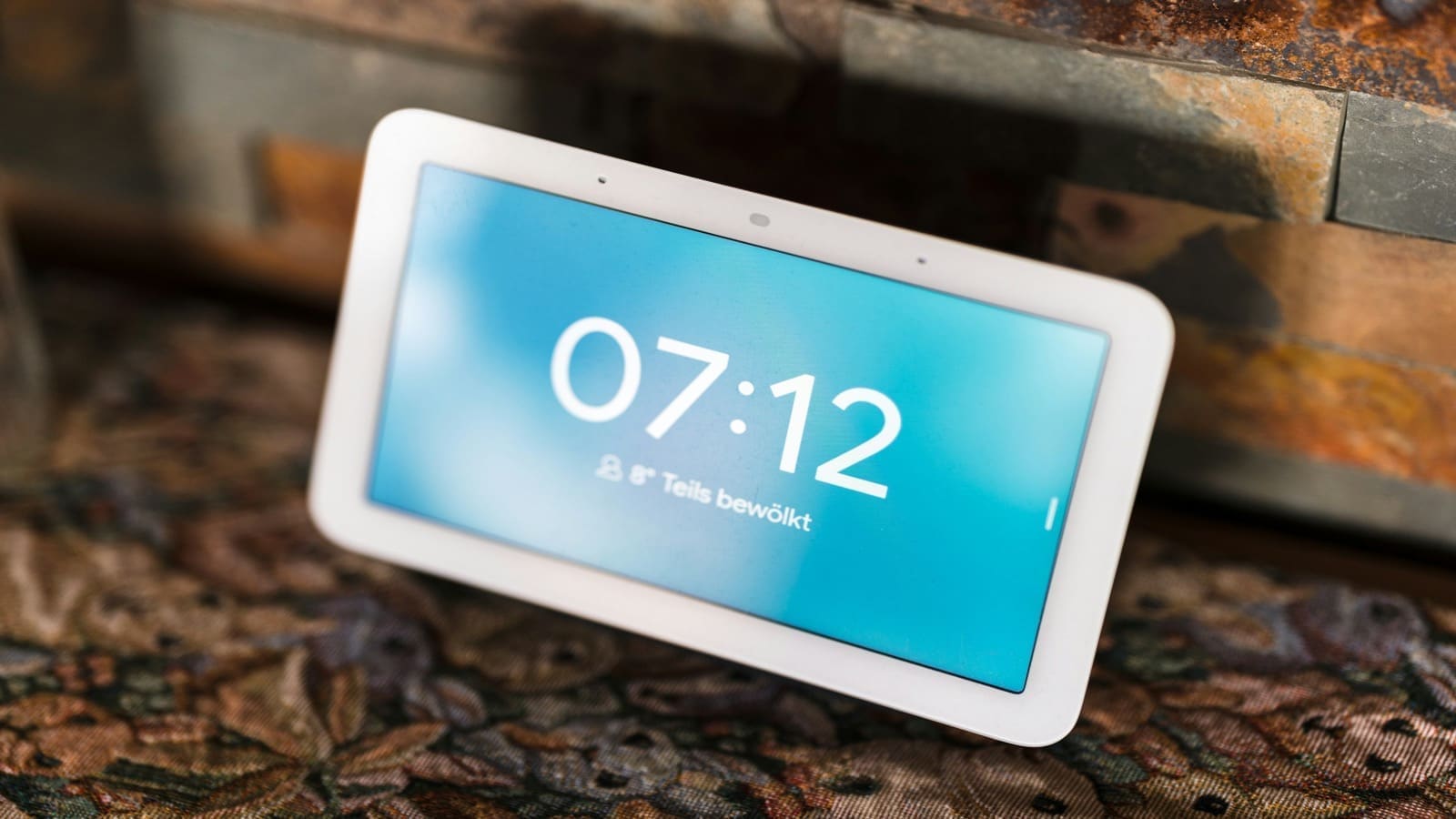
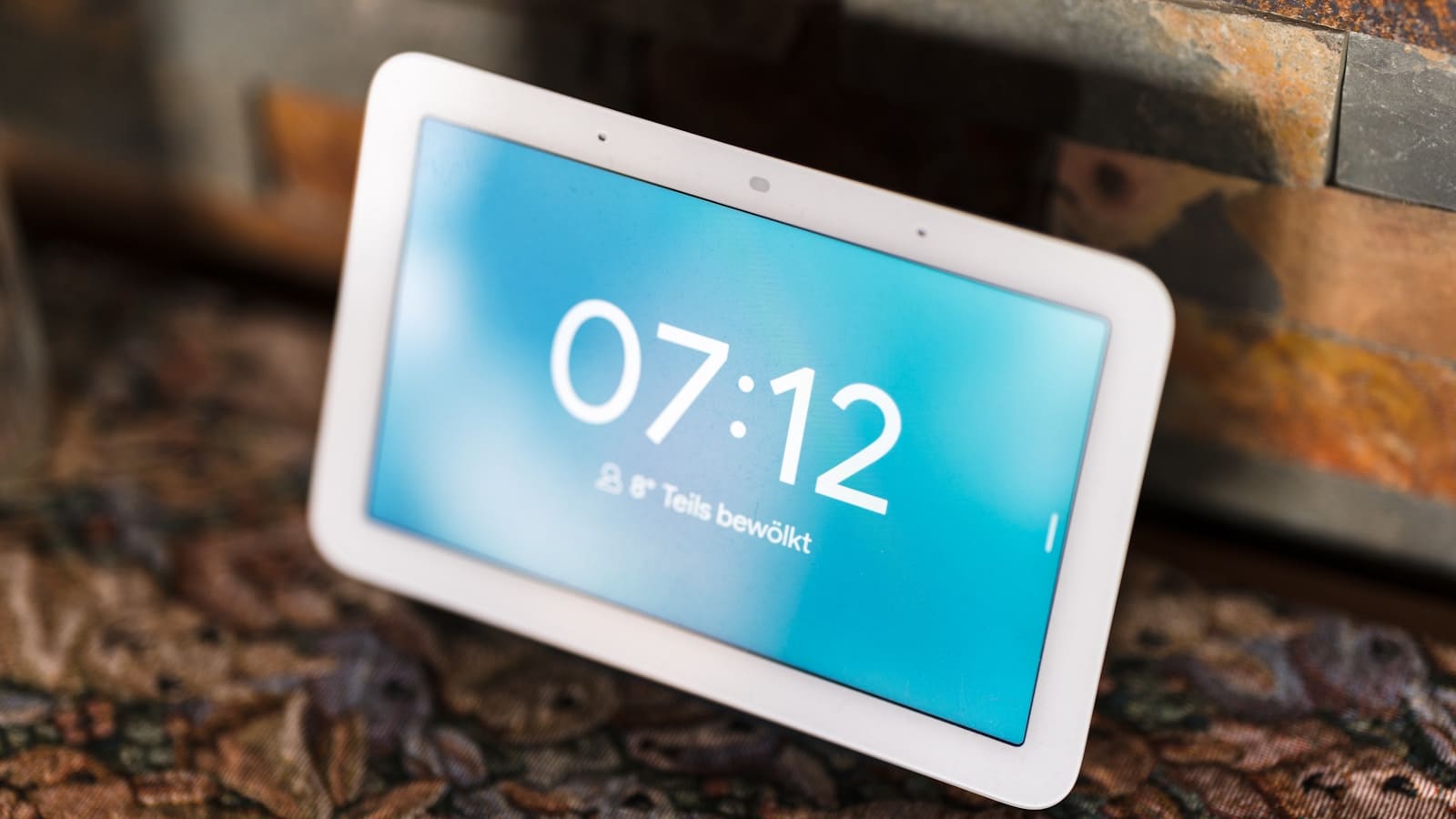
The 10-inch LCD panel is genuinely usable. At 1,280 × 800 resolution it is not pixel-dense by tablet standards, but text is sharp at normal viewing distances and the ambient display mode — which shows your Google Photos, clock, and weather — looks good from across the room. The screen is reflective, so positioning matters: direct sunlight will wash it out. Two colour options are available in the UK: Chalk (light grey) and Charcoal.
The chassis has a fabric-wrapped base housing the speakers, a recessed display tilt that cannot be adjusted, and a physical camera kill switch on the back — a reassuring hardware guarantee that the lens is off. At 1,176g and 255mm wide, it is a kitchen-counter or bedside-table device rather than something you will move around often.
Sound quality
Audio is the Nest Hub Max's strongest suit. The speaker array consists of a 75mm woofer rated at 30W and two 38mm tweeters, each rated at 10W — a total of 50W of rated output. In practice this translates to music that sounds full and room-filling at moderate volume, with real bass presence that the smaller Nest Hub simply cannot match. At the very top of the volume range, some distortion creeps in, but for a kitchen or living room at sensible listening levels it performs impressively for a device this size.
If you want multi-room audio, it integrates natively with the Google Home ecosystem and supports Chromecast, meaning you can group it with other Google speakers and Chromecast Audio devices. For a broader look at whole-home sound, see our guide to the best multiroom speakers in the UK.
Camera and video calling
The 6.5MP wide-angle camera is the defining hardware difference from the smaller Nest Hub. It enables Google Meet video calls hands-free — you walk up, say "Hey Google, video call Mum", and the Hub Max auto-frames you using what Google calls Face Match. The camera pans digitally to follow you as you move around the kitchen, which works well within a metre or two of the device.
Quick Gestures let you pause or resume media by raising your hand towards the screen — gesture recognition works at up to about 1.5 metres away and is roughly 80% accurate in everyday use. The camera can also be used as a home security monitor when linked to a Nest Aware (now Google Home Premium) subscription, providing motion and person detection, familiar face alerts, and video event history.
The Google Home Premium subscription starts at £8 per month or £80 per year, replacing the old Nest Aware branding. Without it, the security monitoring features are largely unavailable — the subscription is optional but significantly extends what the camera can do.
Google Assistant performance
Google Assistant on the Hub Max remains among the best voice assistants for UK households, handling complex natural-language queries, controlling third-party smart home devices, and answering factual questions more reliably than most alternatives. The six far-field microphones pick up wake words clearly even with music playing at moderate volume.
The screen adds context to voice responses that a standalone speaker cannot — weather forecasts show as animated graphics, recipe timers display a visual countdown, and YouTube playback is a genuine use case that makes the Max useful in a kitchen. If you are considering Google Assistant across multiple device types, our Amazon Echo vs Google Nest comparison covers how the two ecosystems differ in the UK.
Smart home control
As a control panel, the Hub Max works smoothly within the Google Home ecosystem. Lights, thermostats, cameras, locks, and plugs from compatible brands can be controlled by voice or via the home control panel on the touchscreen. Matter support was added via a software update, meaning newer smart home devices using the Matter standard integrate without needing a separate hub.
Does the Google Nest Hub Max work with Home Assistant?
Yes, but it takes some setup. The official Google Nest integration uses the Smart Device Management API and carries a one-time US$5 developer fee. It supports the Hub Max as a media/display device and enables casting Home Assistant dashboards to the screen — a popular workflow for using the large 10-inch display as a Lovelace control panel. See the Home Assistant Google Cast guide for full setup details.
UK price and availability
The Nest Hub Max is available in the UK from Google, Currys, and John Lewis at a standard retail price of around £219, though prices vary by retailer and promotional periods. Both Chalk and Charcoal variants are stocked. The smaller Nest Hub (7-inch) is available from around £75–£100 at the same retailers, which makes the Max's premium significant — you are paying roughly double for the larger screen, camera, and better speaker.
How does the Nest Hub Max compare to the alternatives?
It is harder to recommend if you are primarily after a smart speaker and do not need the camera: the smaller Nest Hub handles music and smart home control at half the price. If audio quality is your priority over Google-ecosystem features, a dedicated speaker like those covered in our multiroom speaker round-up will beat it. And if you are uneasy about a camera in the room — even with the hardware kill switch — the smaller Hub removes that concern entirely.
Who should buy the Google Nest Hub Max?
The Nest Hub Max is the right choice if you want the best smart display Google makes and use Google services — YouTube, Google Photos, Google Meet — regularly. The camera and speaker step-up over the smaller Hub are real and useful, particularly for kitchens where the large screen earns its footprint and video calling from the counter is a genuine convenience.
Verdict
For UK households already invested in Google Home, the Nest Hub Max sits comfortably as a kitchen or living room anchor: capable, well-built, and genuinely useful across music, calls, and smart home control.