
What Is the Hive Mini?
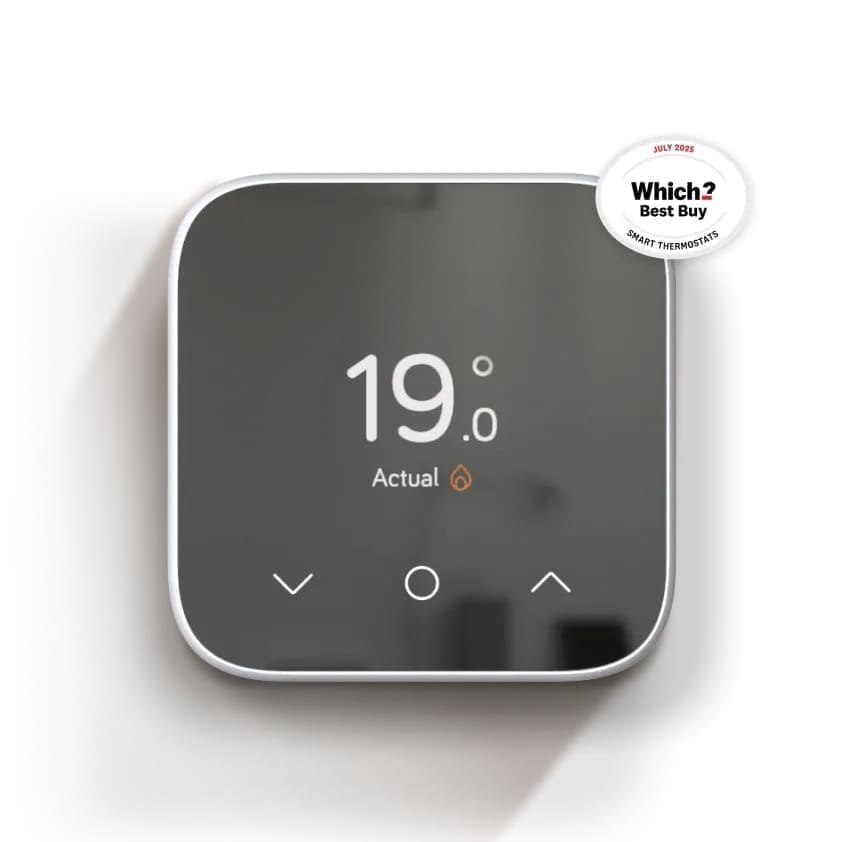
Design and dimensions. The Hive Mini measures 85 × 22 × 85mm and weighs 132g including its four AAA batteries. It is noticeably smaller and more discreet than the standard Hive Thermostat (90 × 37 × 90mm), with a mirrored front plate that hides a small colour LED display beneath it. When the display is inactive, the thermostat blends into the wall; when you approach or tap it, the screen illuminates to show the current temperature and heating status.
Controls. Three capacitive touch buttons sit along the base — boost, temperature up, and temperature down. There is no scheduling functionality on the device itself; all programme management happens in the Hive app. This is the key difference from the standard Hive Thermostat, which allows direct scheduling from the device. If you lose internet connectivity or your phone battery dies, you can still trigger a one-hour boost or nudge the temperature from the thermostat, but that is as far as on-device control goes.
Connectivity and Hub Requirement
Zigbee, not Wi-Fi. The Hive Mini communicates with the Hive Hub using Zigbee — a low-power mesh wireless protocol that operates in the 2.4GHz band. The thermostat does not connect directly to your router or broadband; it needs the Hive Hub (a small plug-in device) connected to your router via ethernet. The Hub then relays commands to the cloud, and from there to the Hive app on your phone.
Hive recommends a broadband connection of at least 1.5Mbps. Hub placement matters: a Hive Hub too far from the thermostat can cause connectivity issues. Hive's support guidance recommends placing the Hub in a central location and avoiding thick concrete walls between the two devices.
Does the Hive Mini support Bluetooth? The current Hive Mini (model SLT6/SLT6b) is Zigbee-only and does not have Bluetooth. Hive has introduced a newer V4 Mini thermostat that operates hubless using Bluetooth and Wi-Fi, but that is a different product — the two are not interchangeable, and the SLT6b reviewed here requires the Hive Hub to function.
Installation
DIY or professional. Installing the Hive Mini involves mounting a plastic wall bracket, running two wires to your boiler's existing thermostat terminals, and fitting the Receiver near the boiler. Hive's in-app installation guide walks through the process step by step. Most UK gas and LPG combi, system, and heat-only boilers are compatible; the Hive website lists specific incompatible models including some Worcester Bosch units, Vaillant VR 65 control centres, and Honeywell SmartFit controls.
Professional installation through a Hive engineer costs approximately £100. The full bundle with professional installation therefore runs to around £200–£240 depending on your area — worth factoring in if you are not comfortable with basic electrical work. If you are comparing against rivals, our Hive vs Tado comparison covers installed costs side by side.
OpenTherm support. The Hive Mini Receiver supports OpenTherm on compatible boilers. OpenTherm allows the thermostat to modulate boiler output rather than simply switching the boiler on and off, which Hive claims can deliver up to 12% additional energy savings on top of smart scheduling alone.
App and Features
The Hive app (iOS and Android) is where the Hive Mini earns its keep. From the app you can set a heating schedule, view your current and target temperatures, trigger a heating boost of up to six hours, activate holiday mode, and monitor basic usage history. The interface is clean and well-regarded among Hive users — simpler than the Tado app's energy-focused dashboard, but approachable for less technical households.
Geolocation. The Hive app uses your phone's location to detect when you leave or return home and can alert you if you forget to turn the heating off. It does not automatically adjust the schedule based on your presence in the way that Tado or Nest does by default, but you can set up automations via Hive Actions to trigger temperature changes when you arrive or depart.
Voice assistant support. The Hive Mini works with Amazon Alexa, Google Assistant, Apple HomeKit, and Siri Shortcuts out of the box. You can ask Alexa to set the temperature, check if the heating is on, or turn it off — all standard commands work without any workarounds.
Multi-zone heating. The Hive system supports up to six heating zones by adding extra thermostats. Hive Smart Radiator Valves (sold separately at approximately £54 each) allow per-room temperature control, which adds considerably to the overall cost but transforms the Mini into a genuinely capable multi-room system. See our guide to British Gas Hive boiler control for more on building out a full Hive system.
Hive Heating Plus subscription. An optional subscription at £3.99/month (or £39.90/year) unlocks advanced features including detailed energy reports, extended usage history, and priority support. The core scheduling, geolocation alerts, and voice control all work without a subscription.
Hive Mini vs Standard Hive Thermostat
The standard Hive Thermostat (part of the Hive Active Heating bundle at around £179) shares the same app, Hub, and feature set as the Mini, but adds a larger display and the ability to create and edit heating schedules directly on the device — useful if you prefer not to use your phone for routine adjustments. The standard thermostat is also thicker (37mm depth vs 22mm for the Mini), making it more prominent on the wall.
If app-first control suits your lifestyle — and for most smartphone users under 50 it likely will — the Mini's lower price makes it the more sensible choice. If you share your home with people who prefer a physical interface, or if you regularly want to adjust schedules without reaching for a phone, the standard thermostat is worth the premium.
Home Assistant Compatibility
The official Hive integration for Home Assistant supports Hive Active Heating thermostats and radiator valves. It connects via your Hive account credentials (two-factor authentication must be enabled), and once configured, Home Assistant detects all Hive devices automatically. The integration exposes current temperature, target temperature, heating mode, and battery level as entities.
Note that the official integration requires a cloud connection — it routes through Hive's servers rather than communicating locally with the Hive Hub. For homeowners wanting a fully local setup, a community project called HA-Hive-Local-Thermostat (available on GitHub, by andrew-codechimp) provides MQTT-based local control via Zigbee2MQTT. This requires a Zigbee USB coordinator (such as the Sonoff Zigbee 3.0 USB Dongle Plus) rather than the Hive Hub itself, effectively replacing the Hive infrastructure entirely.
Pros and Cons
Pros:
- Competitive price — £79 for the thermostat alone, £119 with Hub and Receiver
- Compact and discreet design with mirror finish
- Works with Alexa, Google Assistant, Apple HomeKit, and Siri Shortcuts
- OpenTherm support on compatible boilers
- Expandable to multi-zone with Hive Radiator Valves
- Compatible with most UK gas, LPG, and oil boilers
- Home Assistant integration available (cloud and local options)
Cons:
- No on-device scheduling — app required for programme changes
- Requires Hive Hub — adds cost and a point of failure
- No learning capability (unlike Nest or some Tado modes)
- Smart Radiator Valves are expensive if building out multi-room control
- Official Home Assistant integration is cloud-dependent
- Hive Heating Plus subscription needed for detailed energy history
Verdict
The Hive Mini thermostat is a solid, no-frills smart heating upgrade for UK homes that are already in the Hive ecosystem or happy to adopt it. Its £79 price point (£119 with Hub and Receiver) is genuinely competitive, and the app experience is polished enough that the absence of on-device scheduling rarely causes frustration in daily use. Alexa, Google Assistant, and HomeKit support are all present without needing workarounds.
Where the Hive Mini falls short is in intelligence: there is no learning mode, no automatic demand-response, and no TPI (time-proportional integral) control without OpenTherm. Competitors like Tado and Nest offer more sophisticated energy management for similar or slightly higher prices. If you want the best overall smart thermostat for UK homes, our round-up of the best smart thermostats UK compares the full field including Tado, Nest, and Drayton Wiser. If you want the best value in the Hive range with minimum fuss, the Mini delivers exactly what it promises.