M5Stack
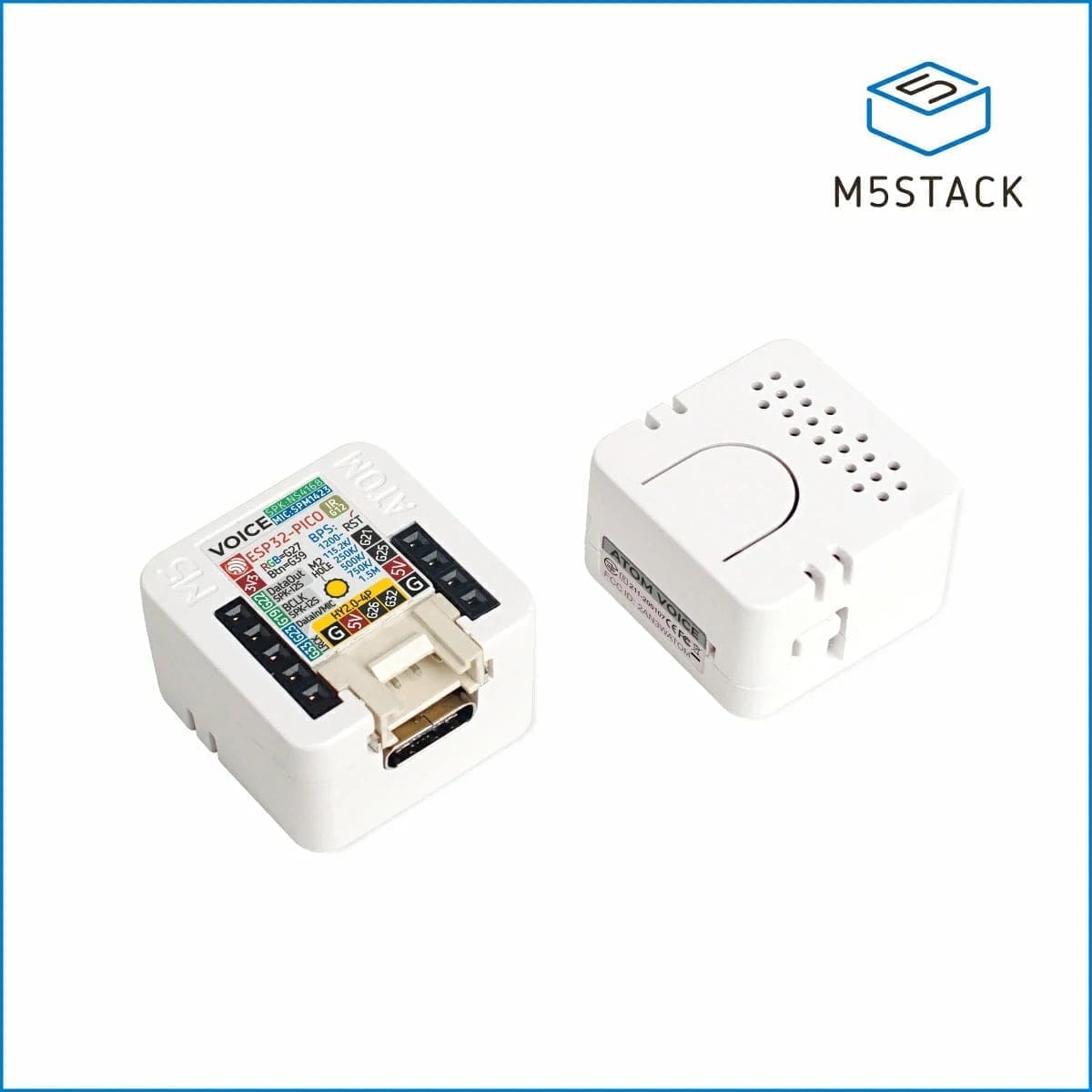
M5Stack ATOM Echo (ATOM Voice)
- Native integration
- Local control
- Wi-Fi
- Bluetooth
Prices verified September 2026
See more hubs & dongles picks on our Amazon storefront →Our verdict
The budget DIY voice satellite the community was building years before the official Voice Preview Edition existed — a sub-£15, thumb-sized ESP32 board with a mic and speaker. Flash it with ESPHome, register it as an Assist Satellite, and pair with openWakeWord for hands-free voice control in a second room. It needs manual flashing and YAML, so it's not a plug-and-play product. USB-C powers it directly with no internal battery, so it needs to stay plugged in — no cordless placement. A Grove expansion connector and a handful of GPIO pins are broken out too, useful if you want to bolt on a sensor rather than just use it as a mic/speaker satellite. As a cheap way to add extra voice satellites around the house alongside the official hardware, nothing else comes close on price.
What can Home Assistant control on the M5Stack ATOM Echo (ATOM Voice)?
| Control | Type | What it does |
|---|---|---|
| Pipeline state | Sensor | Reports the live voice pipeline stage — idle, listening, processing, responding, or error. |
| Wake word engine | Select | Runtime toggle between on-device wake-word detection and streaming audio to Home Assistant for server-side processing. |
| Status LED | Light | Onboard RGB LED with distinct colour/pulse patterns per pipeline stage, independently automatable as a light entity. |
| Mic mute | Switch | Disables audio capture and wake-word detection, exposed as a controllable entity for privacy or do-not-disturb automations. |
| Button | Event | Onboard button triggers a manual voice interaction on short press, or a factory reset on a long press. |
Setup runs through the ESPHome web installer, but the ATOM Echo has no auto-reset circuit, so you must hold the physical button while plugging in USB-C to force bootloader mode before flashing — a step nothing in the HA UI warns you about. Current ESPHome configs default to on-device wake word detection with a runtime select entity to fall back to streaming detection through Home Assistant if the local model misfires; older community builds ran wake-word detection entirely server-side instead, continuously streaming raw audio to HA over Wi-Fi. The Assist Satellite entity exposes each pipeline stage live, mirrored in real time by a single onboard RGB LED. Community threads consistently flag the mic as the weak point — usable at close range but degrading fast with distance or background noise unless gain and noise-suppression are manually tuned, well short of the official Voice Preview Edition's far-field array.
Specs
| led | SK6812 addressable RGB (WS2812-compatible) |
|---|---|
| mic | SPM1423 PDM microphone |
| chip | ESP32-PICO-D4, 240MHz dual-core |
| size | 24x24x17mm, 5g |
| power | USB-C, no internal battery — must stay plugged in |
| speaker | 0.5W NS4168 I2S |
| expansion | Grove connector plus broken-out GPIO pins (G21/G25/5V/GND, 3V3/G22/G19/G23/G33); G19/G22/G23/G33 are pre-assigned to onboard hardware, don't reuse them |
How does the M5Stack ATOM Echo (ATOM Voice) compare?
| Product | From | Protocol | Local control | Integration |
|---|---|---|---|---|
| M5Stack ATOM Echo (ATOM Voice) (this product) | £13 | Wi-Fi, Bluetooth | Yes | Native |
| Aeotec Z-Stick 7 | £46.43 | Z-Wave | Yes | Native |
| Apple TV 4K (Wi-Fi + Ethernet, 128GB) | £249 | Thread, Matter, Wi-Fi, Bluetooth | Yes | Native |
| Aqara Hub M3 | £109.99 | Zigbee, Thread, Matter, Wi-Fi, Bluetooth | Yes | Native |
Frequently asked questions
- Does the M5Stack ATOM Echo (ATOM Voice) work with Home Assistant locally?
- Yes. The M5Stack ATOM Echo (ATOM Voice) is controlled locally in Home Assistant through a built-in Home Assistant core integration (ESPHome (Assist Satellite)), so it keeps working if your internet connection or the M5Stack cloud goes down. Control and state updates stay on your own network.
- Which protocol does the M5Stack ATOM Echo (ATOM Voice) use, and do I need a hub?
- The M5Stack ATOM Echo (ATOM Voice) uses Wi-Fi and Bluetooth. To pair it with Home Assistant you need no hub — it joins your Wi-Fi network directly; or a Bluetooth adapter on your Home Assistant host or an ESPHome Bluetooth proxy. M5Stack's own hub is not required when you integrate through a built-in Home Assistant core integration (ESPHome (Assist Satellite)).
- How much does the M5Stack ATOM Echo (ATOM Voice) cost in the UK?
- The lowest price we have listed for the M5Stack ATOM Echo (ATOM Voice) is £13 at The Pi Hut, with other UK retailers at up to £27.47. Prices were last checked in September 2026 and change often, so confirm on the retailer's page before buying.