Waveshare
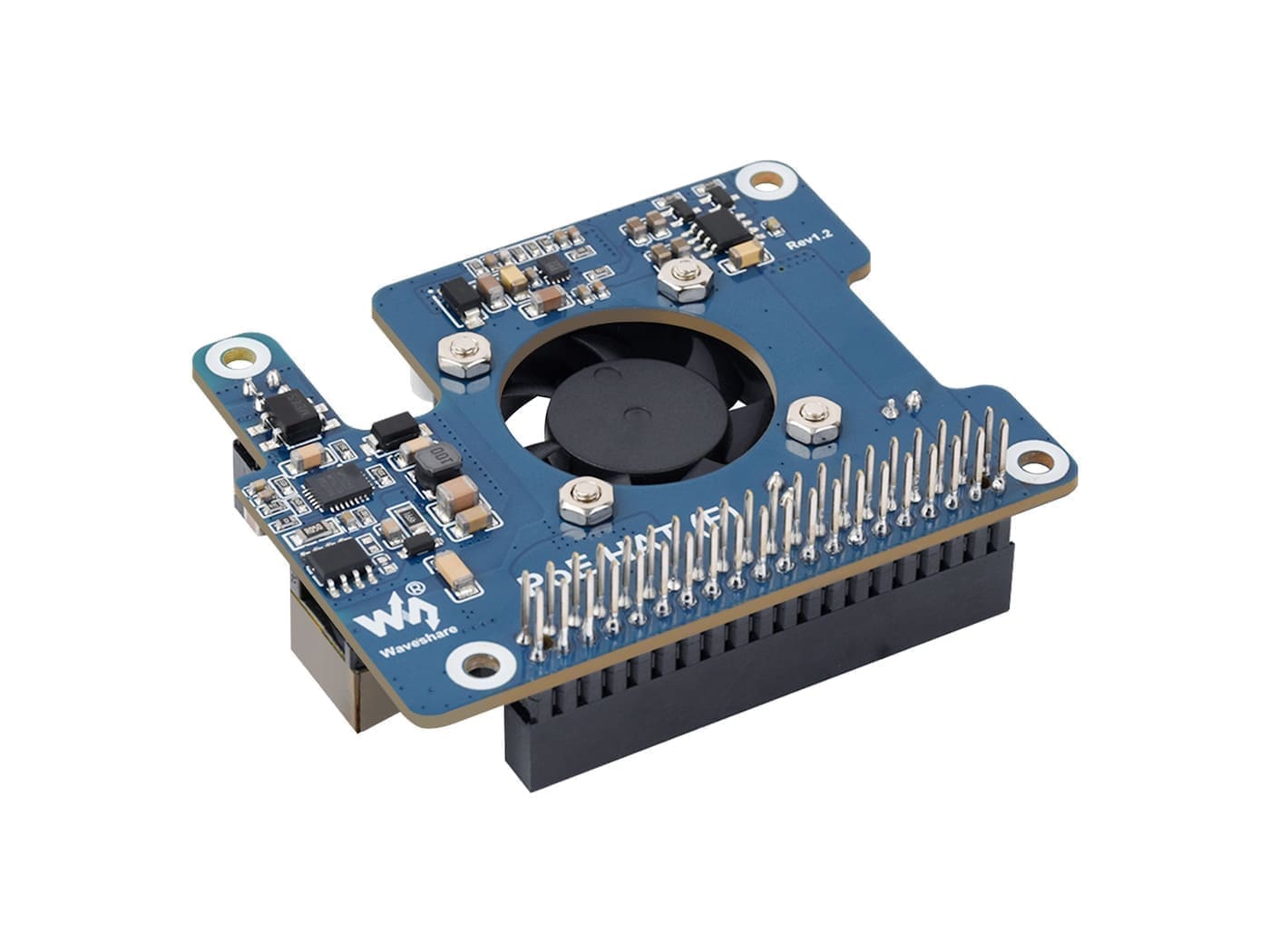
Waveshare PoE HAT (F) for Raspberry Pi 5
- Native integration
- Local control
- Ethernet
Prices verified September 2026
See more hubs & dongles picks on our Amazon storefront →Our verdict
If you're running Home Assistant on a Raspberry Pi 5, this powers it over the Ethernet cable instead of a separate USB-C brick — handy for mounting the Pi centrally near your Zigbee/Thread coordinator rather than next to a socket. There's no official Raspberry Pi 5 PoE+ HAT yet (the old official one doesn't fit the new connector layout), so this third-party board is currently the go-to. It's pure power hardware — no software integration, it just keeps the box that runs HA alive. Being a stacked board over the GPIO header, it will occupy that connector, so check compatibility before also fitting a GPIO-dependent HAT like a Zigbee or Z-Wave add-on board.
What can Home Assistant control on the Waveshare PoE HAT (F) for Raspberry Pi 5?
| Control | Type | What it does |
|---|---|---|
| Under-voltage detected | Notification | HAOS raises a notification and Supervisor log line when input voltage drops below threshold — the first visible symptom of a power-negotiation failure or an underpowered PoE switch/injector. |
| CPU temperature | Sensor | The only indirect way to confirm the HAT's autonomous fan and heatsink are actually keeping pace, since the fan's own state isn't readable. |
| Throttled state | Diagnostic (DIY) | Not a native HA entity — a shell command sensor decoding the bootloader's throttling flags can alert on a power-negotiation problem before it causes a Zigbee dongle brownout. |
The HAT's fan is thermally managed by its own onboard controller with no PWM/GPIO line broken out to the Pi, so there's no fan speed or duty-cycle entity to surface in HA — that's not a gap in vendor support, the component just isn't host-controllable. The real risk with Pi 5 PoE HATs generally is that the bootloader must recognise the HAT's power capability via a firmware/device-tree overlay before it unlocks the full USB current budget; on outdated bootloader firmware it silently falls back to a conservative per-port limit, which reads as under-voltage throttling in HAOS even though the PoE switch is delivering full power — and a USB Zigbee/Z-Wave dongle is usually what starves first. Update the Pi's bootloader and confirm the overlay loads before trusting this setup to run a USB coordinator rather than a wired one.
Specs
| output | 12V + 5V dual output, up to 25W |
|---|---|
| cooling | Onboard fan + metal heatsink |
| standard | 802.3af/at PoE |
| compatibility | Raspberry Pi 5 / CM5 |
How does the Waveshare PoE HAT (F) for Raspberry Pi 5 compare?
| Product | From | Protocol | Local control | Integration |
|---|---|---|---|---|
| Waveshare PoE HAT (F) for Raspberry Pi 5 (this product) | £24 | Ethernet | Yes | Native |
| Aeotec Z-Stick 7 | £46.43 | Z-Wave | Yes | Native |
| Apple TV 4K (Wi-Fi + Ethernet, 128GB) | £249 | Thread, Matter, Wi-Fi, Bluetooth | Yes | Native |
| Aqara Hub M3 | £109.99 | Zigbee, Thread, Matter, Wi-Fi, Bluetooth | Yes | Native |
Frequently asked questions
- Does the Waveshare PoE HAT (F) for Raspberry Pi 5 work with Home Assistant locally?
- Yes. The Waveshare PoE HAT (F) for Raspberry Pi 5 is controlled locally in Home Assistant through a built-in Home Assistant core integration, so it keeps working if your internet connection or the Waveshare cloud goes down. Control and state updates stay on your own network.
- How much does the Waveshare PoE HAT (F) for Raspberry Pi 5 cost in the UK?
- The lowest price we have listed for the Waveshare PoE HAT (F) for Raspberry Pi 5 is £24 at The Pi Hut, with other UK retailers at up to £32.32. Prices were last checked in September 2026 and change often, so confirm on the retailer's page before buying.