Which UK providers actually sell 5G home broadband? (At a glance)
Only three UK networks currently sell 5G-based home broadband directly: Three, EE and Vodafone. Vodafone's older GigaCube MiFi product has been withdrawn from sale to new customers, but Vodafone still sells 5G home broadband hubs under its own "5G Home Broadband" range. All three ship a mains-powered router — not a battery MiFi — designed to sit by a window for the best signal and cover a whole home over Wi-Fi, the setup Ofcom recommends over a portable MiFi unit for anyone using it as a main household connection.
| Provider | Entry price | Contract | Data | Advertised avg. speed |
|---|---|---|---|---|
| Three 5G Home Broadband | From £18/month (24-month, rising to £21.50 in Apr 2027, £25 in Apr 2028) or £22/month (12-month) | 12 or 24 months, or 1-month rolling | Unlimited | ~150Mbps |
| EE Smart 5G Hub 7 Plus/Pro | From £45/month + £50-£100 upfront hub cost | 18 months or 30-day rolling | Unlimited (fair use above 1000GB) | ~146Mbps |
| Vodafone 5G Home Broadband | From £18/month (24-month, rising to £21.50 in Apr 2027, £25 in Apr 2028) or £29-£30/month rolling | 1, 12 or 24 months | Unlimited | Up to 150Mbps (area-dependent 50 or 150Mbps tier) |
Prices and contract lengths change often and typically increase from an anniversary date each year, so always check the provider's current terms before ordering rather than relying on a fixed figure — this is exactly the kind of small print Ofcom flags when it publishes contract-variation guidance for broadband customers.
5G home broadband vs fibre: which is better?
For most everyday use — streaming, video calls, browsing, and a houseful of smart home devices — a good 5G signal comfortably keeps up with a mid-range fibre package. The advertised averages from Three, EE and Vodafone (roughly 146-150Mbps) sit in the same range as a 150-500Mbps fibre tier, and unlike ADSL or old cable lines, 5G doesn't have the distance-from-cabinet problems that used to make wireless broadband unreliable. Where fibre wins outright is consistency: a fibre line is dedicated to your home, so speed stays roughly constant at 8am and 9pm, while 5G capacity is shared with everyone else's phones and devices on the same mast and can dip during busy evening periods in built-up areas. Fibre also typically has a few milliseconds less latency, rarely noticeable for browsing but occasionally relevant for competitive online gaming, and doesn't depend on a hub having a clear line of sight to a mast through a window — thick stone walls, basement flats, or a weak local signal can drag 5G's real-world speed well below the advertised average. Ofcom's most recent Connected Nations data puts outdoor 5G availability from at least one UK network at 97% of premises, but that's a coverage figure, not a guaranteed speed — check a provider's specific postcode checker before choosing. If you're weighing up the fixed-line side of this decision in more detail, our fibre vs cable broadband guide covers how full-fibre and Virgin Media's cable network compare on their own terms.
What's the best 5G router or hub for home broadband?
You don't choose a 5G hub separately from your provider — each network only lets you use the router it ships with your plan, so the "best" one comes down to which provider's hardware and coverage fit your home. Three's 5G Hub supports Wi-Fi 6 and is included free with every plan; it's a straightforward mains-powered box with an external antenna port for boosting signal in a weak-coverage spot. EE's Smart 5G Hub 7 Plus and 7 Pro step up to Wi-Fi 7 tri-band and can connect over 100 devices simultaneously, which suits a smart-home-heavy household, but the Pro model carries a £100 upfront cost on top of the monthly price. Vodafone's 5G Home Broadband hub is a simpler mains unit tuned to whichever of its two speed tiers (50Mbps or 150Mbps) is available at your address. Whichever hub you get, position matters more than the model: place it near a window facing the direction of the nearest mast, away from thick walls, metal cabinets or other electronics, since indoor signal loss is the single biggest cause of underperforming 5G broadband. If you want a router that isn't tied to one network's SIM — for example a dual-SIM 4G/5G router you can move between providers, or one to extend a weak signal further round the house with mesh Wi-Fi — see our guide to the best 4G and 5G routers for UK homes.
Is there contract-free 5G home broadband?
Yes — all three UK 5G home broadband providers offer a rolling monthly option with no fixed term, though it costs more than committing to a 12- or 24-month contract. Three's 1-month rolling plan needs 30 days' notice to cancel and has no upfront or installation costs, but typically prices around £28-£30 a month against £18-£22 a month on its fixed-term deals. Vodafone's rolling plan works the same way, at £29 a month for its 50Mbps tier or £30 a month for 150Mbps, roughly £8-£12 more than its 24-month price. EE offers a 30-day rolling option alongside its 18-month minimum term, at the same headline price but without the contract lock-in. A rolling plan makes sense for a short let, a move-in gap before a fibre order completes, or simply testing whether 5G signal at your address is strong enough before committing to a longer contract — you can always switch to a fixed-term deal with the same provider later once you're confident it works well.
Does 5G home broadband need an engineer or a phone line?
No — that's the main practical advantage. You order online, a hub arrives by post (often next-day), you plug it in and it connects to the mobile network automatically, with no Openreach engineer visit, no phone line, and typically a working connection within minutes rather than the 2-4 week wait common for a new fibre install. That makes it a strong short-term or bridging option: moving into a flat before your fibre order completes, a short rental let, a new-build estate where full fibre hasn't been laid yet, or a spare room being used as a temporary office. It's also fully portable within reason — because it's not tied to a physical line, you can take the router with you if you move house, provided your new address gets a decent 5G signal on the same network.
Is 5G broadband good for a smart home?
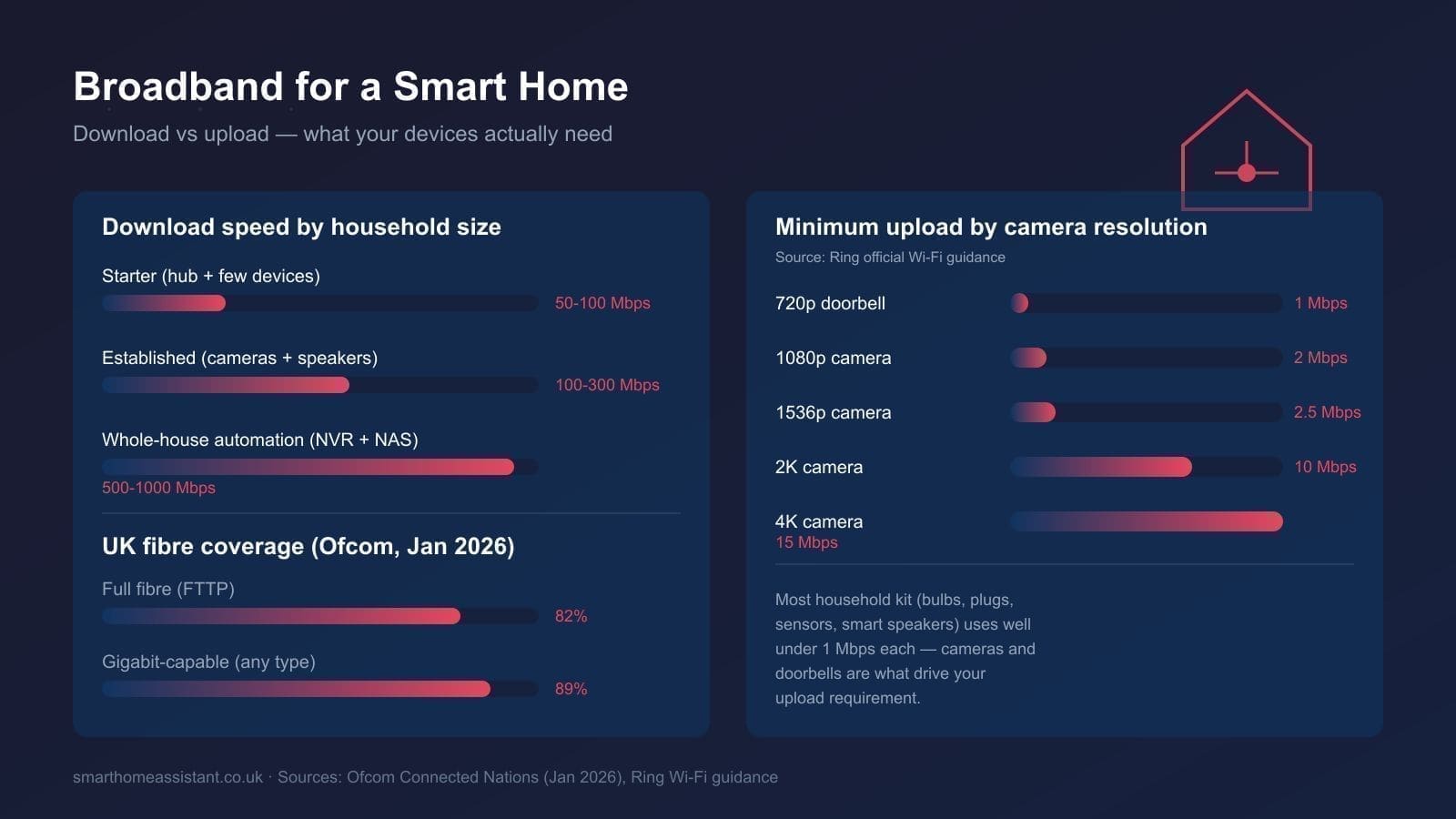
Yes, for most households — a 5G hub's Wi-Fi handles the same local device traffic (smart plugs, bulbs, sensors, hubs like Home Assistant) exactly as a fibre router would, since those devices talk to each other over your home Wi-Fi network rather than needing a specific type of internet connection behind it. Where it matters more is cloud-dependent traffic: video doorbells and security cameras that stream or upload clips to the cloud rely on upload bandwidth, and 5G's upload speeds, while unpublished by most providers, are typically lower and less consistent than a full-fibre line's because capacity is shared with other mobile users nearby. A household running one or two smart cameras and the usual mix of lighting, heating and voice-assistant traffic will rarely notice a difference; running several always-on cameras recording continuously to the cloud, alongside video calls and cloud backups, is where a shared 5G connection is more likely to become the bottleneck than a dedicated fibre line. If you self-host cameras locally (for example with Frigate or a local NVR) rather than pushing footage to the cloud, this matters far less, since that traffic never has to leave your home network. EE's higher-end hub supporting 100+ connected devices is worth considering if you have an unusually device-dense smart home; see our best broadband for a smart home in the UK guide for a fuller breakdown of bandwidth needs by device type.
Who should actually choose 5G home broadband?
It suits renters and short-term movers who don't want an 18-24 month fibre contract, anyone in a new-build or rural spot where full fibre isn't installed yet but 5G coverage is strong, and households that just want a fast, no-engineer setup on day one. It's a weaker fit if you already have full fibre available at a similar or lower price, if you live somewhere with patchy 5G indoors, or if your household regularly needs guaranteed high-bandwidth performance for things like large backups, several cloud cameras, or competitive gaming.