
How each technology actually works
Full-fibre (FTTP) stands for "fibre to the premises": a single strand of glass fibre runs from the local exchange or street cabinet directly into your router, with no copper in the connection at all. Because the signal is light rather than an electrical current, FTTP suffers far less interference and signal loss over distance, and most UK full-fibre providers use Openreach's shared network — Openreach builds and maintains the physical fibre, and retail ISPs (BT, Sky, TalkTalk, Zen, Plusnet, Vodafone and others) sell access over it, alongside a smaller number of independent "altnet" networks such as Hyperoptic and Community Fibre in specific towns and cities.
Cable broadband, in the UK, effectively means Virgin Media. Its network is a hybrid fibre-coaxial (HFC) build: fibre optic cable runs from the exchange to a local street cabinet, then the final leg into your home uses coaxial copper cable — the same type of cable historically used for cable TV — running the DOCSIS 3.1 standard. DOCSIS is capable of very high download speeds, but because the technology was designed around asymmetric use (fast downloads, modest uploads), upload speed is the area where it trails full-fibre most noticeably.
Speed: download is close, upload is not
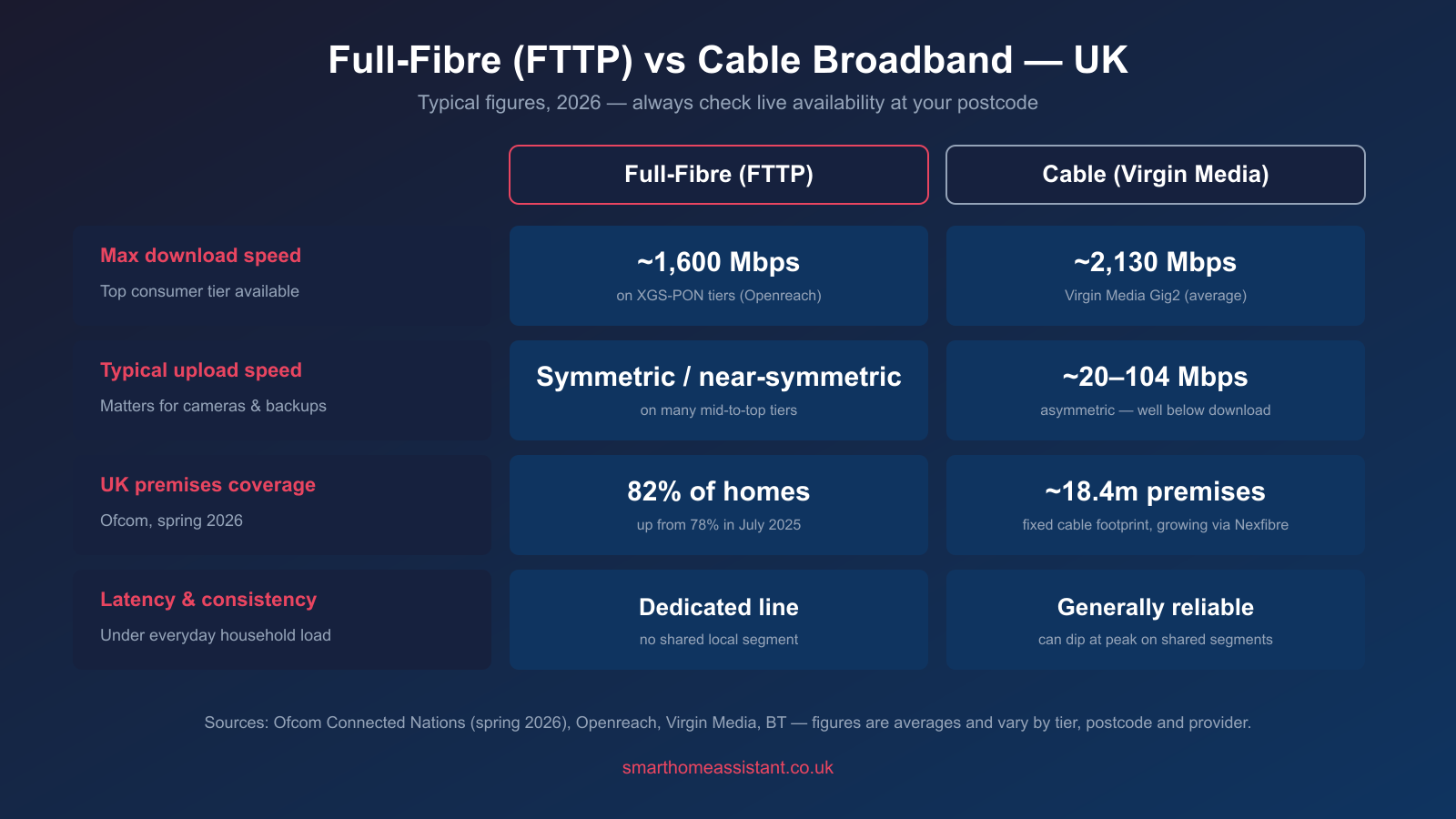
On paper, both technologies now reach into gigabit territory. Virgin Media's entry gigabit tier, Gig1, delivers average speeds of around 1,130Mbps download — but only around 104Mbps upload, according to Virgin Media's own published package figures. BT's top full-fibre tier, Full Fibre 900, advertises average speeds of around 900Mbps download paired with roughly 110Mbps upload, a broadly similar upload figure at a lower download tier. The real differentiator shows up further down each provider's range: many full-fibre packages from BT, Sky, Zen and others offer symmetric or near-symmetric upload speeds even on mid-tier plans, while Virgin Media's lower cable tiers can drop to somewhere in the 20–50Mbps upload range, well below their download speed on the same package.
Openreach's newest full-fibre infrastructure (XGS-PON) is also capable of speeds up to around 1,600Mbps on the tiers some ISPs now sell, according to Openreach's own network pages — Virgin Media's Gig2 tier competes at a similar download level (around 2,130Mbps average) but again with upload capped well below download.
Why upload speed matters for a smart home
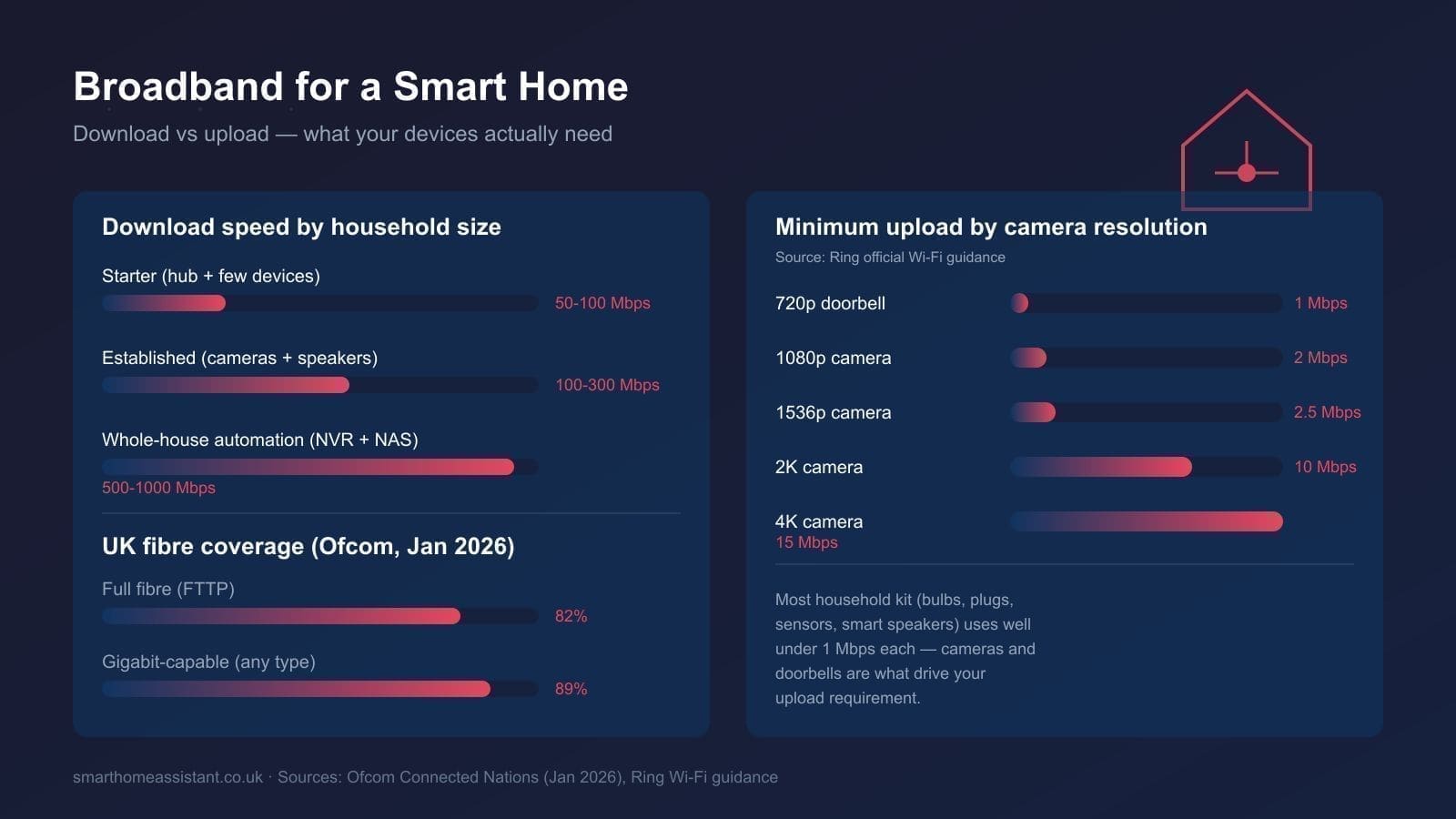
Most broadband marketing is built around download speed because that's what streaming and browsing need. A smart home flips a chunk of that traffic around: every indoor and outdoor camera pushing a live feed or clip to the cloud, every video doorbell, every backup of a local NAS or Home Assistant instance to off-site storage, and every video call from a home office all rely on upload bandwidth. Run four or five cameras recording continuously to the cloud alongside a video call and a cloud backup, and a connection with 20–50Mbps upload can become the bottleneck long before download speed does — even though the download number on the box looks impressive. See our guide to best broadband for a smart home in the UK for a fuller breakdown of how much upload and download bandwidth different smart home setups typically need.
If you self-host cameras locally (for example with Frigate or a local NVR) rather than relying on cloud storage, upload speed matters far less — most of that traffic never leaves your home network in the first place. A good router or mesh system also plays a part in how efficiently that bandwidth gets distributed to every device; see our best router for smart home UK guide for hardware picks that pair well with either connection type.
Coverage: fibre is catching up fast, cable is more static
UK-wide, gigabit-capable broadband (which includes both full-fibre and Virgin Media's cable network) reached 89% of UK premises by spring 2026, up from 87% in July 2025, according to Ofcom's Connected Nations tracking. Full-fibre specifically reached 82% of homes by spring 2026, up from 78% the previous summer — a fast-moving figure, since Openreach alone passed 20 million premises in September 2025 on its way to a stated target of 25 million homes and businesses by the end of 2026. Ofcom's most recent full report also noted that only around 42% of premises with full-fibre access had actually switched to it, meaning many households can already order FTTP on their line without realising it.
Virgin Media's cable network, by contrast, passes a comparatively fixed footprint of a little over 18 million UK premises and has grown mainly through its Nexfibre joint venture extending fibre into new areas rather than expanding the legacy cable footprint itself. Practically, this means: if you're in a flat or house Virgin Media has never cabled, cable broadband simply isn't an option for you, whereas full-fibre coverage is still actively expanding street by street. Always check availability at your specific postcode — coverage varies a great deal even between neighbouring streets. If neither full-fibre nor Virgin Media's cable network covers your address yet, our 5G home broadband guide covers the mobile-network alternative many renters and new-builds use as a bridge until a fixed line arrives.
Reliability and latency
Because full-fibre carries a signal as light through glass with no copper or shared local segments in the final connection, it tends to have very low, consistent latency and is not affected by electrical interference, extreme heat, or the peak-time contention that can occur when many neighbours share the same coaxial cable segment on Virgin's cable network. Virgin Media's cable connections are generally reliable and its outage rates are broadly comparable to other major UK ISPs, but its architecture shares local capacity between the households on the same segment, which can occasionally show up as a dip during your street's busiest evening hours — something FTTP's dedicated-line design avoids by design. For a smart home running always-on hubs, security cameras and voice assistants, consistency matters as much as peak speed.
UK pricing: what to expect
Pricing changes frequently and varies significantly by postcode, contract length and provider, so treat the following as a rough guide rather than a quote. Entry-level full-fibre packages from BT, Sky and other Openreach-based providers typically start from around £24–£28 a month for lower-tier speeds (roughly 50–150Mbps), rising to somewhere in the £40–£50+ a month range for the fastest tiers such as BT's Full Fibre 900. Virgin Media's cable packages span a similar range: its entry-level M125 tier starts from roughly £24 a month, through to around £45–£50 a month for its Gig1 and Gig2 tiers, based on Virgin Media's own published package pricing. Full-fibre altnets in cities with their own infrastructure (Hyperoptic, Community Fibre, Zzoomm and others) sometimes undercut both BT and Virgin Media significantly where they've built. In all cases, prices vary by provider, contract length and postcode — always compare live deals for your address rather than relying on any figure quoted here.
Which should a smart home household choose?
If full-fibre is available at your address, it's generally the stronger pick for a heavily connected smart home: symmetric or near-symmetric upload on most tiers suits cloud-connected cameras and backups, latency is consistently low, and Openreach's network is still expanding rather than standing still. If you're on Virgin Media's cable network and it already delivers strong download speeds at a competitive price, it remains a solid option, particularly for households that stream and download more than they upload, or that self-host cameras locally rather than pushing footage to the cloud. Households running several cloud-connected cameras, a home office with regular video calls, and cloud backups should weigh the upload gap carefully before choosing on download speed alone — check what a candidate package's actual upload speed is, not just its download headline, before signing a contract.