Quick Verdict
Here is how each system compares at a glance:
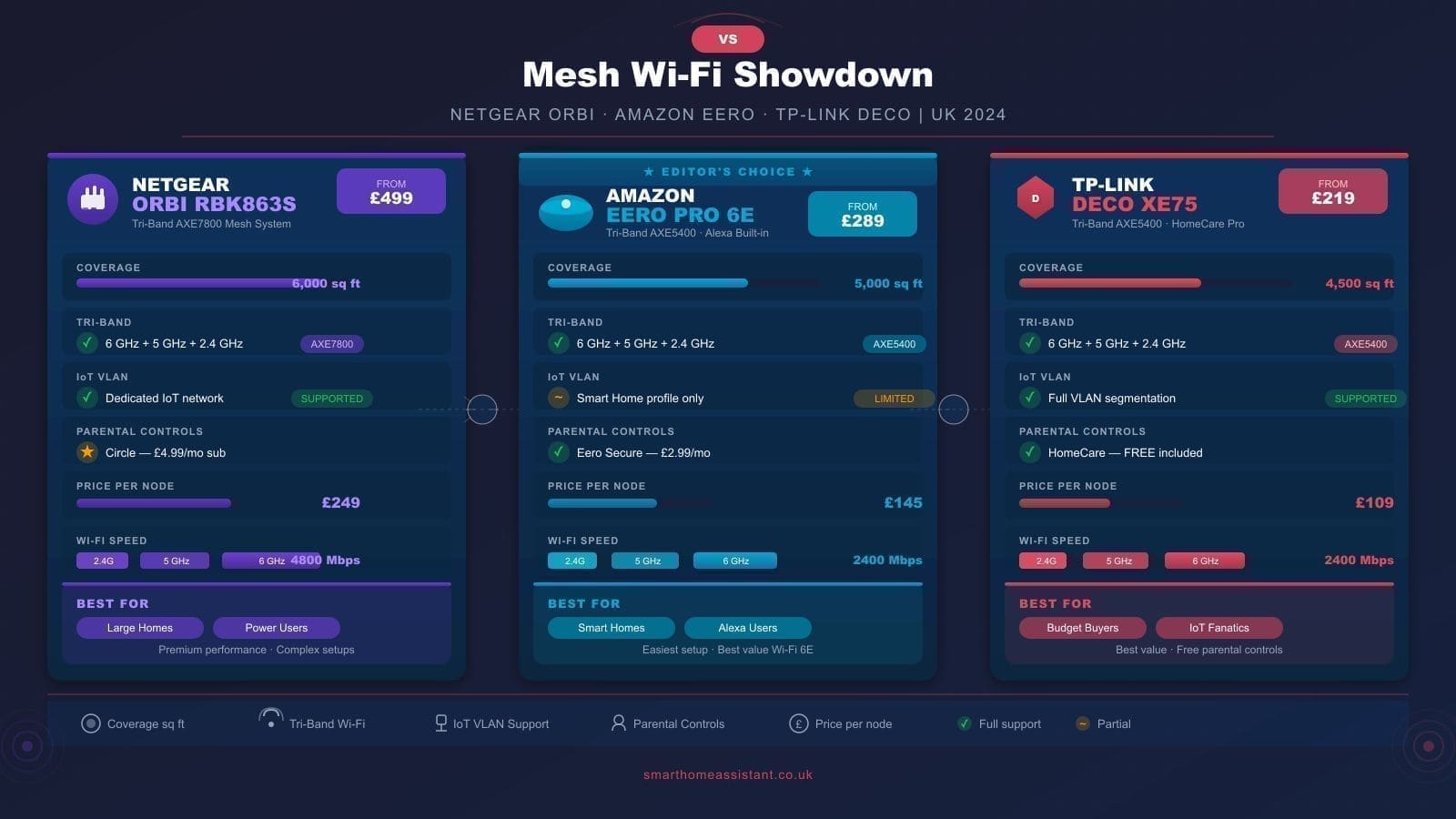
| Feature | Netgear Orbi RBK863S | Amazon Eero Pro 6E | TP-Link Deco XE75 Pro |
|---|---|---|---|
| UK price | ~£499 (2-pack) | ~£299 (1 unit) / ~£549 (3-pack) | ~£349 (2-pack) |
| Wi-Fi standard | Wi-Fi 6 (AX6000, tri-band) | Wi-Fi 6E (tri-band inc. 6 GHz) | Wi-Fi 6E (tri-band inc. 6 GHz) |
| Coverage per pack | ~465 sq m (2-pack) | ~140 sq m per unit | ~280 sq m (2-pack) |
| Backhaul | Wireless tri-band or Ethernet | Wireless tri-band | Wireless tri-band |
| Thread border router | No | Yes (built-in) | No |
| Top Ethernet port speed | 2.5G WAN + 3× Gigabit per satellite | 1× Gigabit per unit | 1× 10G + 1× 2.5G WAN + 2× Gigabit |
| Parental controls | Basic (Circle app) | Eero Secure (subscription) | HomeCare Pro (subscription after trial) |
| Best for | Large homes, power users, Ethernet backhaul | Matter/Thread smart homes, simplicity | Best value; gigabit broadband households |
- Best performance: Netgear Orbi RBK863S — fastest throughput, Ethernet backhaul, tri-band 6 Gbps
- Best for simplicity and smart home: Amazon Eero Pro 6E — Thread border router built-in, effortless app setup
- Best value: TP-Link Deco XE75 Pro — Wi-Fi 6E, 10 Gbps port, 2.5G WAN, strong parental controls at a lower price
- Largest coverage per node: Netgear Orbi RBK863S (up to 5,000 sq ft / ~465 sq m per 2-pack)
Netgear Orbi RBK863S
The Netgear Orbi RBK863S is the performance flagship of this comparison. It uses tri-band Wi-Fi 6 (AX6000) with a dedicated 4.8 Gbps backhaul band — the wireless link between the router and its satellites — which means the connection your devices receive is not competing with traffic between mesh nodes. That backhaul architecture is the main reason the Orbi leads on raw speed in head-to-head tests.
Key specifications
- Standard: Wi-Fi 6 (802.11ax), tri-band, up to 6 Gbps combined
- Coverage: up to 5,000 sq ft (~465 sq m) per 2-pack
- Ports: 3 × Gigabit Ethernet per satellite; 1 × 2.5G WAN on the router unit
- Backhaul: wireless tri-band or wired Ethernet
- UK price: around £499 for the 2-pack (prices vary by retailer)
Pros
- Fastest mesh Wi-Fi speeds of the three, particularly on the 5 GHz band
- Ethernet backhaul support for maximum throughput stability
- Three Ethernet ports per satellite — useful for wired devices like smart home hubs, smart TVs, and games consoles
- Excellent range — well-suited to large UK detached or semi-detached homes
Cons
- The most expensive option of the three
- No Thread border router built-in — Eero has an advantage for Matter/Thread smart home devices
- Orbi app is functional but not as polished as Eero's
- Bulkier hardware footprint compared with Eero and Deco
For a deeper look, see our full Netgear Orbi review.
Amazon Eero Pro 6E
The Amazon Eero Pro 6E is the most user-friendly system here. Setup takes under ten minutes through the Eero app, and the interface is clean enough that non-technical users rarely need to dig into settings. What makes the Pro 6E particularly compelling for smart home enthusiasts is the built-in Thread border router: it can communicate natively with Thread-based Matter devices such as newer smart plugs, bulbs, and sensors without requiring a separate hub.
Key specifications
- Standard: Wi-Fi 6E (802.11axe), tri-band including 6 GHz
- Coverage: up to 140 sq m (approx. 1,500 sq ft) per unit
- Thread border router: built-in
- UK price: around £299 for a single unit; around £549 for a 3-pack (prices vary by retailer)
- Amazon affiliate link: Amazon Eero Pro 6E on Amazon.co.uk
Pros
- Built-in Thread border router — the best choice if you are building a Matter smart home
- Simplest setup of the three; excellent companion app
- Wi-Fi 6E gives access to the less-congested 6 GHz band
- Compact, discreet hardware design
Cons
- Coverage per unit is lower than Orbi — larger homes need the 3-pack
- Advanced settings (VLAN, custom DNS) are limited compared with Orbi or Deco
- Amazon account required for full functionality
- 3-pack price is the highest of the three systems
Read our dedicated Eero Pro 6E review for detailed real-world test results.
TP-Link Deco XE75 Pro
The TP-Link Deco XE75 Pro punches well above its price bracket. For around £349 for a 2-pack, you get Wi-Fi 6E, a 10 Gbps port (future-proofed for multi-gigabit broadband), 2.5G WAN, and some of the most comprehensive parental controls available on a consumer mesh system. For UK households where BT, Virgin Media, or Openreach are rolling out gigabit services, the 2.5G WAN is a meaningful practical advantage.
Key specifications
- Standard: Wi-Fi 6E (802.11axe), tri-band including 6 GHz
- Ports: 1 × 10 Gbps, 1 × 2.5G WAN, 2 × Gigabit Ethernet per unit
- Parental controls: HomeCare Pro — content filtering, time scheduling, usage reports
- UK price: around £349 for a 2-pack (prices vary by retailer)
- Amazon affiliate link: TP-Link Deco XE75 Pro on Amazon.co.uk
Pros
- Best value of the three — Wi-Fi 6E and a 10 Gbps port at the lowest 2-pack price
- 2.5G WAN ready for gigabit broadband connections
- Excellent built-in parental controls at no extra subscription cost
- Works with Alexa and Google Home for basic voice control
Cons
- No Thread border router — not ideal if you are heavily invested in Matter/Thread devices
- HomeCare Pro parental controls require a subscription after the trial period
- Deco app can feel less polished than Eero's
- Coverage per unit is similar to Eero but lower than Orbi
Our full TP-Link Deco review goes into more detail on real-world performance across a typical UK semi-detached.
Head-to-Head Comparison
Speed and throughput
The Orbi RBK863S is the clear leader here. Its dedicated 4.8 Gbps tri-band backhaul prevents the satellite-to-router link from eating into the bandwidth available to your devices. In practical terms, you will notice this most in large homes where nodes are several rooms apart. The Eero Pro 6E and Deco XE75 Pro both use Wi-Fi 6E with 6 GHz access — making them faster than their Wi-Fi 6-only predecessors — but neither matches Orbi's peak throughput in a large-home scenario.
Coverage
Netgear claims up to 5,000 sq ft (around 465 sq m) for the RBK863S 2-pack. Eero rates each Pro 6E unit at up to 140 sq m; a 3-pack therefore covers around 420 sq m. The Deco XE75 Pro 2-pack is comparable to a 2-unit Eero deployment. For the average UK home — which is around 80–100 sq m — any of these systems will be more than sufficient with a single router, but detached homes, Victorian terraces with thick walls, or houses with garden offices will benefit from Orbi's larger range per node.
Ease of setup
Eero wins this category without contest. The app-guided setup requires no networking knowledge, and most users are up and running within five to ten minutes. TP-Link Deco is similarly approachable but offers more configuration options, which can add complexity. Netgear Orbi provides the most granular controls — useful for power users who want to configure VLANs or set custom DNS — but that depth adds friction for casual users.
Smart home integration
If you are building a smart home network, the Eero Pro 6E holds a meaningful advantage: its built-in Thread border router means it can act as the hub for Thread-based Matter devices without any additional hardware. Orbi and Deco both support Alexa and Google Home for basic network controls (pausing Wi-Fi, running speed tests by voice), but neither includes a Thread radio. If you use Zigbee or Z-Wave devices, all three systems are neutral — those protocols run on a separate hub regardless.
Price and value
Ranked by 2-node or equivalent coverage cost:
- TP-Link Deco XE75 Pro 2-pack: around £349
- Amazon Eero Pro 6E (2 units, bought individually): around £598
- Netgear Orbi RBK863S 2-pack: around £499
The Deco XE75 Pro offers the best feature-per-pound ratio. The Orbi is competitive when you factor in its higher coverage per node reducing the number of units required. Eero's single-unit price is low, but scaling to a full home often requires the 3-pack, pushing costs up.
Which Should You Buy?
Choose the Netgear Orbi RBK863S if you have a large detached home (four or more bedrooms), want Ethernet backhaul, or are a power user who wants deep network controls. The raw performance and port density per satellite are unmatched at this price point. It is also worth considering if you want to minimise the number of nodes required.
Choose the Amazon Eero Pro 6E if simplicity is your priority or if you are building a Matter/Thread smart home. The setup experience is the best in class, and the built-in Thread border router means fewer hubs on your network. A good fit for flats, terraced houses, and anyone who wants networking that just works.
Choose the TP-Link Deco XE75 Pro if value matters and you want future-proof connectivity. Wi-Fi 6E and a 10 Gbps port at the lowest price of the three makes this the pragmatic choice for most UK households — especially families who want strong parental controls without a separate subscription service. Also worth considering if you are on a gigabit broadband package and want 2.5G WAN now.
Whichever system you choose, pairing it with a sensible home network setup — wired backhaul where possible, a central router location, and a separate IoT VLAN for smart devices — will extract the most from your investment. For comparison with other premium mesh options, our ASUS ZenWiFi review and Wi-Fi 6E router roundup cover additional alternatives worth considering.