Design and build
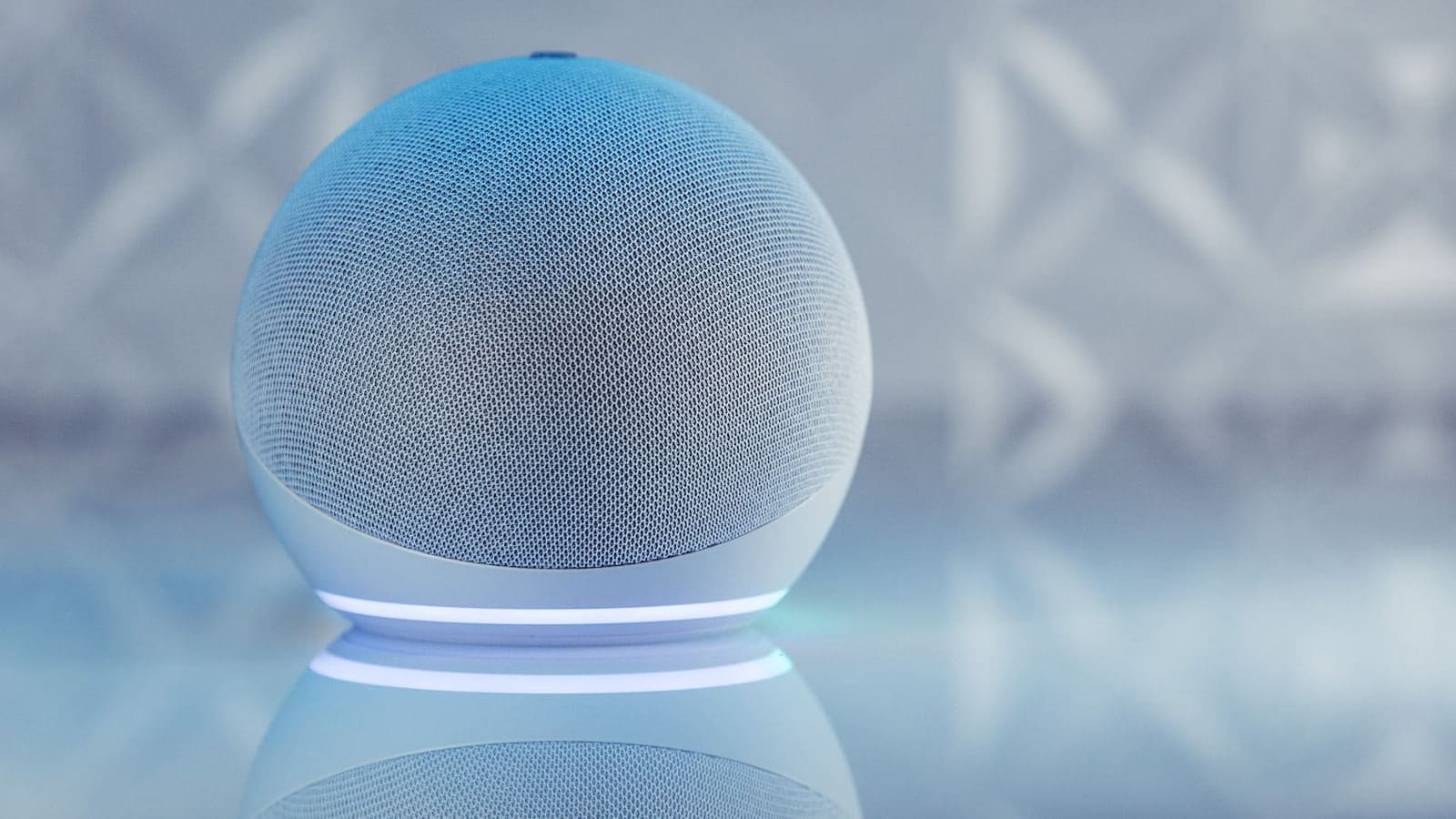
The new shape is a significant departure. Gone is the tall, five-sided tower; in its place is a spherical speaker wrapped in woven fabric mesh, with a circular recessed panel on the front housing the volume and microphone-mute buttons. It measures just 155 mm in diameter and fits on a bookshelf far more discreetly than its predecessor. Colour options at launch are limited to Graphite, with Glacier White joining the range shortly after. The LED light ring sits at the base — useful, though harder to see from certain angles than on earlier Echo models.
Build quality feels solid. There are no 3.5mm or optical audio connections on the 2025 model — a step back for anyone wanting to connect to a Hi-Fi amp — but Bluetooth 5.3 is present alongside Wi-Fi 6E (2.4 GHz and 5 GHz and 6 GHz), which means the speaker benefits from a less congested wireless band in modern homes. Alexa can also pair it with a compatible Fire TV for a stereo TV audio setup.
Sound quality
The driver array is the headline specification. Three 1.5-inch full-range tweeters are angled to fire left, right, and upward, while a 3.75-inch high-excursion woofer handles the low end. Together they create what Amazon calls a 3.1.1 channel configuration, designed to produce a wide, spatially convincing soundstage from a single unit. The speaker supports Dolby Atmos and Sony 360 Reality Audio, though spatial audio content is primarily accessed via Amazon Music.
In practice, the Echo Studio 2025 sounds genuinely impressive for a single-unit speaker at this size. Vocals are clear, mids are well defined, and the spatial processing lends tracks an airy, open quality that belies the compact cabinet. The woofer delivers a clean, controlled bass — though reviewers at Expert Reviews note it lacks the room-filling punch of the original model. If deep, impactful bass is your priority, the 2025 Studio trades low-end muscle for overall balance and clarity. For most living room listening — podcasts, playlists, background music — the sound is excellent.
One caveat: the best audio experience is currently locked to Amazon Music. Spotify and Apple Music streams via Bluetooth or Alexa Cast sound good but do not benefit from the spatial audio processing. If you're a Tidal or Qobuz subscriber hoping for lossless spatial audio, you'll need to use Bluetooth streaming for now.
Alexa and smart home
The 2025 Echo Studio doubles as a capable smart home hub. The built-in hub supports Zigbee (for controlling Philips Hue, IKEA Tradfri, and many other devices directly), Thread (as a Thread Border Router), and Matter — making it one of the most connectivity-rich smart speakers available without a separate hub device. This is a meaningful upgrade for anyone building a mixed-protocol smart home.
Alexa integration with Home Assistant has also improved significantly. Home Assistant 2025.6 introduced a native Alexa Devices integration, allowing HA users to expose their Echo Studio as a media player and trigger automations via voice commands through Amazon's cloud. For deeper local control, the Echo Studio's Matter support means it can participate in a local Matter fabric alongside your Home Assistant instance — useful if you're running Home Assistant's Matter integration on a Raspberry Pi or similar server.
In the UK, Alexa Plus — Amazon's upgraded conversational AI with multi-turn dialogue and agentic capabilities — is not yet available at launch, with a rollout expected in 2026. Standard Alexa performs well for timers, shopping lists, smart home control, and music playback, but UK buyers miss the headline AI feature that US customers get out of the box. The promised Alexa Home Theater feature, which would let you combine multiple Echo speakers into a multi-channel surround system, had also not launched at time of review.
Comparison with rivals
At £220, the Echo Studio competes directly with the Sonos Era 100 and Apple HomePod (2nd gen). The Sonos Era 100 offers arguably superior audio tuning and Trueplay room correction, and integrates more naturally with third-party streaming services, but lacks a built-in smart home hub. The Apple HomePod focuses on AirPlay and HomeKit users and sounds exceptional, but is firmly locked to the Apple ecosystem. The Echo Studio's advantage is breadth: it handles Alexa, Amazon Music spatial audio, Zigbee, Thread, and Matter in a single device — a genuine all-rounder for mixed-protocol UK smart homes.
If budget is a concern, the cheaper Amazon Echo Pop or Echo Dot Max offer decent audio and Alexa at a fraction of the price, though neither matches the Echo Studio's sound quality or hub capabilities. For audiophiles who want maximum quality from a single unit, the Sonos Era 100 remains the stronger pure audio choice.
Verdict
The Amazon Echo Studio 2025 is a well-rounded upgrade — smaller, smarter, and better connected than its predecessor. The sound quality is genuinely good for a speaker of this size, the built-in Zigbee/Thread/Matter hub adds real value, and Wi-Fi 6E future-proofs the connectivity. The trade-offs are real: bass is lighter than the original, Alexa Plus is absent in the UK, and the £220 price is a jump. But if you want one speaker that covers excellent audio, Alexa voice control, and a comprehensive smart home hub — all without a separate bridge — this is the one to buy.