How a Ground Source Heat Pump Works
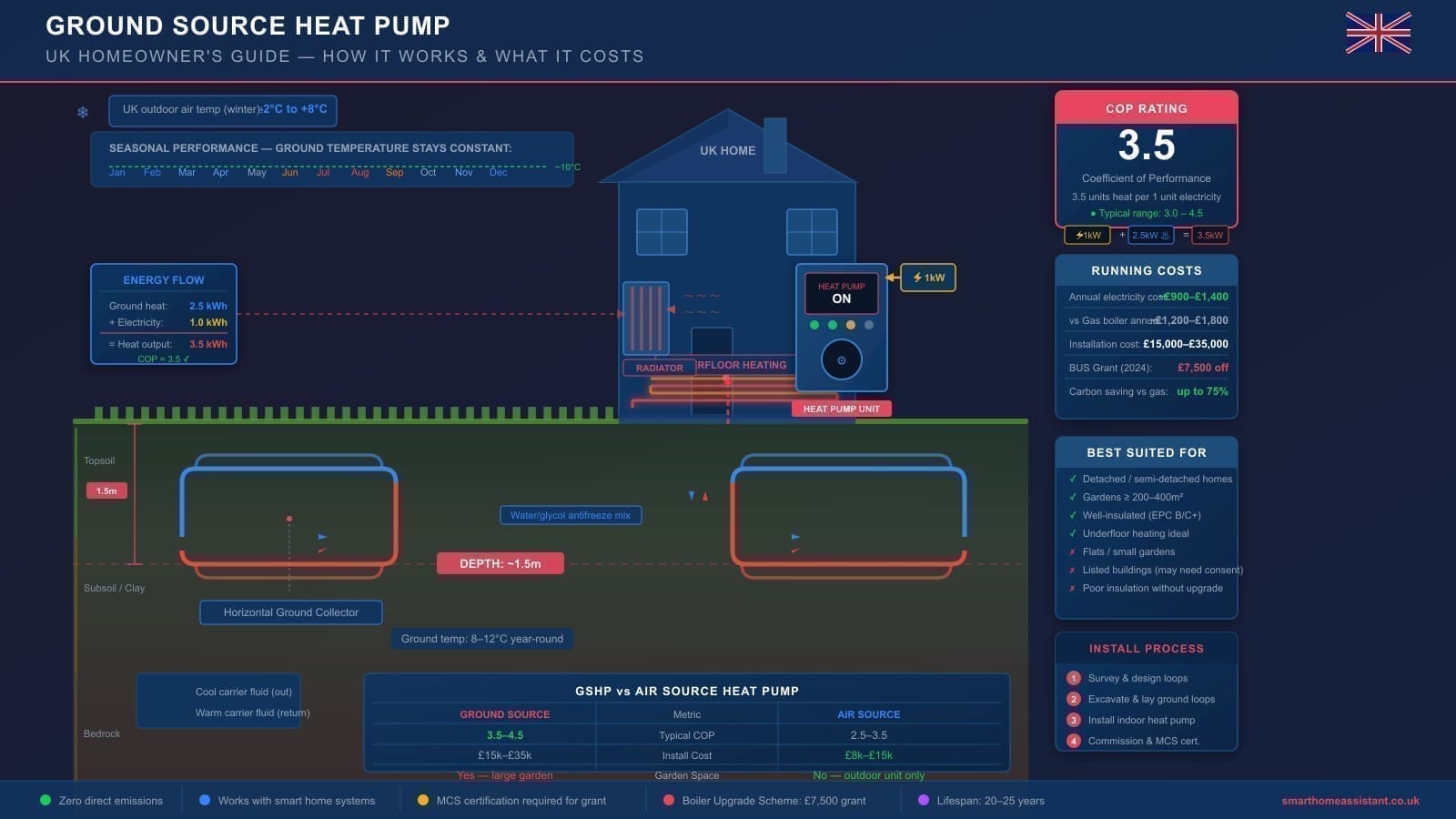
The ground loop. A GSHP circulates a water-antifreeze mixture through a loop of pipe buried in the ground. The fluid absorbs heat from the soil, carries it back to the heat pump unit, and the refrigerant cycle amplifies that heat to a usable temperature — typically 35–55°C for space heating.
COP: the efficiency measure. The efficiency of a heat pump is measured by its Coefficient of Performance (COP). A well-installed GSHP in UK conditions delivers a COP of 3.0–5.0, meaning it produces 3–5 units of heat for every 1 unit of electricity it consumes. Ground temps are more stable than air temps, so GSHPs tend to maintain higher COPs in winter compared with air source models.
Flow temperatures. Most GSHPs produce heat at lower flow temperatures (35–45°C) than a conventional gas boiler (60–80°C). This matters for your emitter choice — see the underfloor heating section below.
Ground Loop Options: Horizontal vs Vertical
Horizontal Trenches
How they work. Pipes are laid in trenches roughly 1.5 metres deep. You need enough land area to absorb sufficient ground heat — as a rule of thumb, approximately twice the floor area of the house. A 100 m² home typically needs around 200 m² of usable garden. The trenches can't be built over or heavily planted, though a lawn above them is fine.
Pros and cons. Horizontal loops are significantly cheaper to install than boreholes because no specialist drilling rig is needed. The downside is land requirement: if your garden is small, paved, or has mature trees whose roots could conflict, horizontal loops may not be feasible.
Vertical Boreholes
How they work. A drilling rig bores one or more holes 50–150 metres deep, into which U-shaped pipe loops are inserted and grouted in place. A single 100m borehole has a far smaller surface footprint than horizontal trenches.
Pros and cons. Boreholes access more stable, warmer ground temperatures at depth, often delivering slightly higher COPs. They're essential for urban or smaller plots. The drilling cost adds £5,000–£10,000 to the overall installation price, making vertical systems more expensive overall.
Installation Costs
A complete ground source heat pump installation in the UK typically costs £10,000–£25,000, including the heat pump unit, ground loop, installation labour, and any required changes to your hot water cylinder or heating distribution. Vertical boreholes sit toward the upper end of that range. For a detailed breakdown of what drives heat pump costs, see our guide to heat pump installation costs in the UK.
Prices depend on:
- Ground loop type (horizontal cheaper; vertical more expensive)
- Property size and existing heating system
- Distance from the ground loop to the indoor unit
- Whether underfloor heating is already installed
- Installer region and day rates
The Boiler Upgrade Scheme Grant
The UK government's Boiler Upgrade Scheme (BUS) provides a £7,500 grant toward a ground source heat pump installation. The grant is the same value as for air source heat pumps. It is paid directly to your MCS-certified installer, who deducts it from your invoice — you never handle the money yourself.
To qualify, you must:
- Be in England or Wales (the scheme does not cover Scotland or Northern Ireland, which have separate programmes)
- Have a valid Energy Performance Certificate (EPC) with no outstanding cavity wall or loft insulation recommendations
- Use an MCS-certified installer (see below)
- Be replacing a fossil fuel heating system, not an existing heat pump
The BUS is administered by Ofgem on behalf of the Department for Energy Security and Net Zero. Check the official gov.uk page for current eligibility and application details.
MCS Certification: Why It Matters
You must use an MCS-certified installer — not just to qualify for the BUS grant, but because MCS certification is the industry standard for heat pump installation quality in the UK. MCS-certified contractors are independently assessed against technical standards covering design, installation, and commissioning.
You can find accredited installers at the MCS Certified installer finder. Always get at least three quotes: GSHP installation costs vary considerably between companies, and the groundworks element in particular is worth comparing.
Running Costs and Electricity Tariffs
A GSHP's running cost depends almost entirely on your electricity tariff — because the pump runs on electricity. At the UK average electricity rate (around 24–26p/kWh in 2025–26), running costs are higher than a gas boiler for heating. The efficiency advantage of a 3–5 COP narrows but doesn't always close that gap, because electricity costs roughly 3–4x more per unit than gas.
The most effective way to reduce GSHP running costs is a smart electricity tariff. Octopus Agile and Octopus Flux, for example, offer half-hourly variable pricing — if you can schedule your heat pump to run primarily during cheap overnight or off-peak periods, costs fall substantially. See our guide to the Octopus Energy smart tariff for how these work in practice.
A well-matched GSHP on a smart tariff, combined with a thermal store or buffer tank to hold heat across expensive peak periods, is currently one of the most cost-effective electric heating approaches available in the UK.
Best Pairing: Underfloor Heating
Ground source heat pumps perform best when paired with underfloor heating (UFH). Here's why: a GSHP produces heat at 35–45°C flow temperature most efficiently. Radiators sized for a gas boiler (which runs at 60–80°C) won't emit enough heat at that lower temperature — you'd need to oversize them substantially. UFH, by contrast, is designed to work at 30–45°C, so it's a natural match.
The result is a system that runs at maximum COP, lowest electricity consumption, and consistent radiant warmth across the floor. If you're planning a new build or full renovation, combining UFH with a GSHP from the outset is strongly recommended. If you're retrofitting, some rooms can work with oversized radiators while others get UFH — a qualified installer can model the heat loss for each room. For cost guidance, see our underfloor heating cost guide.
Ground Source vs Air Source Heat Pumps
Both technologies move heat rather than generate it, and both qualify for the £7,500 BUS grant. The key differences:
- COP in cold weather: GSHPs maintain COP more consistently because ground temps are stable. ASHPs see COP dip during cold snaps.
- Installation cost: GSHPs cost more upfront, primarily due to groundworks.
- Space requirement: GSHPs need a garden large enough for trenches or space for a borehole rig. ASHPs need only a wall or ground-mounted outdoor unit.
- Noise: GSHPs are quieter — the compressor is indoors; there's no outdoor fan unit.
- Suitability: ASHPs are more flexible for urban or smaller properties.
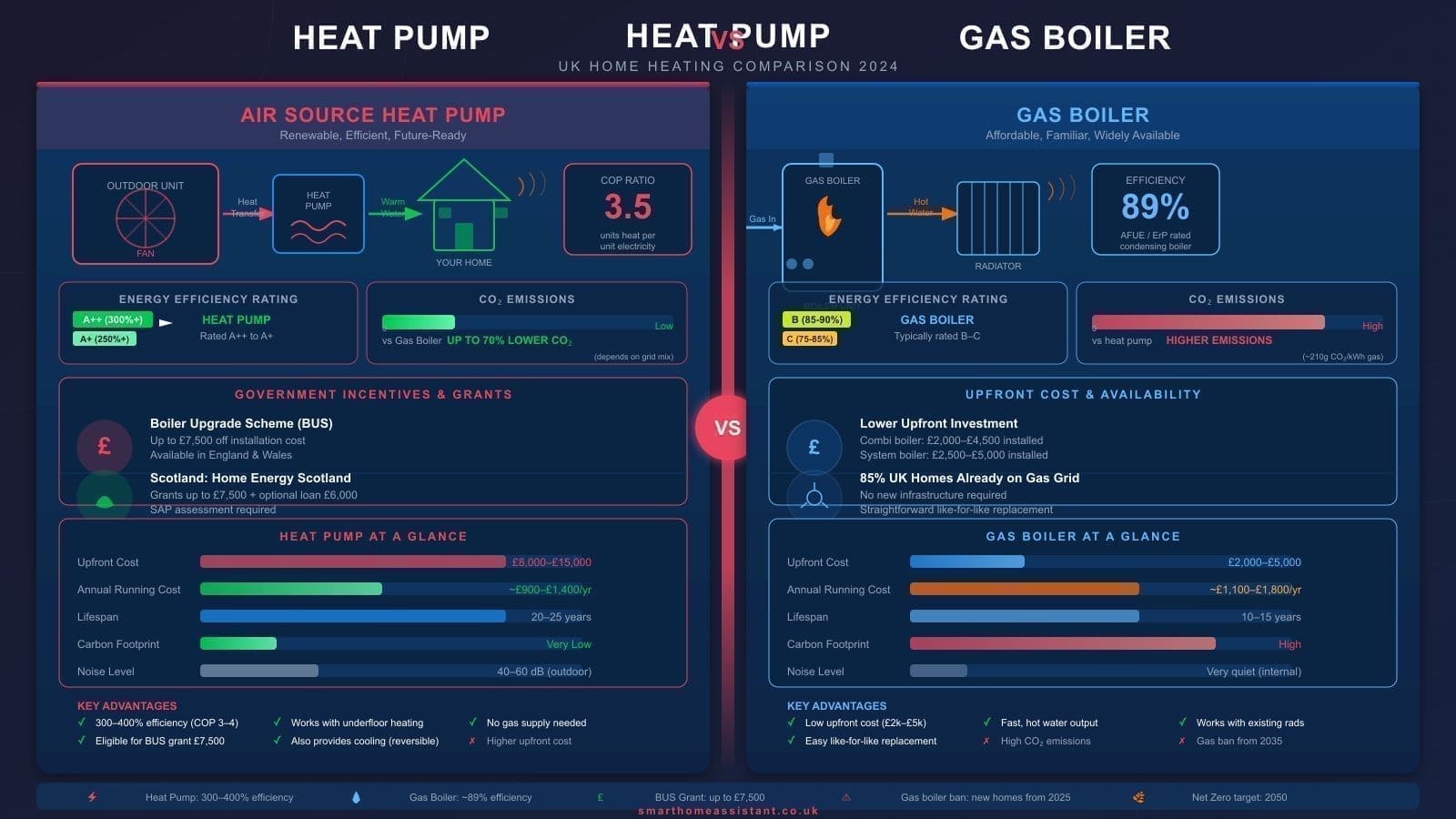
For a side-by-side comparison of all heat pump types versus your current boiler, see our heat pump vs gas boiler guide, and our best heat pumps UK roundup.
Is a Ground Source Heat Pump Right for You?
A GSHP is likely a good fit if you:
- Have a large garden with room for horizontal trenches, or can accommodate a borehole rig
- Are building new or undertaking a deep retrofit (allowing you to install UFH at the same time)
- Want the highest long-term efficiency and can benefit from a smart electricity tariff
- Prefer a quieter system with no outdoor unit visible from the street
It's less suitable if you have a small urban plot, a poorly insulated property with no plans to upgrade, or if you need a simple, low-disruption swap for an existing boiler. In those cases, an air source heat pump may be the more practical choice — or a high-efficiency gas boiler as a stepping stone while you insulate.
Whatever you decide, get a heat loss calculation (MCS-required) and multiple quotes. The Boiler Upgrade Scheme grant is the single biggest financial lever available right now — and it won't last forever.
Related: heat pump vs gas boiler UK, heat pump installation costs UK, and best air source heat pump brands.