
What to look for in a smart flood detector
Connectivity protocol is the first decision. Wi-Fi sensors connect directly to your router and send app alerts without a hub, but they depend on cloud services staying online. Zigbee and Z-Wave sensors are more energy-efficient, mesh across your home, and — critically — can run entirely locally via Home Assistant, meaning alerts fire even when the internet is down.
Detection sensitivity matters more than you'd think. The best sensors trigger at a water level as low as 0.5mm — barely a damp patch. Cheaper models need pooling water before they react, by which point the damage is done.
Battery life ranges from around eighteen months on budget sensors to over five years on the best Zigbee models. Avoid anything requiring USB power in locations where water is likely to pool.
IP rating — look for IP67 as a minimum. That means the sensor can be submerged briefly without damage, which matters when it's sitting on a potentially wet floor.
Best smart flood detectors UK — our top picks
1. Aqara Water Leak Sensor T1 — best for Zigbee smart homes
From around £20 · Zigbee 3.0 · IP67 · ~2-year battery (CR2032)
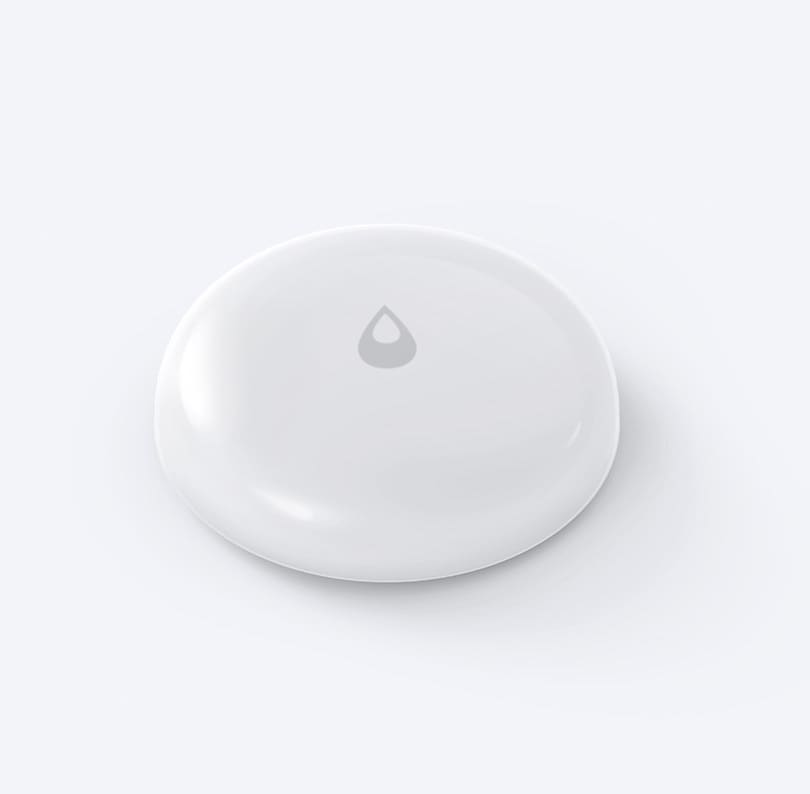
The Aqara T1 is the go-to recommendation for anyone with a Zigbee coordinator running Zigbee2MQTT. It pairs directly without needing an Aqara hub, exposes a simple binary water-detected sensor entity in Home Assistant, and triggers a local alarm through the Aqara Hub if you have one. Detection threshold is 0.5mm — excellent sensitivity — and the IP67 rating means the sensor itself is unaffected by the water it detects. Battery life is around two years under normal use on a standard CR2032 cell. Compatible with Apple HomeKit, Google Assistant, and Alexa when used with an Aqara Hub, and with any Zigbee2MQTT-based setup without one. Prices vary by retailer; expect to pay from £20 to £25 for a single unit from the Aqara UK shop or Amazon.
2. Sonoff SNZB-05P — best budget Zigbee option
From around £17 · Zigbee 3.0 · IP67 · 5+ year battery (CR2477)
Sonoff's SNZB-05P punches well above its price point. The elevated-probe design detects moisture at 0.5mm and the CR2477 battery is rated for over five years — significantly longer than most rivals. It works natively with Zigbee2MQTT and ZHA, so it's a natural fit for Home Assistant's ZHA integration. A detection cable is available as a separate version (SNZB-05P with cable), useful for hard-to-reach spots like behind washing machines. With units available on Amazon UK from around £17, it's one of the most cost-effective ways to add flood protection to a Zigbee smart home.
3. TP-Link Tapo T300 — best for Tapo / standalone Wi-Fi users
From around £18 · Sub-GHz wireless (hub required) · IP67 · ~2-year battery (2× AAA)
The Tapo T300 is TP-Link's answer to water leak detection and it's well priced for households already in the Tapo ecosystem. It uses a sub-GHz wireless protocol at 868/922 MHz rather than Wi-Fi directly, communicating via a Tapo Hub (sold separately), which keeps battery life at up to two years. Six detection probes on the top and bottom mean it works regardless of whether water approaches from a drip above or pools from below. The 90dB onboard siren is one of the loudest in this price bracket, and the sensor integrates with Alexa and Google Assistant. Availability confirmed on Amazon UK and Argos; prices range from around £18 to £22 for the sensor alone.
4. Govee WiFi Water Leak Detector (GoveeLife) — best standalone Wi-Fi option
From around £25–£35 for a pack · Wi-Fi 2.4GHz · 100dB alarm · App alerts
If you want plug-and-play water detection without any hub or smart home platform, Govee's WiFi sensors are among the most popular on Amazon UK. They connect directly to your 2.4GHz Wi-Fi network and push alerts to the Govee Home app, including SMS and email notifications. The 100dB adjustable alarm is audible from well across the house. Multi-packs make good sense for covering several risk areas — under the kitchen sink, beside the dishwasher, near the boiler — at once. Note that Govee sensors rely on the cloud, so app alerts require an internet connection. No official Home Assistant integration exists, though unofficial local polling has been reported in the community. Prices on Amazon UK vary by pack size; expect from around £25 for two sensors.
5. Fibaro Flood Sensor (Z-Wave Plus) — best for Z-Wave smart homes
Around £50–£60 · Z-Wave Plus · Temperature + tilt sensors included · Multi-power
The Fibaro Flood Sensor is the premium option for Z-Wave installations. Beyond water detection it includes a built-in temperature sensor and a tilt sensor that alerts you if the unit is moved — useful if it's placed near high-value equipment. It can run on batteries or a 12/24VDC supply for permanent installation. Z-Wave Plus means it acts as a range extender in your mesh and integrates cleanly with Home Assistant via the Z-Wave JS integration. Availability in the UK is more limited than Zigbee options — specialist retailers such as Smart Home Express and CareFree Smart Homes stock it — and the price reflects the feature set. Worth the premium if you're already committed to Z-Wave.
Where to place your flood detectors
Most UK homes have four or five obvious high-risk locations: under the kitchen sink, beside or behind the washing machine and dishwasher, under the bath or shower tray, near the boiler and any visible pipework, and in any basement or utility cupboard. A single sensor at each of these spots gives comprehensive coverage for well under £100 if you go with the Sonoff or Aqara budget options.
For loft water tanks — common in older UK homes — run the sensor's detection cable (where available) to the base of the tank rather than placing the sensor directly in the loft space, where extreme temperatures may affect battery life and connectivity.
Home Assistant automations
The real advantage of Zigbee and Z-Wave sensors over standalone Wi-Fi detectors is the automation potential. Once a flood sensor is in Home Assistant, you can trigger an announcement on your smart speakers, send a push notification to every household member's phone, flash smart lights red, and — if you've fitted a compatible smart valve controller — automatically shut off the water supply with no human intervention. All of this runs locally with no cloud dependency, so it works during a broadband outage. The Aqara SJCGQ11LM and Sonoff SNZB-05P are both confirmed supported in Zigbee2MQTT's device database.
Which should you buy?
For most UK buyers the Sonoff SNZB-05P is the best all-round choice: lowest price, longest battery life, excellent Home Assistant compatibility, and solid build quality. The Aqara T1 is the better option if you're already in the Apple HomeKit or Aqara ecosystem. Go with the Tapo T300 if you prefer a no-fuss Tapo-branded setup. The Govee range suits households that want simple Wi-Fi alerts without any hub investment. And if you're building a serious Z-Wave installation, the Fibaro is worth the extra spend.
Watch this space: Shelly's new Flood S Gen4 is a compact, IP67 sensor with switchable Matter and Zigbee firmware and full local API support, though it hadn't reached Shelly's UK store at the time of writing.