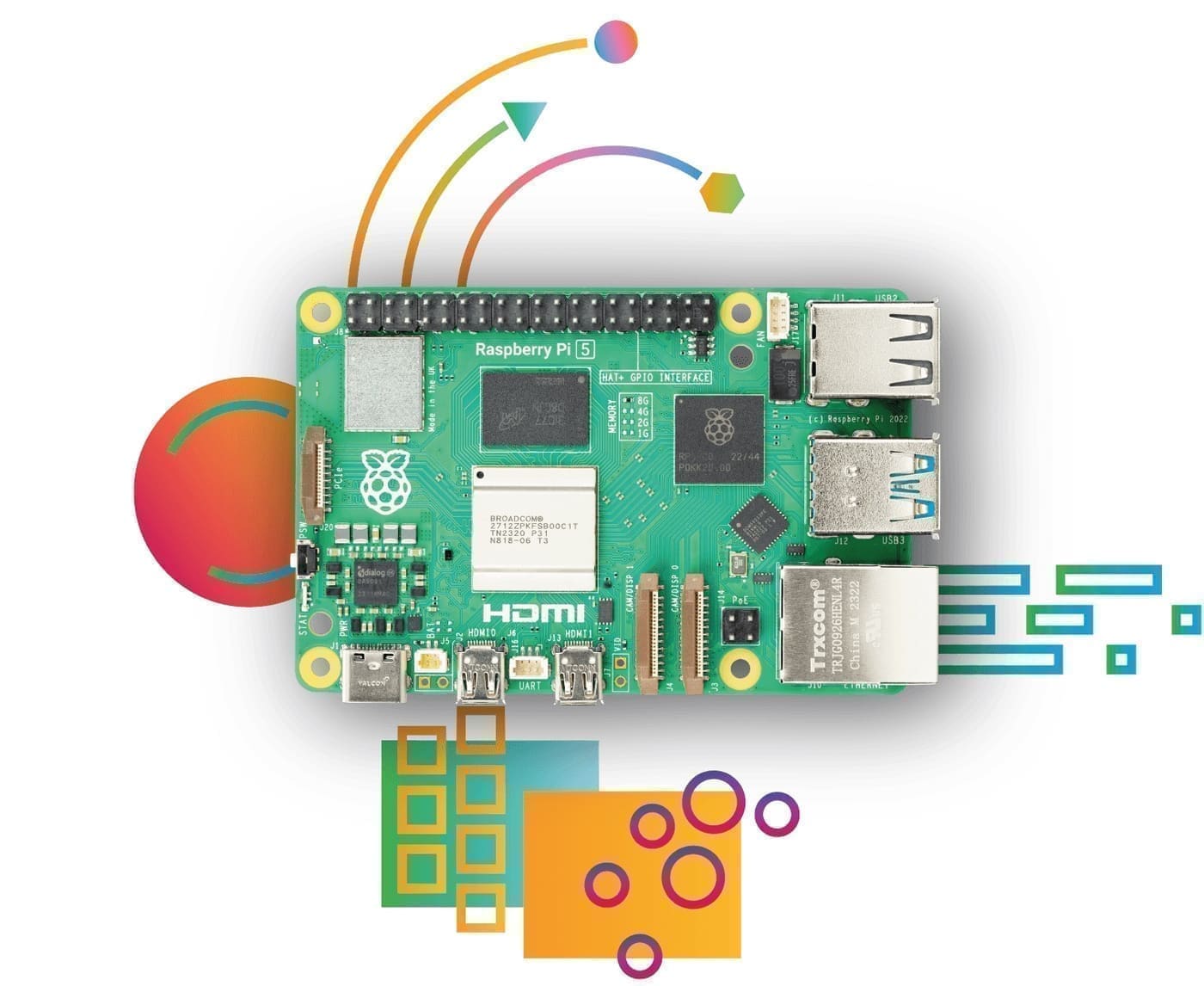
Raspberry Pi
Raspberry Pi 5 Starter Kit (8GB)
- Native integration
- Local control
- Wi-Fi
- Bluetooth
Prices verified September 2026
See more hubs & dongles picks on our Amazon storefront →Our verdict
The DIY route: flash Home Assistant OS onto a Pi 5 and you get real headroom over a Green for Frigate or local voice — though an 8GB kit now costs more than Green's £159, so this is about tinkering power, not savings. For heavy multi-camera Frigate or a stacked add-on list, a mini PC like Beelink's N150 (dual 2.5G LAN, six NVMe slots) offers more headroom still, with less fiddling to keep stable. Buy this if you want to pick your own storage and enjoy building the box; skip it if you just want a hub that works out of the box — that's what Green is for.
What can Home Assistant control on the Raspberry Pi 5 Starter Kit (8GB)?
| Control | Type | What it does |
|---|---|---|
| CPU temperature | Sensor | SoC temperature — the quickest way to confirm the active cooler is keeping the board out of thermal-throttle range under sustained load. |
| CPU usage | Sensor (%) | System-wide CPU utilisation; spikes flag add-ons like Frigate inference or local voice saturating the Pi 5's cores. |
| Memory usage | Sensor (%) | RAM utilisation, worth watching on the 8GB kit since HAOS, add-ons, and Frigate's inference buffers all compete for the same pool. |
| Disk usage | Sensor (%) | Storage utilisation on the boot/data disk — check closely on NVMe setups given reported I/O errors on some drive models under sustained write load. |
| Update available | Binary sensor | Flags a pending HAOS/firmware update; worth checking release notes before applying, since some firmware updates have reset NVMe boot order back to SD-first. |
Running HAOS from the microSD card works out of the box but is a wear item under Frigate-style continuous recording or heavy database writes — community reports describe card corruption after a few months of uptime, so most stable Pi 5 builds move the OS to NVMe via a HAT instead. That move has its own quirk: a firmware update has been known to silently rewrite boot order back to SD-first, leaving the Pi stuck trying to boot from a card that's no longer inserted. Sustained CPU loads — Frigate detection, local voice, heavy automations — will thermal-throttle the SoC without the official active cooler fitted; passive cases aren't rated for continuous load. One practical gotcha for USB-attached Zigbee/Z-Wave coordinators: seating the dongle directly in a USB 3.0 port puts it close enough to the port's RF noise floor to cause dropped devices, so route it through a USB extension away from the board and any other USB 3 peripherals.
Specs
| cpu | Broadcom BCM2712, 2.4 GHz quad-core Cortex-A76 |
|---|---|
| ram | 8GB LPDDR4X-4267 |
| power | 27W USB-C PD power supply required (5V/5A) — official recommended unit; board draws roughly 3W idle, up to 12W under sustained load (NVMe + USB peripherals + heavy CPU), and underpowered third-party supplies are a common cause of random reboots or throttling |
| dimensions | 85 x 56mm bare board; add roughly 20-30mm height once cased and cooled, final footprint depends on the specific case in each seller's kit |
| connectivity | Gigabit Ethernet, dual-band 802.11ac Wi-Fi 5, Bluetooth 5.0/BLE, 2x USB 3.0 + 2x USB 2.0, PCIe 2.0 x1 for NVMe HATs, no built-in Zigbee/Z-Wave — add a USB coordinator |
| kit contents | Pi 5, case, PSU, cooling, pre-installed storage (kit contents vary by seller — some bundle a 128GB microSD, Pi Hut's official kit ships a 32GB card and no active cooler included by default) |
How does the Raspberry Pi 5 Starter Kit (8GB) compare?
| Product | From | Protocol | Local control | Integration |
|---|---|---|---|---|
| Raspberry Pi 5 Starter Kit (8GB) (this product) | £224.5 | Wi-Fi, Bluetooth | Yes | Native |
| Aeotec Z-Stick 7 | £46.43 | Z-Wave | Yes | Native |
| Apple TV 4K (Wi-Fi + Ethernet, 128GB) | £249 | Thread, Matter, Wi-Fi, Bluetooth | Yes | Native |
| Aqara Hub M3 | £109.99 | Zigbee, Thread, Matter, Wi-Fi, Bluetooth | Yes | Native |
Frequently asked questions
- Does the Raspberry Pi 5 Starter Kit (8GB) work with Home Assistant locally?
- Yes. The Raspberry Pi 5 Starter Kit (8GB) is controlled locally in Home Assistant through a built-in Home Assistant core integration, so it keeps working if your internet connection or the Raspberry Pi cloud goes down. Control and state updates stay on your own network.
- Which protocol does the Raspberry Pi 5 Starter Kit (8GB) use, and do I need a hub?
- The Raspberry Pi 5 Starter Kit (8GB) uses Wi-Fi and Bluetooth. To pair it with Home Assistant you need no hub — it joins your Wi-Fi network directly; or a Bluetooth adapter on your Home Assistant host or an ESPHome Bluetooth proxy. Raspberry Pi's own hub is not required when you integrate through a built-in Home Assistant core integration.
- How much does the Raspberry Pi 5 Starter Kit (8GB) cost in the UK?
- The lowest price we have listed for the Raspberry Pi 5 Starter Kit (8GB) is £224.50 at The Pi Hut, with other UK retailers at up to £229.99. Prices were last checked in September 2026 and change often, so confirm on the retailer's page before buying.