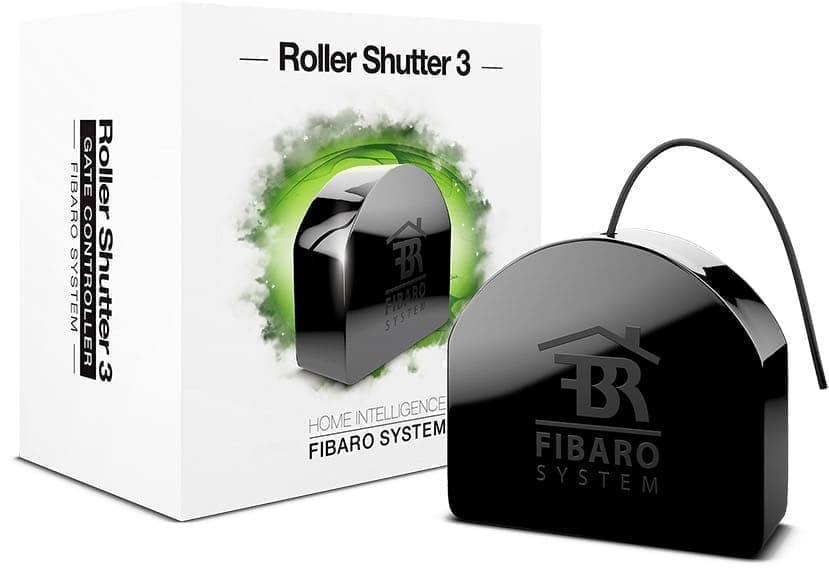
Fibaro
Fibaro Roller Shutter 3 (FGR-223)
- Native integration
- Local control
- Z-Wave
Prices verified October 2026
See more relays & dimmer modules picks on our Amazon storefront →Our verdict
This is the module, not the motor — it fits behind an existing switch and drives the up/down/stop wiring of a mains AC blind, awning, or gate motor you already have, giving precise slat/position control and power metering under Z-Wave JS. It needs a neutral and works best in a 65mm-deep back box (a 45mm box is workable but tight). Worth knowing before you buy: there's a long-running Home Assistant Community thread on quirky zwave_js behaviour (duplicate cover/switch entities, slider lag) across firmware versions, so budget time for calibration and re-interview if you hit odd states.
What can Home Assistant control on the Fibaro Roller Shutter 3 (FGR-223)?
| Control | Type | What it does |
|---|---|---|
| Position | Cover (0-100%) | Drives the connected motor's up/down/stop wiring; accuracy depends on completing force calibration for the motor's real travel time. |
| Slat tilt | Cover (0-100%) | Separate second cover entity for venetian slat angle — only appears when operating mode is set to venetian blind with positioning; not a tilt field on the primary cover. |
| Power | Sensor (W) | Real-time wattage of the connected motor; useful for confirming the motor is genuinely running, especially on a gate or awning with no other feedback. |
| Energy | Sensor (kWh) | Cumulative consumption of the connected motor. |
| Force calibration | Config | Triggers a full up/down calibration run against the connected motor's real travel time — required for accurate position and tilt percentages. |
Setting the operating mode to venetian-blind-with-positioning doesn't add a tilt attribute to the single cover entity — it spins up a second, separate cover entity that drives slat angle independently from the primary position entity, a split that's confused HA users for years and is the root of the entity-duplication complaints referenced in the editor note. Position accuracy on both entities depends on running the device's force-calibration parameter with the motor's real travel time configured; skipping calibration is the most common cause of reported percentage drift. Because this module drives an existing AC motor rather than being the motor itself, per-channel power metering is the most reliable way to confirm the motor is actually running — watch for a spike above the stall threshold while the cover is mid-travel and call stop to catch a jammed gate or awning faster than relying on position alone.
Specs
| channels | 1 |
|---|---|
| controls | existing AC roller/blind/awning/gate motor via up-down-stop wiring |
| zwave frequency | 868MHz EU/UK |
| neutral required | true |
| power monitoring | true |
| back box depth mm | 65 recommended, 45 workable |
How does the Fibaro Roller Shutter 3 (FGR-223) compare?
| Product | From | Protocol | Local control | Integration |
|---|---|---|---|---|
| Fibaro Roller Shutter 3 (FGR-223) (this product) | £69.99 | Z-Wave | Yes | Native |
| Aqara Dual Relay Module T2 | £29.74 | Zigbee | Yes | Zigbee2MQTT / ZHA |
| Aqara Single Switch Module T1 (No Neutral) | £26.99 | Zigbee | Yes | Zigbee2MQTT / ZHA |
| Candeo Zigbee Dimmer Module (C-ZB-DM204) | £39.99 | Zigbee | Yes | Zigbee2MQTT / ZHA |
Frequently asked questions
- Does the Fibaro Roller Shutter 3 (FGR-223) work with Home Assistant locally?
- Yes. The Fibaro Roller Shutter 3 (FGR-223) is controlled locally in Home Assistant through a built-in Home Assistant core integration (zwave_js), so it keeps working if your internet connection or the Fibaro cloud goes down. Control and state updates stay on your own network.
- Which protocol does the Fibaro Roller Shutter 3 (FGR-223) use, and do I need a hub?
- The Fibaro Roller Shutter 3 (FGR-223) uses Z-Wave. To pair it with Home Assistant you need a Z-Wave controller stick attached to your Home Assistant host. Fibaro's own hub is not required when you integrate through a built-in Home Assistant core integration (zwave_js).
- How much does the Fibaro Roller Shutter 3 (FGR-223) cost in the UK?
- The lowest price we have listed for the Fibaro Roller Shutter 3 (FGR-223) is £69.99 at Amazon UK. Prices were last checked in October 2026 and change often, so confirm on the retailer's page before buying.