Roborock
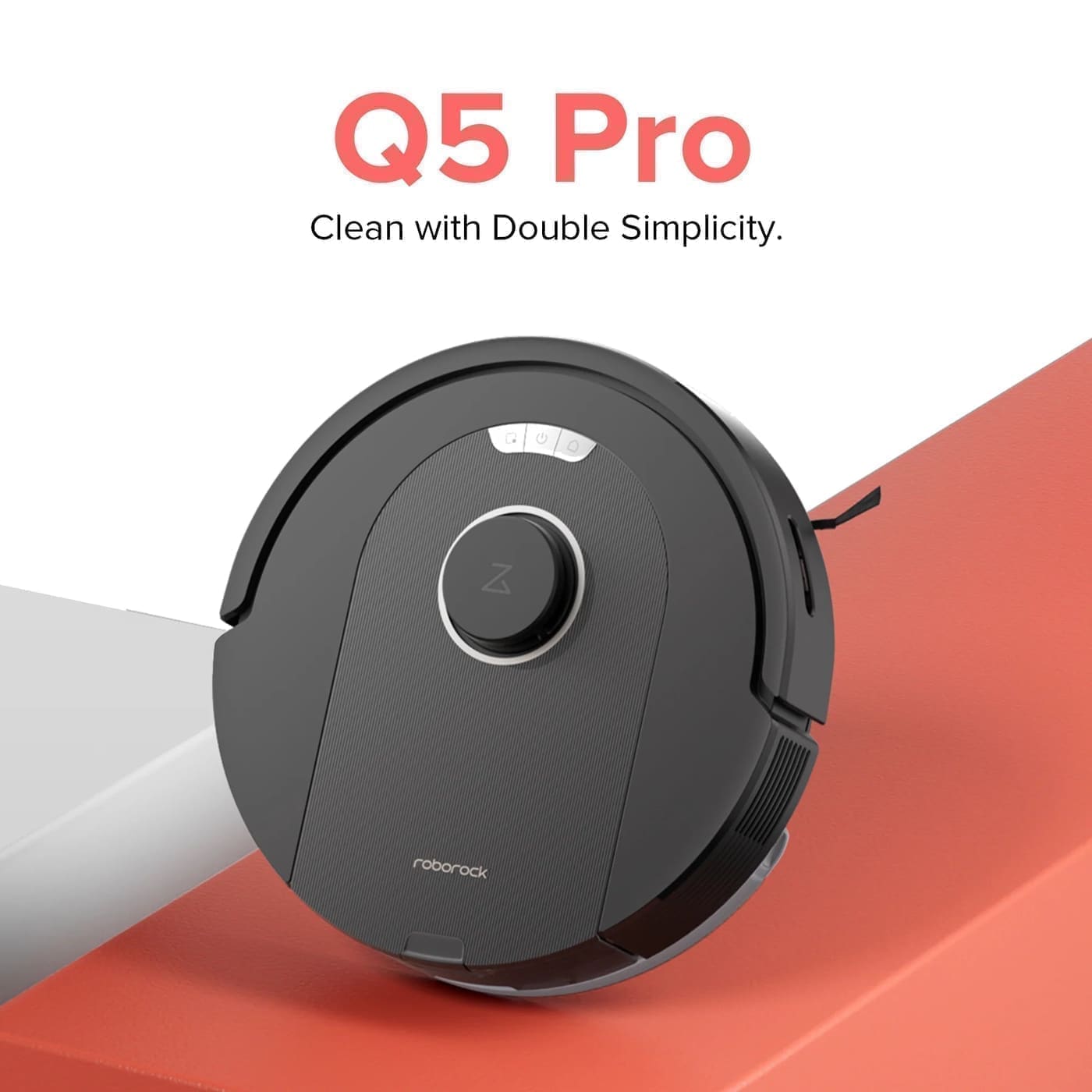
Roborock Q5 Pro
- Cloud integration
- Cloud required
- Wi-Fi
Prices verified October 2026
See more robot vacuums picks on our Amazon storefront →Our verdict
The entry point: LiDAR mapping and 5500Pa suction for well under £300, and Home Assistant's core roborock integration picks it up over your Roborock account with room-by-room clean commands. There's no obstacle avoidance — just bump and cliff sensors — so it'll shove toys, cables and pet mess around rather than dodge them. The 770ml dustbin and 180ml water tank are solid for the price, but expect ~67-69dB on higher suction modes, and there's no auto-empty dock. Best suited to smaller, tidy flats without pets or floor clutter — buy it for the mapping, not obstacle intelligence, and like every Roborock it's cloud-polling (~30s) rather than local.
What can Home Assistant control on the Roborock Q5 Pro?
| Control | Type | What it does |
|---|---|---|
| Clean area | Service | Cleans one or more Home Assistant Areas mapped to Roborock's internal room segments; call with friendly area names instead of raw segment numbers. |
| Get maps | Service | Retrieves the current map and its room/segment list — used to rebuild the area-to-segment mapping after a remap changes segment IDs. |
| Go to position | Service | Sends the vacuum to specific map coordinates, for spot-checks or custom routing outside standard room-level cleaning. |
| Consumable life | Sensor | Separate percentage-remaining sensors for main brush, side brush, filter and dust sensor. |
| Fan speed / mop intensity | Select | Selectable suction and mop water-intensity presets, settable per clean. |
The roborock integration lets you map each cleaned room to a genuine Home Assistant Area from the vacuum entity's settings, after which automations can call a standard area-cleaning service with real room names instead of opaque coordinates. Those mappings are pinned to Roborock's internal room segment IDs, which the firmware reassigns whenever the map is redrawn from scratch — a full remap silently detaches every room-to-area link and each one has to be reassigned by hand. The integration also exposes per-consumable sensors (main brush, side brush, filter, sensor) with remaining-life percentages, so a low-filter-life automation can nag before suction actually degrades.
Specs
| dock | charging only, no auto-empty |
|---|---|
| brush | DuoRoller dual rubber main brush (anti-tangle) |
| mopping | yes, simultaneous vacuum+mop with detachable pad |
| runtime | ~240 min (5200mAh battery) |
| suction | 5500Pa |
| dimensions | 350 x 350 x 96.5mm (robot only) |
| navigation | LiDAR, 3D mapping |
| noise level | ~67-69dB on max suction (no listed quiet-mode figure) |
| dust bin capacity | 770ml onboard |
| obstacle avoidance | none — bump and cliff sensors only, no camera/AI detection |
| water tank capacity | 180ml |
How does the Roborock Q5 Pro compare?
| Product | From | Protocol | Local control | Integration |
|---|---|---|---|---|
| Roborock Q5 Pro (this product) | £299 | Wi-Fi | Cloud | Cloud |
| Dreame L10s Ultra Gen 3 | £349 | Wi-Fi | Yes | HACS |
| Dreame X50 Ultra Complete | £838.98 | Wi-Fi, Matter | Yes | HACS |
| Ecovacs Deebot N20 Plus | £199 | Wi-Fi | Cloud | Cloud |
Frequently asked questions
- Does the Roborock Q5 Pro work with Home Assistant locally?
- Partly. The Roborock Q5 Pro connects to Home Assistant through the manufacturer's cloud integration (roborock), which relies on the Roborock cloud. It works in Home Assistant, but commands go via the internet and stop working during an outage of your connection or the Roborock service.
- Which protocol does the Roborock Q5 Pro use, and do I need a hub?
- The Roborock Q5 Pro uses Wi-Fi. To pair it with Home Assistant you need no hub — it joins your Wi-Fi network directly. Roborock's own hub is not required when you integrate through the manufacturer's cloud integration (roborock).
- How much does the Roborock Q5 Pro cost in the UK?
- The lowest price we have listed for the Roborock Q5 Pro is £299 at Amazon UK. Prices were last checked in October 2026 and change often, so confirm on the retailer's page before buying.