Roborock
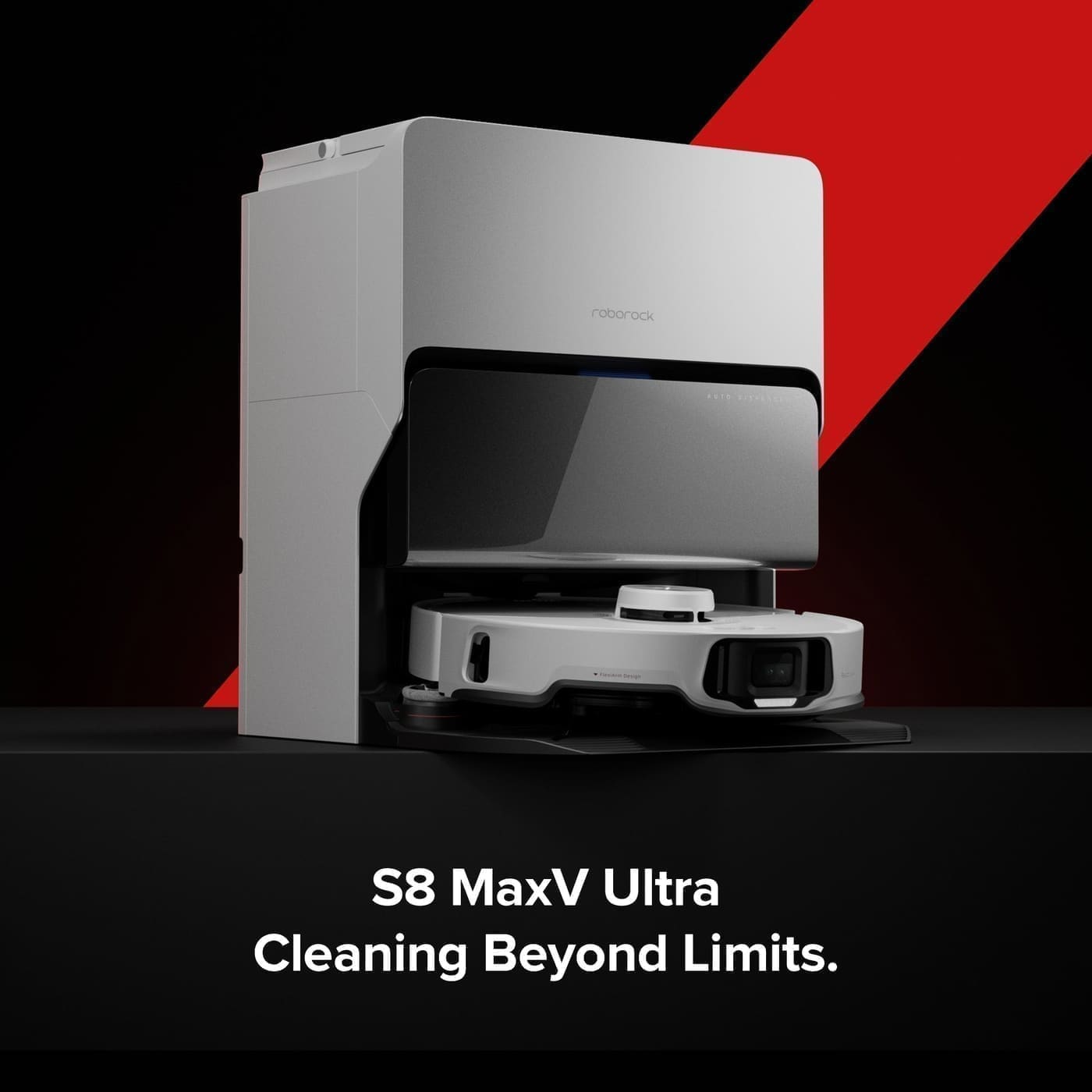
Roborock S8 MaxV Ultra
- Native integration
- Cloud required
- Wi-Fi
- Matter
Prices verified October 2026
See more robot vacuums picks on our Amazon storefront →Our verdict
The flagship: 10000Pa suction, an all-in-one dock that washes, dries and refills itself, and reactive AI obstacle avoidance that actually works around pet mess. At 350mm across and 103mm tall it clears most low furniture other robots get stuck under, and the 5200mAh battery covers a full multi-room clean before it needs the dock. It also has partial Matter support, so basic start/stop/state entities update locally instead of waiting on the usual cloud poll — but full room control and mapping still go through your Roborock account. Expensive, but it's the one enthusiasts actually recommend.
What can Home Assistant control on the Roborock S8 MaxV Ultra?
| Control | Type | What it does |
|---|---|---|
| Vacuum state | Sensor (Matter, local) | Docked/cleaning/paused/returning/error, pushed sub-second over the Matter bridge — no room-in-progress detail included. |
| Start/pause/stop/dock | Service (Matter, local) | Executes without the cloud round-trip but can't carry a specific room or zone argument. |
| Room/segment cleaning | Select (cloud) | Zone and room selection still goes through the app-mapped segment IDs on the cloud entity — not implemented on the Matter bridge. |
| Fresh water tank | Binary sensor (cloud) | Flags when the dock's auto-refill reservoir needs topping up. |
| Dirty water / drain status | Binary sensor (cloud) | Reports when auto-drain hasn't fully emptied the dirty tank after a cleaning cycle. |
The Matter bridge only implements basic run-mode and operational-state clusters — not the newer service-area cluster — so the resulting local HA vacuum entity gives you a locally-pushed docked/cleaning/paused/error state plus start/pause/stop/return-to-dock, but no room or zone arguments; targeting a specific room still has to go through the separate cloud vacuum entity. Because it's effectively two logically-separate entities for one device, automations that only need to know whether it started, stopped, or docked can bind to the Matter entity and react in well under a second instead of the cloud integration's usual poll delay, while anything needing room targeting still waits on the cloud entity. Reactive AI 2.0's obstacle detection runs entirely on-device and isn't surfaced as a sensor or event on either integration — there's no obstacle-avoided binary sensor to trigger off.
Specs
| dock | all-in-one: auto-empty, auto-refill, auto-drain |
|---|---|
| matter | partial — basic state entities only, full control via cloud |
| battery | 5200mAh Li-ion |
| mopping | yes, auto mop wash & hot-air dry, detergent dispenser |
| suction | 10000Pa |
| navigation | PreciSense LiDAR + RGB, Reactive AI 2.0 obstacle avoidance |
| dock dimensions | 409 x 419 x 470mm (16.1 x 16.5 x 18.5in) |
| robot dimensions | 350 x 353 x 103mm (13.8 x 13.9 x 4.06in) |
How does the Roborock S8 MaxV Ultra compare?
| Product | From | Protocol | Local control | Integration |
|---|---|---|---|---|
| Roborock S8 MaxV Ultra (this product) | £549.99 | Wi-Fi, Matter | Cloud | Native |
| Dreame L10s Ultra Gen 3 | £349 | Wi-Fi | Yes | HACS |
| Dreame X50 Ultra Complete | £838.98 | Wi-Fi, Matter | Yes | HACS |
| Ecovacs Deebot N20 Plus | £199 | Wi-Fi | Cloud | Cloud |
Frequently asked questions
- Does the Roborock S8 MaxV Ultra work with Home Assistant locally?
- Partly. The Roborock S8 MaxV Ultra connects to Home Assistant through a built-in Home Assistant core integration (roborock), which relies on the Roborock cloud. It works in Home Assistant, but commands go via the internet and stop working during an outage of your connection or the Roborock service.
- Which protocol does the Roborock S8 MaxV Ultra use, and do I need a hub?
- The Roborock S8 MaxV Ultra uses Wi-Fi and Matter. To pair it with Home Assistant you need no hub — it joins your Wi-Fi network directly; or a Thread border router if it is Matter-over-Thread, or just your Wi-Fi network if it is Matter-over-Wi-Fi. Roborock's own hub is not required when you integrate through a built-in Home Assistant core integration (roborock).
- How much does the Roborock S8 MaxV Ultra cost in the UK?
- The lowest price we have listed for the Roborock S8 MaxV Ultra is £549.99 at Amazon UK (Renewed). Prices were last checked in October 2026 and change often, so confirm on the retailer's page before buying.