Sonoff
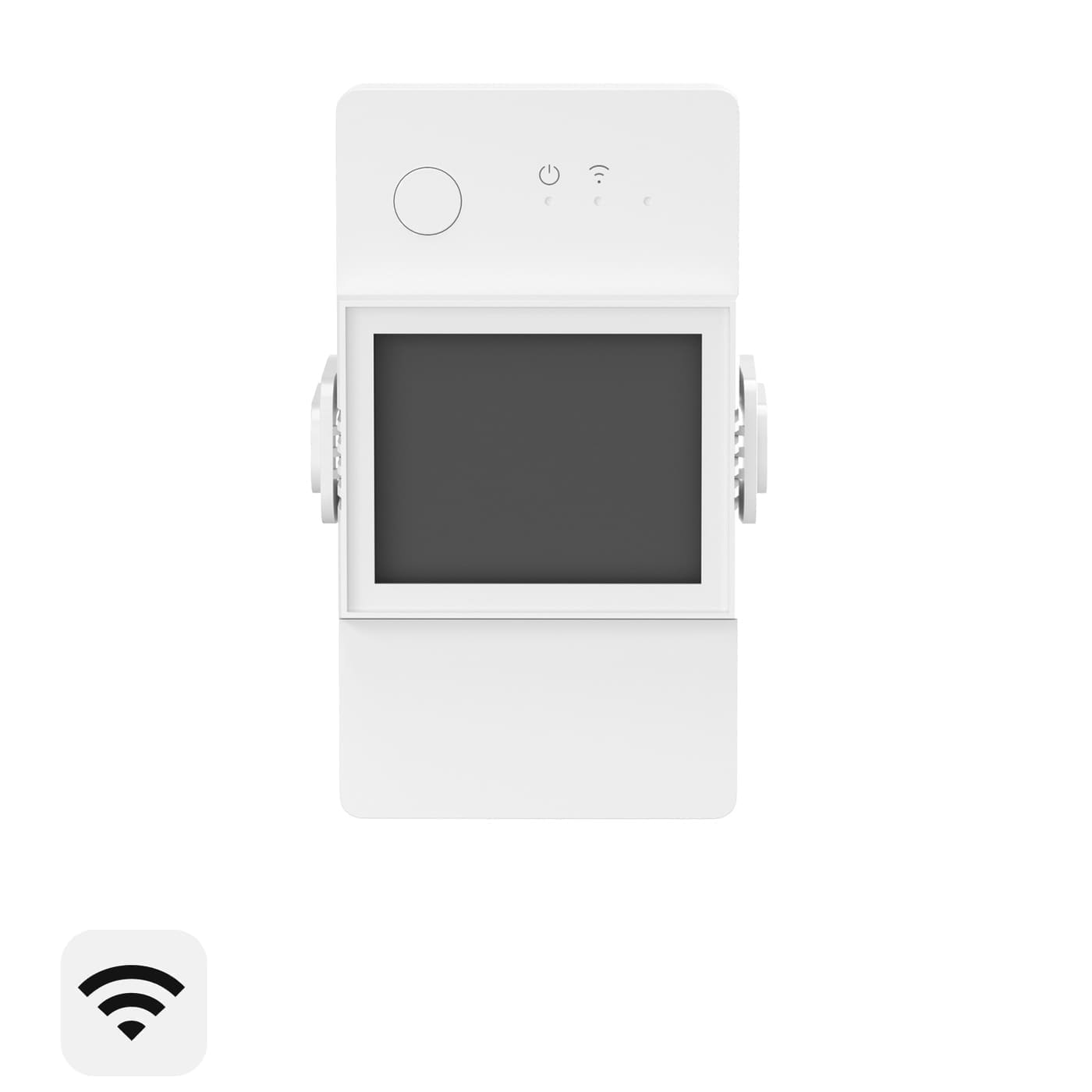
Sonoff POW Elite POWR320D
- HACS component
- Local control
- Wi-Fi
Prices verified September 2026
See more smart plugs & energy picks on our Amazon storefront →Our verdict
This is a 20A in-line wired switch, not a plug — it's wired directly into the circuit it monitors, typically an immersion heater or another hardwired appliance. That's mains-wiring work, realistically electrician territory for anything permanent, unlike a £15 plug-in energy monitor you just plug in and forget. The trade-off buys you whole-circuit monitoring a plug-in device can't offer, plus an on-device LCD for at-a-glance power, voltage and current without opening Home Assistant. Works locally via the SonoffLAN HACS integration, and the ESP32 inside is ESPHome-flashable if you want eWeLink out of the picture entirely.
What can Home Assistant control on the Sonoff POW Elite POWR320D?
| Control | Type | What it does |
|---|---|---|
| Switch | Switch | Relay on/off, controlled locally via SonoffLAN when LAN mode succeeds, or over cloud as a fallback if local commands fail. |
| Power | Sensor (W) | Real-time active power from the onboard CSE7766 chip; confirm SonoffLAN is updated to avoid the known scaling bug reported on this model. |
| Voltage | Sensor (V) | Live mains voltage reading, same source and scaling caveat as the power sensor. |
| Current | Sensor (A) | Live current draw, useful for near-zero-current detection (e.g. finished appliance cycle) since it updates faster than cumulative energy. |
| Energy | Sensor (kWh) | Total consumption; reported as sometimes lagging until the eWeLink app has been opened at least once to trigger a push update. |
SonoffLAN pulls live power, voltage and current straight off the device's CSE7766 metering chip, but early releases misparsed the POWR320D's payload and reported values 100x too high — fixed from SonoffLAN v3.2.0, so update the HACS integration before trusting the numbers. A separate reported issue shows local switch commands sometimes bouncing with an encrypt mismatch even though local polling and cloud control both work fine, so a LAN-only setup can occasionally need an eWeLink cloud fallback for reliable on/off. If you flash ESPHome instead, the community template drives the bistable relay from two GPIO pins and reads the CSE7766 chip over a third, but flashing over 3.3V DC rather than mains AC has caused reported boot loops on this specific board.
Specs
| wifi | 802.11 b/g/n, 2.4GHz |
|---|---|
| display | LCD showing power/voltage/current |
| max load | 20A |
| plug type | n/a (in-line wired switch) |
| dimensions mm | 98 x 54 x 31 |
| voltage rating | 100-240V AC, 50/60Hz |
| casing material | PC, V0 flame-rated |
| energy monitoring | true |
How does the Sonoff POW Elite POWR320D compare?
| Product | From | Protocol | Local control | Integration |
|---|---|---|---|---|
| Sonoff POW Elite POWR320D (this product) | £17.06 | Wi-Fi | Yes | HACS |
| Aqara Power Plug H2 UK (RGB) | £32.99 | Zigbee, Thread, Matter, Bluetooth | Yes | Works with HA |
| Aqara Wall Outlet H2 UK | £67.99 | Matter, Thread, Zigbee | Yes | Native |
| Eve Energy (Matter) UK Smart Plug | £39.95 | Thread, Matter, Bluetooth | Yes | Works with HA |
Frequently asked questions
- Does the Sonoff POW Elite POWR320D work with Home Assistant locally?
- Yes. The Sonoff POW Elite POWR320D is controlled locally in Home Assistant through a community integration installed through HACS (sonoff_lan), so it keeps working if your internet connection or the Sonoff cloud goes down. Control and state updates stay on your own network.
- Which protocol does the Sonoff POW Elite POWR320D use, and do I need a hub?
- The Sonoff POW Elite POWR320D uses Wi-Fi. To pair it with Home Assistant you need no hub — it joins your Wi-Fi network directly. Sonoff's own hub is not required when you integrate through a community integration installed through HACS (sonoff_lan).
- How much does the Sonoff POW Elite POWR320D cost in the UK?
- The lowest price we have listed for the Sonoff POW Elite POWR320D is £17.06 at Amazon UK. Prices were last checked in September 2026 and change often, so confirm on the retailer's page before buying.