What Makes Pathway Lighting Different
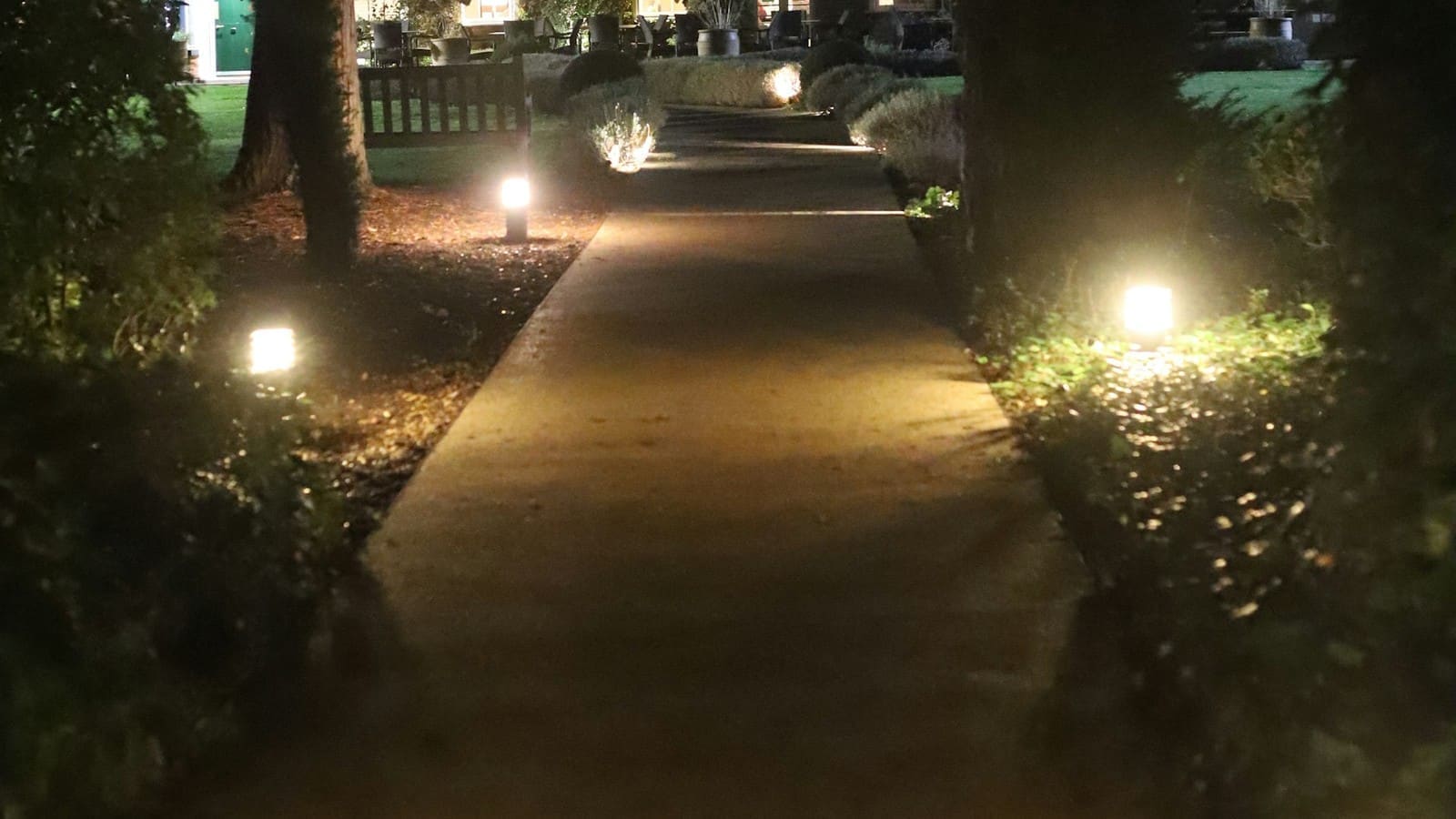
It's about the line, not the scene. Where our best smart garden lights UK guide covers spike lights, wall lights and string lights for general outdoor ambience, this guide focuses specifically on linear path and walkway lighting: bollards or stakes spaced every metre or so along a route, low-level step lights, and motion-triggered path lighting for security and safety. If you want colour-changing spotlights for a patio or flower bed instead, that garden lights guide is the better starting point — the two are designed to work alongside each other, not replace one another.
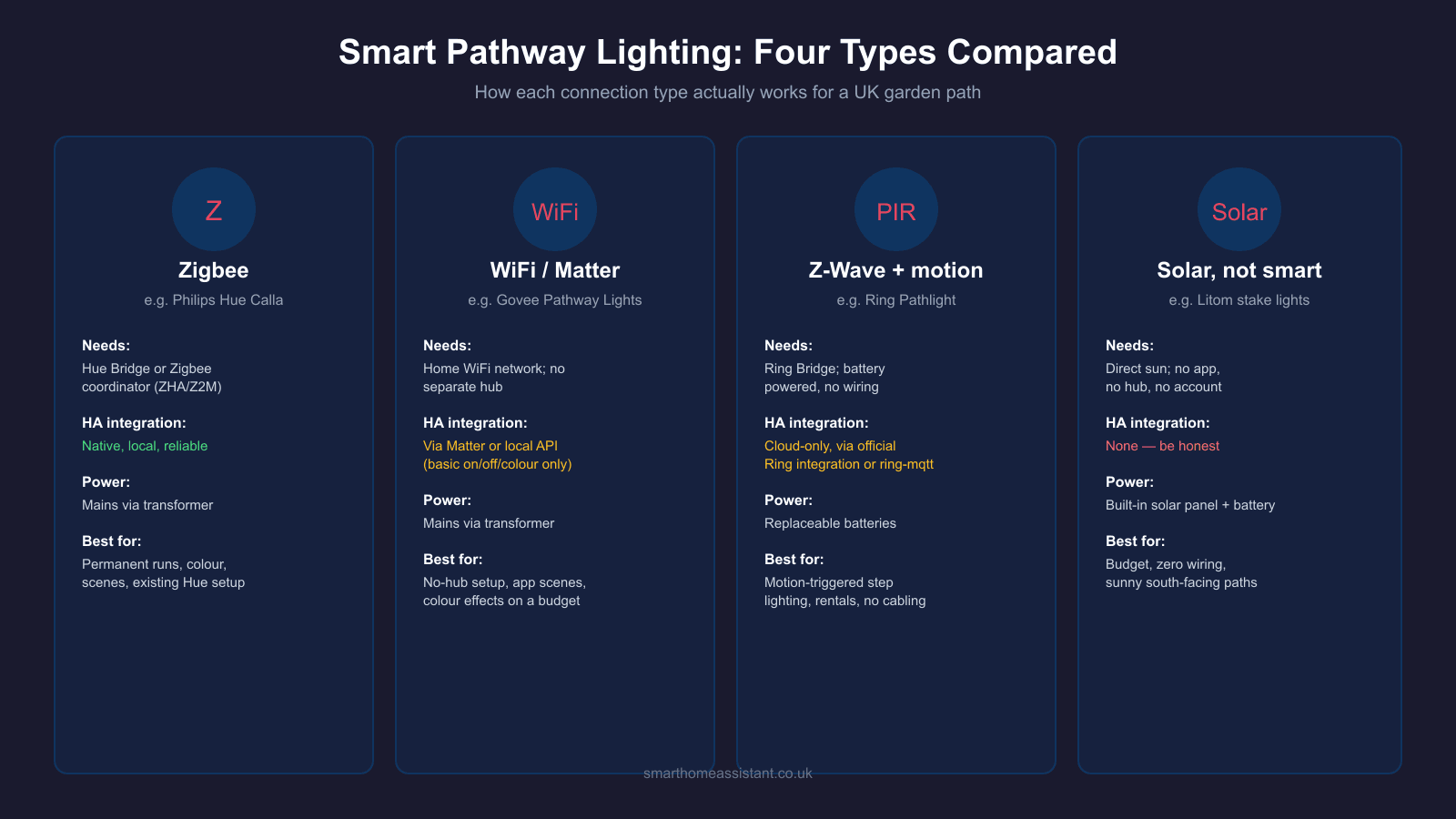
Three connection types dominate the UK market: Zigbee bollards that need a bridge or coordinator, WiFi/Matter stakes that connect straight to your router, and battery-powered motion-triggered lights on Z-Wave. A fourth category — solar stake lights with no smart features at all — is worth including honestly, because for a lot of UK gardens it's genuinely the most practical option.
Best Smart Pathway Lights UK — Our Top Picks
1. Philips Hue Calla Outdoor Bollard — Best Overall
Around £139.99, the Philips Hue Calla is a mains-powered bollard light designed specifically for path and driveway runs, not general garden ambience. Each unit puts out 590 lumens at 4000K (or 350 lumens in warm 2700K white), is IP65-rated for UK rain, and connects over Zigbee — which means it needs a Hue Bridge, but also means it integrates natively and locally with Home Assistant via the official Hue integration, ZHA, or Zigbee2MQTT if you're running a non-Hue coordinator. Because it's designed to be daisy-chained along a route with an extension cable, it's the most purpose-built option here for lining an actual path rather than dotting lights around a lawn. If you already run Hue indoors, this is the straightforward buy.
2. Govee Outdoor Pathway Lights 2 — Best WiFi/Matter, No Hub Needed
Typically £70–£100 for a 4-pack depending on retailer, the Govee Outdoor Pathway Lights 2 (Cylinder) are IP66/IP67-rated stake lights that connect over WiFi with Matter support, so there's no separate bridge to buy. Brightness runs up to 425 lumens per stake with full-colour RGBIC output and 60-plus preset scenes in the Govee Home app. For Home Assistant users, integration works either through the official govee_light_local integration over the local network, or via Matter — though Matter support on Govee's outdoor range currently only exposes basic on/off, brightness and colour, not the app's full scene library. It's a genuinely good no-hub option if you don't already own Zigbee kit.
3. Ring Smart Lighting Pathlight — Best for Motion-Triggered Step Lighting
Battery-powered and IP66-rated, the Ring Pathlight is built around motion detection rather than always-on ambience — each light senses movement and switches on as you walk the route, then times out. Ring rates battery life at around a year under typical use of roughly 8–10 activations a day at 30-second duration, and the unit outputs 80 lumens, which is enough for step-by-step visibility rather than broad illumination. It needs a Ring Bridge to connect to the Ring app and Alexa, and once linked it can trigger from Ring camera and doorbell motion events too. Home Assistant support exists but is worth being clear-eyed about: the official Ring integration is cloud-only and exposes Pathlights as basic light entities (on/off/brightness), while the community ring-mqtt add-on gives fuller access to motion sensor and lighting features if you want deeper automation. There's no local API — everything routes through Ring's cloud.
4. Solar Stake Lights (Litom, Otdair and similar) — Honest Budget Pick, Zero Smart Features
Budget solar pathway stakes from brands like Litom and Otdair are worth including precisely because they're the opposite of everything above: no app, no hub, no account, and no Home Assistant integration of any kind. They charge via a built-in solar panel through the day and switch on automatically at dusk using a photocell, with some models adding basic PIR motion boost. For path lighting specifically, aim for 100–200 lumens per light, which buying guides note gives good ground visibility without being harsh underfoot — anything much dimmer struggles to actually light a route, and much brighter isn't necessary for a garden path. Look for at least IP65. The trade-off for the zero-wiring, zero-subscription simplicity is that output depends entirely on how much sun the spot gets; a shaded north-facing path will underperform badly through a UK winter. If you want a smart pathway light, skip this category — but if you just want a path lit without touching an app, it's a legitimate choice and shouldn't be dismissed as "not proper smart lighting" when it was never trying to be.
Which Connection Type Should You Buy?
Zigbee (Philips Hue Calla): Best if you already run a Hue Bridge or Home Assistant Zigbee coordinator. Local control, no cloud dependency once paired, and reliable mesh performance along a long path run. See our best Zigbee bulbs UK guide for more on the protocol.
WiFi/Matter (Govee): Easiest setup with no extra hardware, good for renters or anyone not committed to an ecosystem yet. Matter support in Home Assistant is currently basic, so don't expect the full app scene library to carry over.
Z-Wave + motion (Ring): The right choice specifically for security-style, motion-triggered step lighting rather than always-on path ambience — particularly if you already run Ring cameras or a Ring Alarm. See our Ring Alarm UK review for the wider ecosystem.
Solar, non-smart: The right choice if you want a lit path without any app, hub or subscription, and your route gets reasonable direct sun. It's not a compromise version of a smart light — it's a different category of product entirely.
Installation Tips for UK Gardens and Driveways
Mains-powered bollard and stake lights like the Hue Calla run on a low-voltage transformer, not household mains, so they don't require the same electrician sign-off as a full outdoor circuit — but any new outdoor mains wiring back to that transformer should still sit on an RCD-protected circuit under UK wiring regulations (BS 7671). Battery and solar options sidestep this entirely, which is part of why they're popular for path lighting specifically: no cable trench needed along the route. Space stake and bollard lights every 1.5–2 metres for continuous ground coverage on a path, and drive stakes at least 10–15cm into the soil so they stay upright after heavy UK rain softens the ground. For broader outdoor lighting beyond the path itself, our best outdoor smart lights UK guide and Philips Hue outdoor lights review cover wall lights and floodlights.
If you're setting any of these up alongside a wider smart home, our Home Assistant UK setup guide is the place to start before adding outdoor lighting automations.