Smart Home Assistant

Repenic RD-250ZG Zigbee Dimmer Review: No Neutral, Full Home Assistant Support

SepehrBy Sepehr· 29 September 2026· Updated 30 September 2026· 8 min read
✓ Independent — no paid placements✓ UK-tested in real homes✓ Cited sources
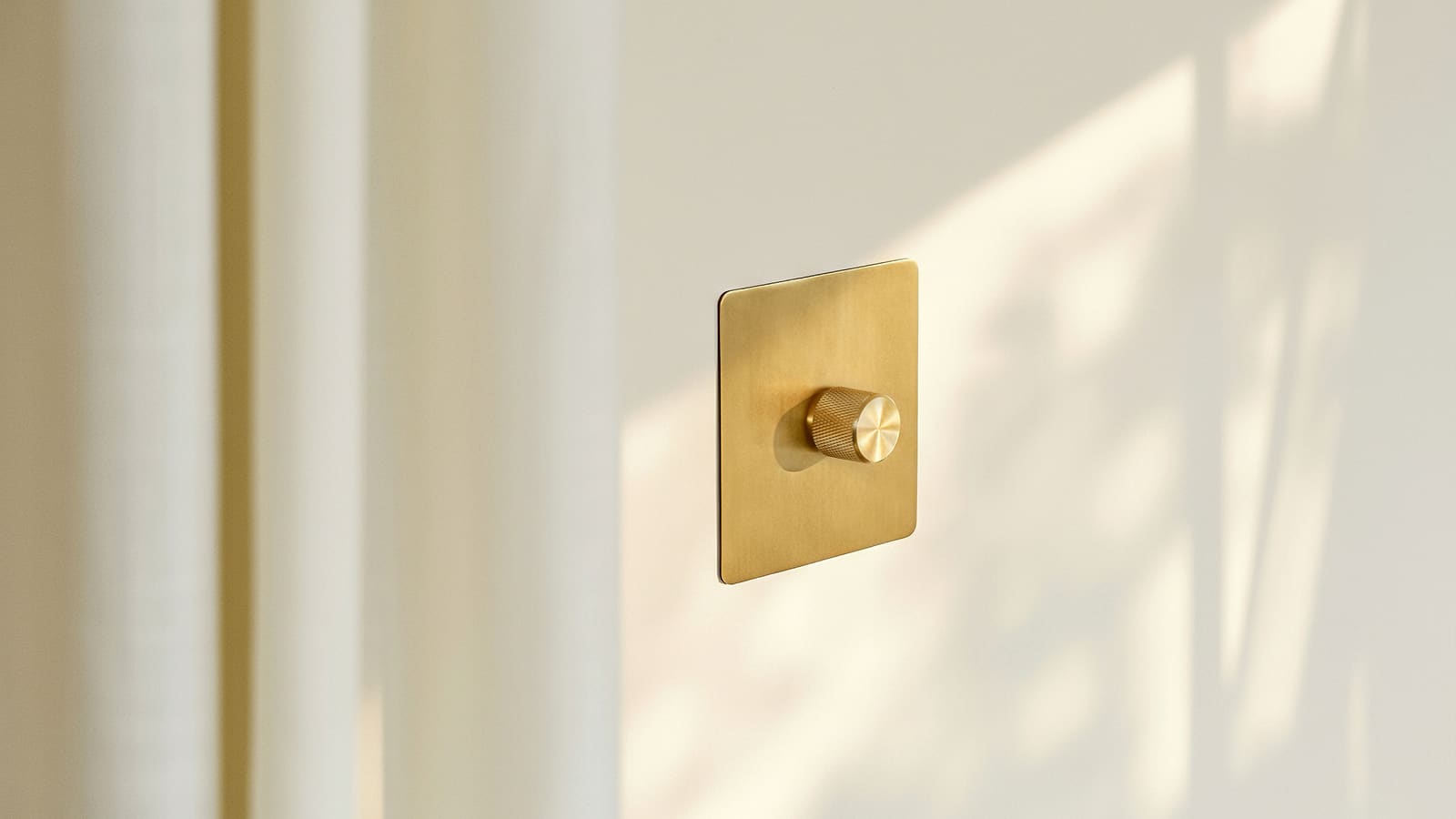
Brushed brass Repenic Zigbee smart dimmer switch on a sunlit wall, showing the knurled rotary knob.

Key takeaways

  • The Repenic RD-250ZG is a genuinely premium-feeling brushed-brass Zigbee dimmer, with weighted knurled knobs and precisely matched parts.
  • It paired to Home Assistant over ZHA within seconds of powering up, with no manual pairing code or app needed.
  • Its live power, voltage and current readings held up as internally consistent under test, a good sign the sensors are properly calibrated.
  • It needs no neutral wire and fits a standard UK back box, but installing the mains wiring itself still requires Part P-compliant electrical work.
  • A three-block automation — state trigger, time condition, brightness action — caps it at 15% brightness overnight so it never flashes on at full brightness.
On this page[tap to expand]

Our Repenic RD-250ZG review verdict: this 2-gang brushed-brass rotary Zigbee dimmer — sold as the Repenic Smart Dimmer Switch — is a strong buy — a genuinely premium-feeling fascia that pairs to Home Assistant in seconds, needs no neutral wire, and backs it up with accurate live power, voltage and current sensors.

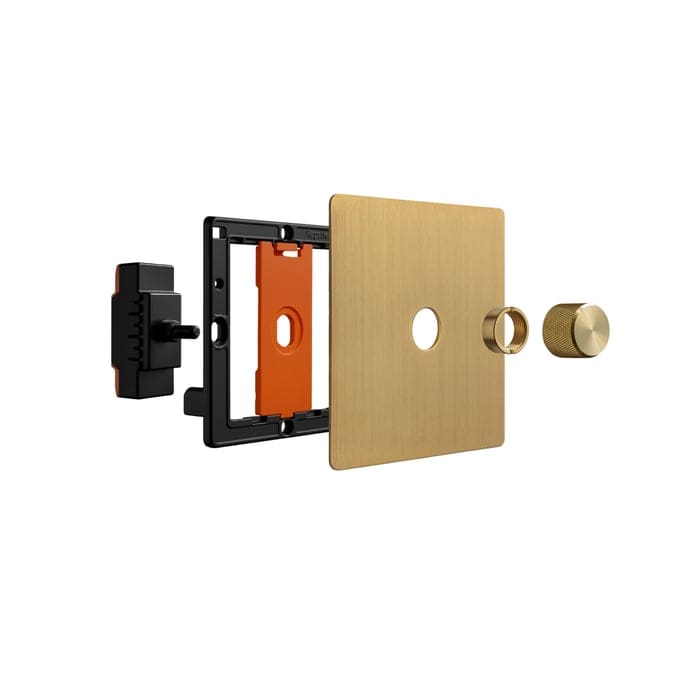
Verdict: Buy Exploded view of the Repenic RD-250ZG brass Zigbee dimmer switch and its components on a white background
Repenic Repenic Smart Dimmer Switch (RD-250ZG) — 2-gang, brushed brass ✓ Works with Home Assistant — auto-discovered over ZHA/Zigbee2MQTT, no hub needed
  • Genuinely premium fit and finish — weighted knurled-brass knobs, precisely matched collars, no rattle
  • Pairs to Home Assistant in seconds and reports accurate live power/voltage/current, not just on/off
Check price at Repenic →

Pros

  • Premium fit and finish throughout — weighted, precisely knurled brass knobs, matched collars and a fascia that doesn't flex or rattle against the wall
  • Pairs to Home Assistant in seconds over ZHA or Zigbee2MQTT, with no manual pairing code or app account needed
  • Accurate, live-updating power, voltage and current sensors, not just an on/off relay pretending to be a dimmer
  • No neutral wire required, so it fits older UK back boxes that many rivals can't
  • Physical rotary knob still works for dimming even if Wi-Fi, Zigbee or Home Assistant itself is down
  • Switchable leading/trailing-edge dimming mode, so it can be tuned to LED or legacy incandescent/halogen loads
  • A 2-gang unit controls two independent circuits from a single UK back box

Readers can get 10% off the Repenic range with code SEPEHR at checkout.

Cons

  • The 2-gang version needs a reasonably deep two-gang back box — tight older boxes may need a deeper pattress fitted first
  • Full zigbee-herdsman-converters support only merged in March 2026, so an older Zigbee2MQTT install needs updating before every entity appears
  • Several diagnostic entities (including one under Configuration) arrive disabled in Home Assistant by default and need enabling by hand
  • Costs noticeably more than Wi-Fi rivals like the Shelly Dimmer 2
SpecRepenic RD-250ZG
ConnectivityZigbee 3.0 — works via Home Assistant's built-in ZHA integration or Zigbee2MQTT, no proprietary hub or cloud account required
Load rating (per gang)5–250W resistive/capacitive (RC), 5–100W LED (RL) — printed on the module's own rating label
Neutral wireNot required
Dimming modeLeading or trailing edge, switchable in software
Gang options1–4 gang, same RD-250ZG module behind each gang
Finish testedBrushed brass (also available in brushed stainless steel, matt white, matt black)
Typical UK priceFrom £79 for a single gang across all four finishes; multi-gang units cost more — check the current listing for the exact 2-gang price

Build quality: does the Repenic Smart Dimmer Switch actually feel premium?

Yes, and it's the first thing you notice before it's even wired in. The knurling on the two brass knobs is deep and even rather than the shallow, off-centre texture on budget dimmers, and each turns with a smooth, weighted resistance rather than the loose click of a plastic rotary switch. The fascia is a single piece of brushed brass with no visible seams, and the collars between knob and plate are machined to match the knob spacing exactly, so nothing sits proud or wobbles once it's screwed together.

Repenic RD-250ZG box opened to show the two brass rotary dimmer knobs sitting on the module
First impression out of the box: the knurling on the brass knobs is deep and even, with real weight to the metal.

That attention to detail carries through to the parts you never see again once it's on the wall. The 2-gang kit breaks down into a black dimmer module carrying both gangs, a mounting bracket, the brass fascia, matched collars and a small bag of correctly-sized fixing screws — nothing loose, nothing needing a trip to the hardware drawer. Each gang has its own colour-coded terminal block with a wiring diagram printed directly onto the orange safety cover, which matters when you're working inside a dead back box and want to get it right first time.
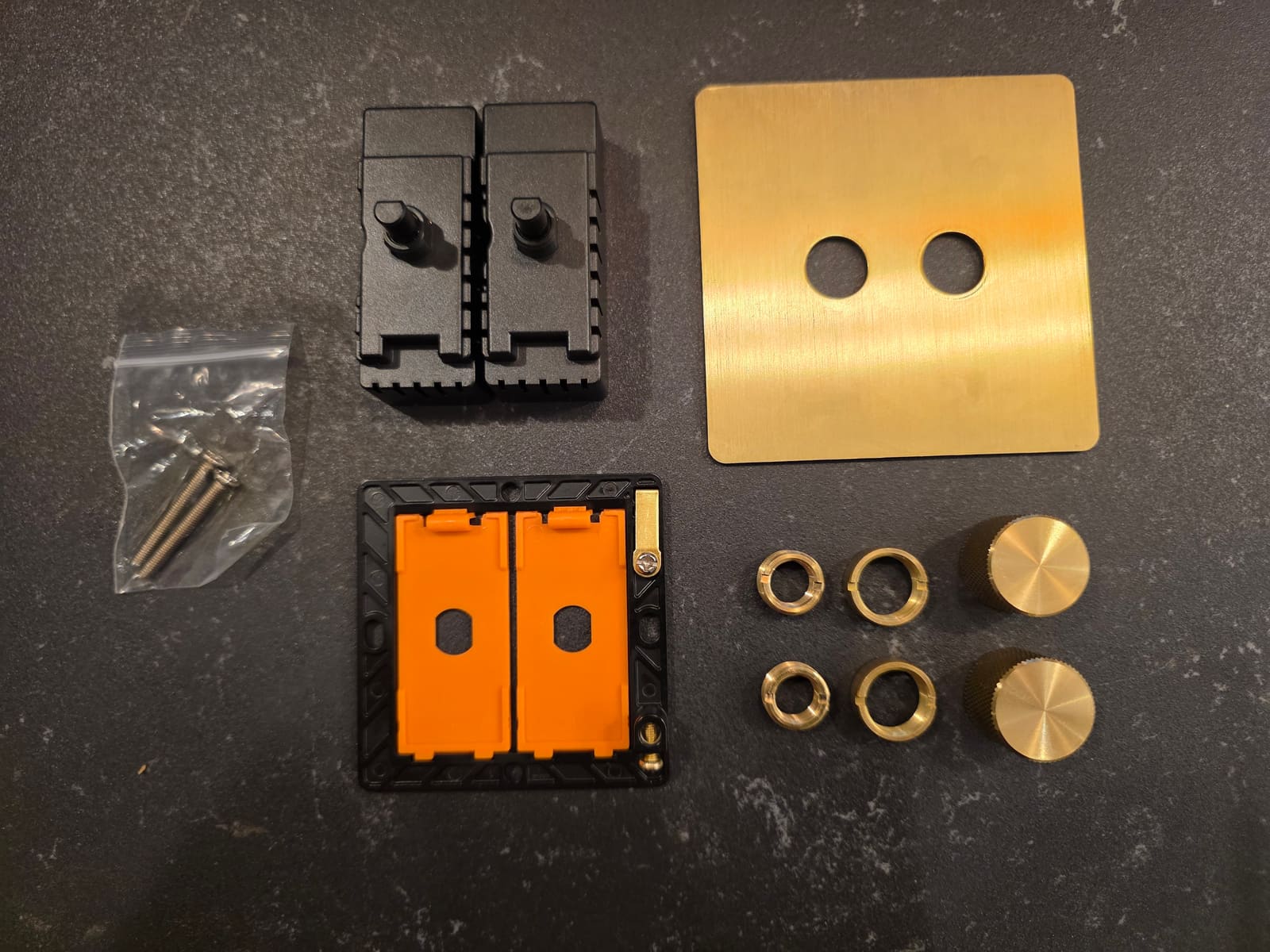
Repenic RD-250ZG dimmer disassembled into its module, mounting plate, brass fascia, knobs and screws
Every part of the 2-gang kit laid out: dimmer module, mounting bracket, brass fascia, matched collars and the exact screws needed — nothing extra to source.

The module's own printed rating label is a handy sanity check against the manufacturer's site, and it's another sign of a label doing its job rather than being an afterthought: RD-250ZG, 230V~50Hz, RC: 5–250W, RL: 5–100W LED, UKCA marked, Zigbee logo alongside — confirming it's the same module used across Repenic's 1–4 gang range, just wired once per gang.
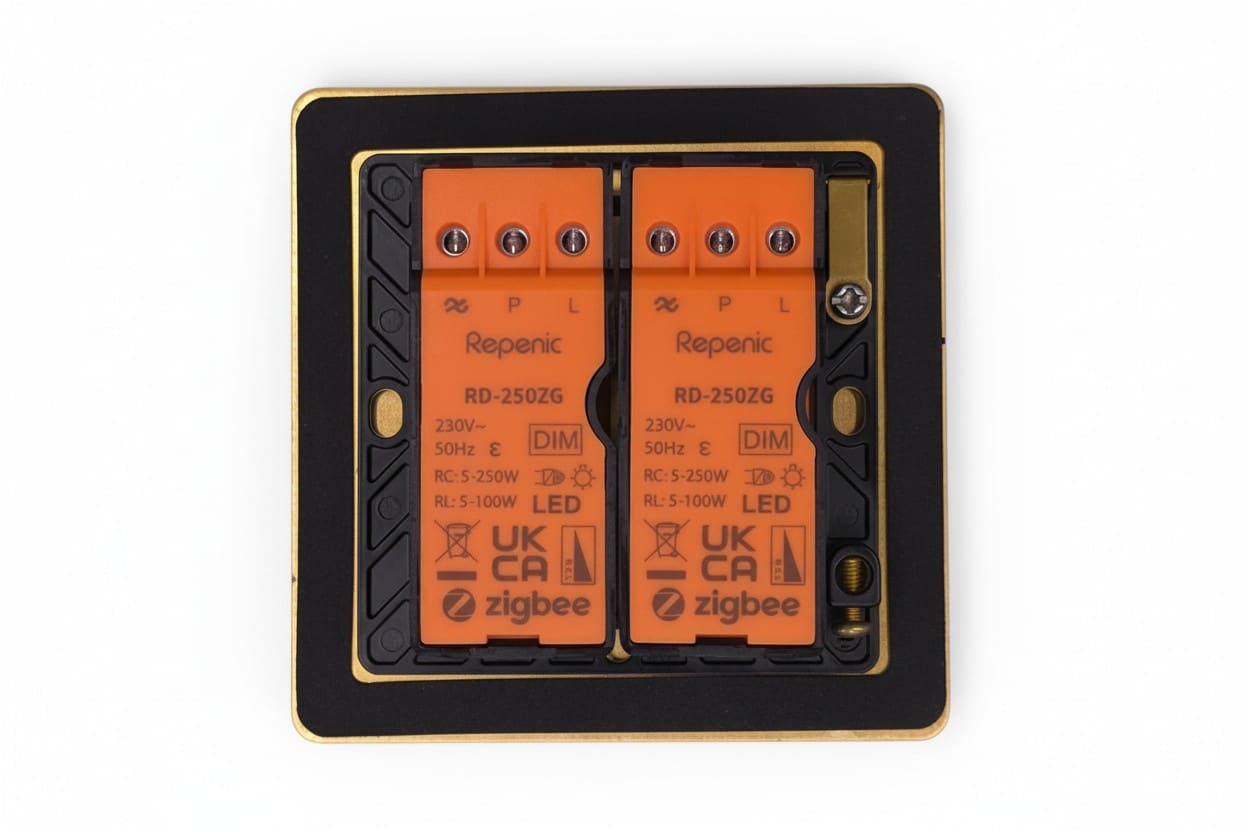
Close-up of the RD-250ZG module's printed rating label showing 230V, load wattage and the Zigbee and UKCA marks
The module's own label confirms the RD-250ZG model, load rating and UKCA/Zigbee certification.

Fitting a mains dimmer behind an existing UK switch plate is notifiable electrical work under Part P of the Building Regulations — isolating the circuit, wiring the module in, mounting the bracket and fascia — so it's a job for a competent DIYer or a registered electrician, not a five-minute swap. Where it genuinely earns "easy" is everything else: no neutral wire to source, a standard back box, and connectors keyed so the module only goes together one way.

Does the Repenic Smart Dimmer Switch work with Home Assistant?

Yes, and pairing it is genuinely one of the easiest parts of the whole review. It's a standard Zigbee 3.0 device, joining through Home Assistant's built-in ZHA integration or Zigbee2MQTT, with no Repenic hub, app or account anywhere in the process. On our ZHA coordinator (a Texas Instruments CC2652 stick) it appeared in the discovered-devices list within seconds of being powered up — no manual pairing code, just power it on and add it — landing as light.repenic_ltd_rd_250zg with a device page split into Controls, Sensors, Configuration and Diagnostic cards.
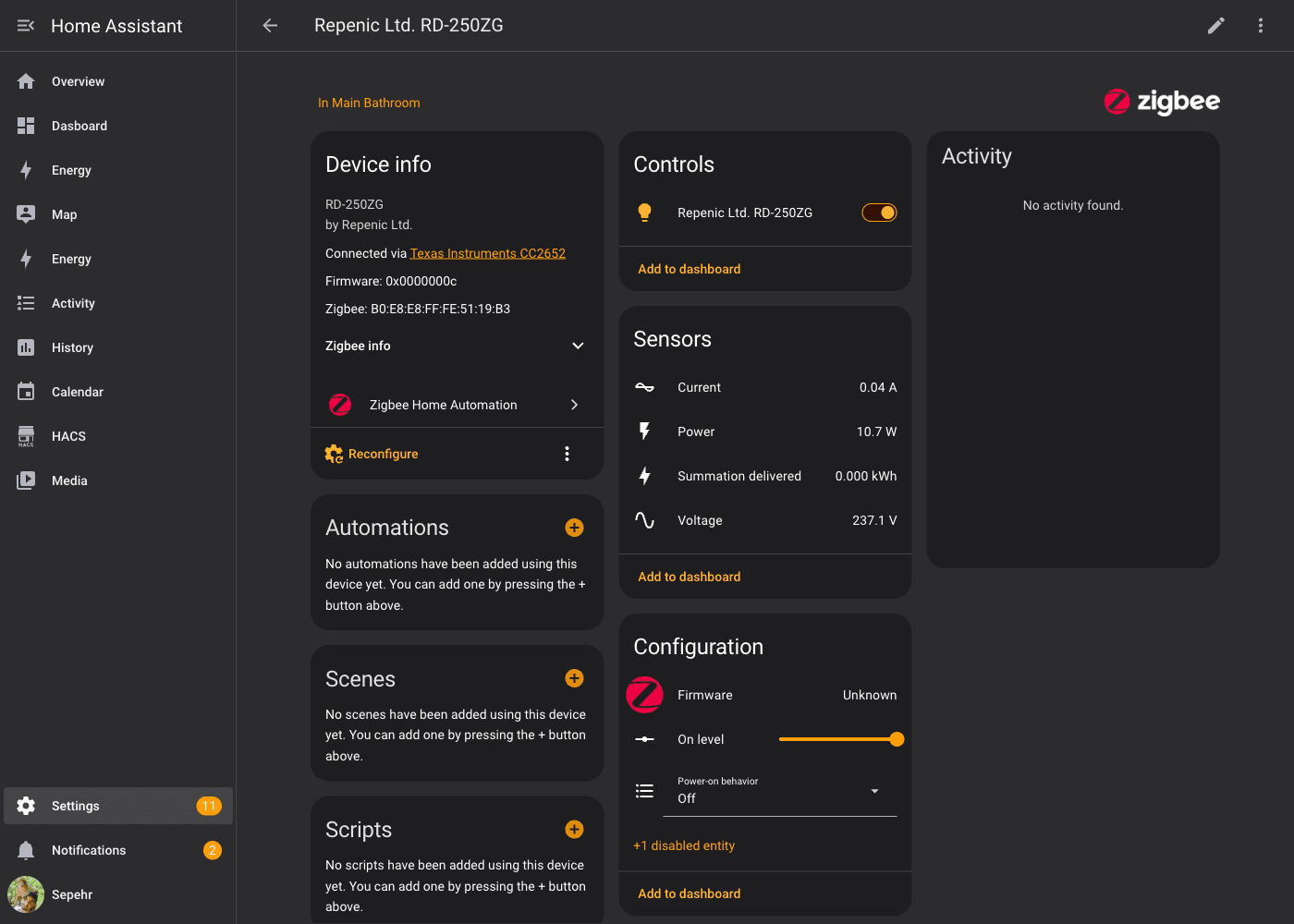
Home Assistant device page for the Repenic RD-250ZG showing Controls, Sensors and Configuration entity cards
The RD-250ZG's Home Assistant device page: a light control, four live sensors, and configuration entities including power-on behaviour.

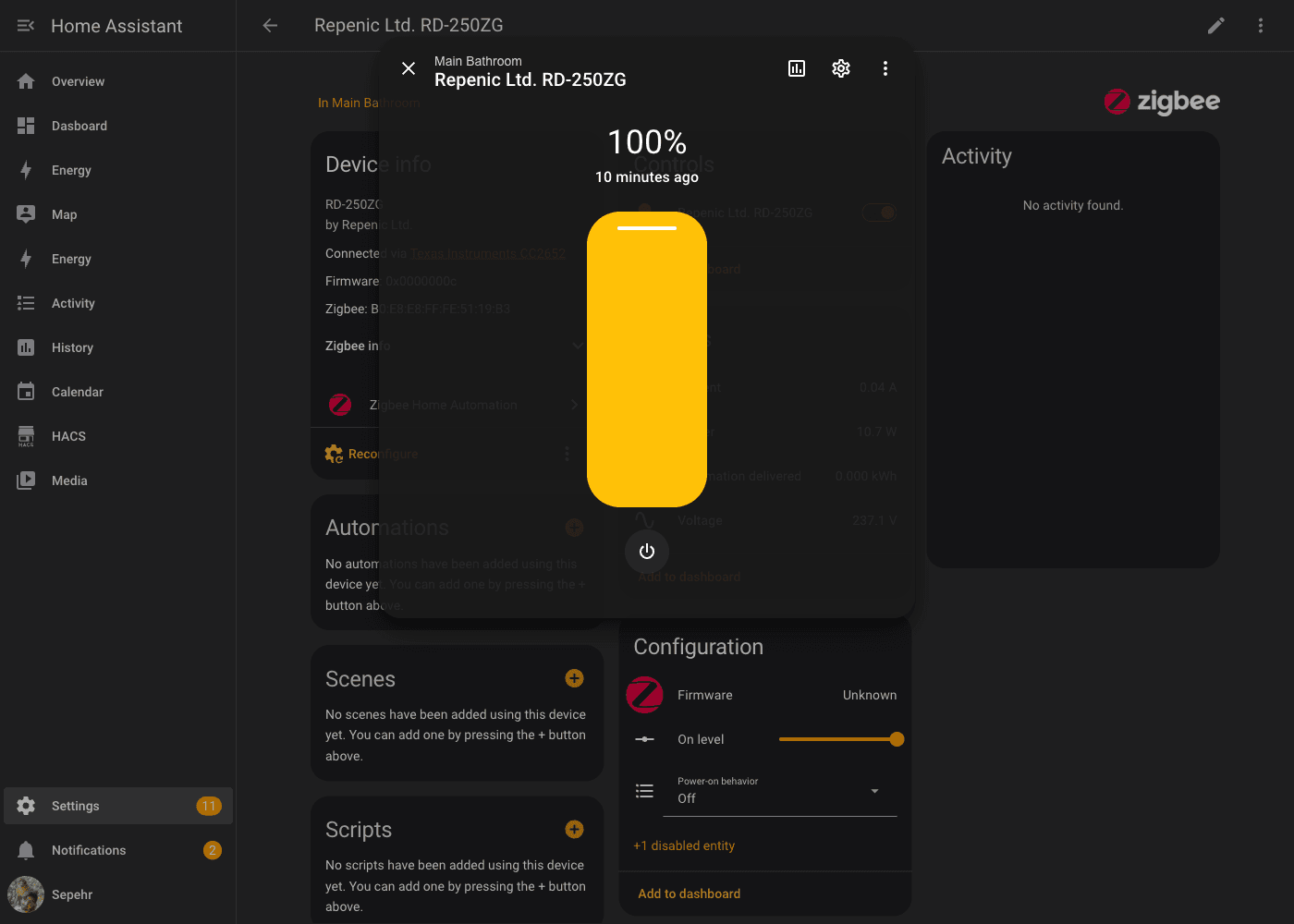
The Controls card looks like a plain on/off switch at a glance, but tapping into it opens a full brightness dialog — this is a proper dimmable light entity, not just a relay pretending to be one. With the dimmer sitting at 100% brightness, the Sensors card reported 0.04A current, 10.7W active power and 237.1V voltage, updating live as we moved the slider, plus a Summation delivered counter tracking cumulative energy in kWh for the Energy dashboard. The numbers hold together, too: 237.1V × 0.04A works out to roughly 9.5W of apparent power, close enough to the 10.7W of active power reported that the gap looks like a light load's power factor rather than a badly-calibrated sensor — a good sign the metering chip is measuring properly, not just displaying plausible-looking figures. Configuration adds an On level slider (the brightness it restores to) and a Power-on behaviour selector, set to "Off" by default so the light doesn't snap back on after a power cut.
Home Assistant more-info dialog for the dimmer showing a 100 percent brightness slider and toggle
The more-info dialog exposes a proper brightness slider, not just an on/off toggle.

This level of detail isn't an accident: the Repenic Smart Dimmer Switch's own Zigbee2MQTT device page lists brightness and light-effect control, power-on behaviour, min/max brightness limits, a boost mode, switchable dimming curve, and read-only power/voltage/current/energy monitoring as exposed features — support for the model was merged into zigbee-herdsman-converters in a pull request from March 2026, so anyone running an older Zigbee2MQTT build should update before pairing to get the full entity set. For background on choosing between the two integration paths, see our Zigbee2MQTT vs ZHA guide.

Building a Home Assistant automation with the Repenic Smart Dimmer Switch

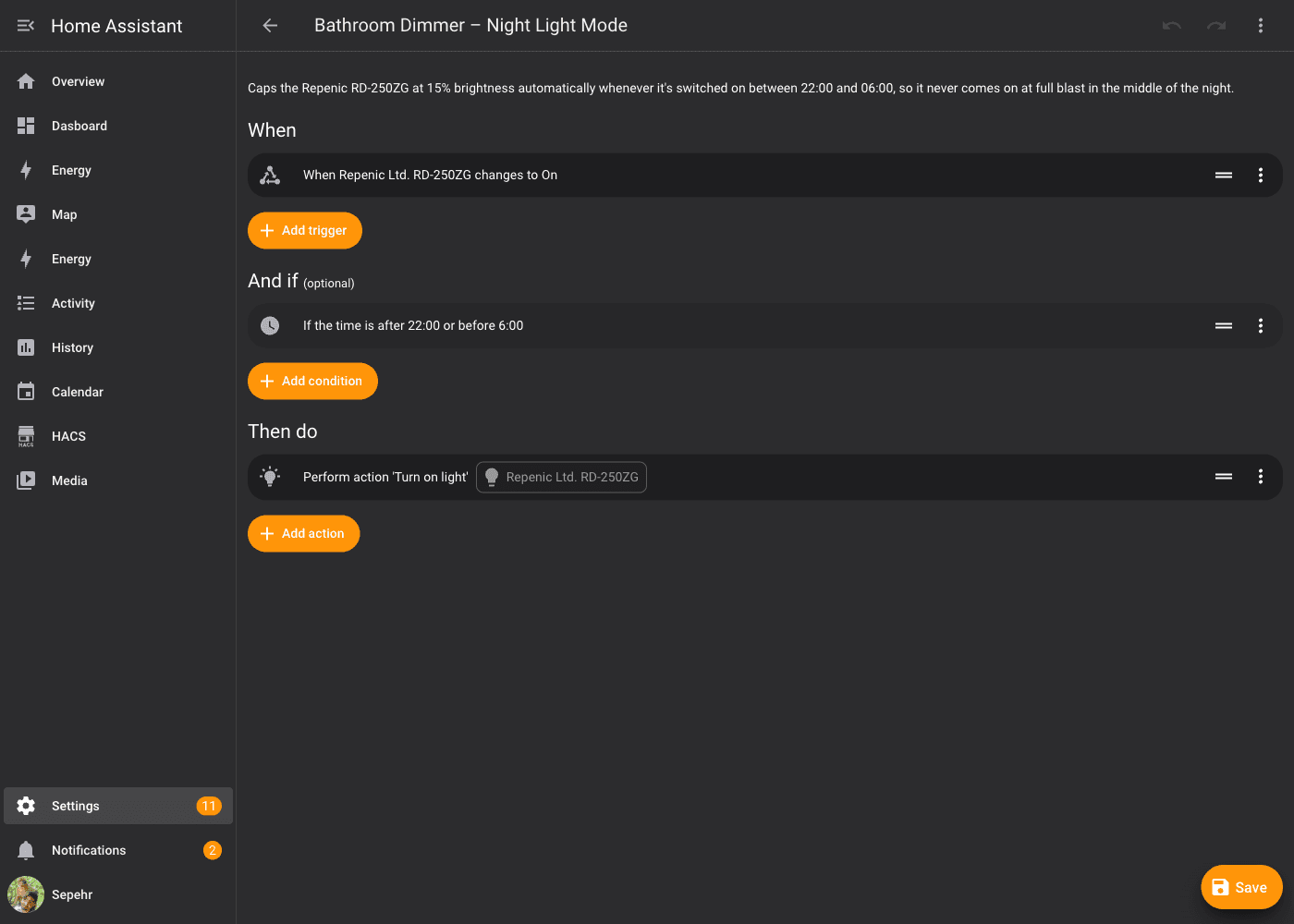
Because it's a genuine dimmable light entity with a state-change trigger available, the Repenic Smart Dimmer Switch works with Home Assistant's standard light automations rather than needing anything device-specific. As a practical example, we built a "night light mode" automation: whenever the dimmer is switched on between 22:00 and 06:00, Home Assistant immediately caps it at 15% brightness, so it never comes on at full blast in the middle of the night.
Home Assistant automation editor showing a trigger, time condition and turn-on action for the Repenic dimmer
The finished automation in Home Assistant's visual editor: a state trigger, a time condition, and a light.turn_on action with brightness_pct set.

The automation uses a state trigger watching for the light turning on, a time condition restricting it to the overnight window, and a single light.turn_on action with brightness_pct set — no templates or helpers required. Here's the YAML in full:

alias: Bathroom Dimmer – Night Light Mode
description: >-
  Caps the Repenic RD-250ZG at 15% brightness automatically whenever it's
  switched on between 22:00 and 06:00, so it never comes on at full blast in
  the middle of the night.
triggers:
  - trigger: state
    entity_id: light.repenic_ltd_rd_250zg
    to: "on"
conditions:
  - condition: time
    after: "22:00:00"
    before: "06:00:00"
actions:
  - action: light.turn_on
    target:
      entity_id: light.repenic_ltd_rd_250zg
    data:
      brightness_pct: 15
mode: single

Swap the entity ID for your own dimmer and adjust the time window and brightness_pct to taste — the same three-block pattern (state trigger, time condition, brightness action) works for any Home Assistant dimmable light, not just this one.

How does the Repenic Smart Dimmer Switch compare to the Shelly Dimmer 2 and Candeo Zigbee Dimmer Module?

It sits at the premium end of the no-neutral Zigbee dimmer field. The Shelly Dimmer 2 costs a fraction of the price at £18.99, but it's a Wi-Fi device that needs a neutral wire on most variants and no fascia of its own — it fits behind whatever switch plate you already own. The Candeo Zigbee Dimmer Module is the closer rival: a UK-designed no-neutral module at £39.99 with full Zigbee2MQTT support, rated for 200W LED/400W halogen on standard 25mm back boxes. Candeo undercuts the Repenic Smart Dimmer Switch on price and load headroom, but it's a bare module for your existing switch plate, whereas Repenic bundles the electronics with its own brushed-metal rotary fascia — you're paying partly for the finish, not just the electronics.

Who should buy the Repenic Smart Dimmer Switch?

Anyone renovating a room who wants a smart Zigbee dimmer that also looks like a considered fascia choice, not a bare module hidden behind a cheap plate — particularly in an older UK property where a missing neutral wire rules out many mainstream smart dimmers. It's a strong pick for a Home Assistant household already running ZHA or Zigbee2MQTT that wants real energy monitoring per gang rather than a basic on/off relay. It's a poor fit if you just want the cheapest possible Zigbee dimmer behind an existing plate — the Candeo module does that job for less — or if you'd rather avoid Zigbee mesh devices altogether and stick to Wi-Fi.

Verdict

The Repenic Smart Dimmer Switch earns its higher price with a genuinely complete Home Assistant entity set — brightness, live power/voltage/current, cumulative energy and configurable power-on behaviour — behind a brushed-brass fascia that needs no neutral wire to fit. The one real caveat is timing: make sure Zigbee2MQTT is updated past the March 2026 zigbee-herdsman-converters release before pairing, or ZHA users can simply add it and let auto-discovery do the work. For a UK smart-home upgrade that has to look right as well as work right, it's an easy recommendation.
Buy the picks in this guide

Recommended for Smart Lighting

See all devices →
Shop these picks on our Amazon storefront →

Frequently asked questions

Does the Repenic RD-250ZG need a neutral wire?
No. Repenic lists the RD-250ZG as working without a neutral wire, which is the single biggest reason to pick it over many mainstream Wi-Fi smart dimmers in an older UK property, where the back box behind a light switch often only has a live and switched live present. The module still needs a two- or multi-gang back box with enough depth to fit the dimmer electronics behind the fascia, so it's worth checking your box before ordering, especially for the 2-gang and larger versions. As with any dimmer install behind an existing switch plate, fitting one is notifiable electrical work under Part P of the UK Building Regulations, so unless you're confident isolating a lighting circuit and working to BS 7671 yourself, it's a job for a registered electrician rather than a pure DIY swap.
Does the Repenic RD-250ZG work with Home Assistant?
Yes, and thoroughly. It's a standard Zigbee 3.0 device, so it works through Home Assistant's built-in ZHA integration or through Zigbee2MQTT with no Repenic hub, app or cloud account required. On our test unit it was auto-discovered within seconds of joining a ZHA network and exposed a full dimmable light entity, plus live sensors for current, power, voltage and cumulative energy, alongside configuration entities for on-level (start brightness) and power-on behaviour after an outage. Support for the exact RD-250ZG model was merged into the zigbee-herdsman-converters library — the device database Zigbee2MQTT relies on — in a pull request from March 2026, so anyone running an older Zigbee2MQTT installation should update it before pairing to make sure every entity, including the power/energy sensors, actually appears.
What's the difference between the Repenic RD-250ZG and the Candeo Zigbee Dimmer Module?
Both are UK-focused, no-neutral-capable Zigbee 3.0 dimmers with full Home Assistant support, but they solve different problems. The Candeo Zigbee Dimmer Module is sold as a bare £39.99 module rated for 200W LED or 400W halogen loads, designed to sit behind whatever switch plate you already own — you keep your existing fascia and only replace the electronics. The Repenic RD-250ZG bundles the same kind of dimmer module with its own brushed-metal rotary fascia, in brass, stainless steel, matt white or matt black, at a higher from-£79 starting price. Choose Candeo if you want the cheapest way to add smart dimming behind an unchanged switch plate; choose the Repenic RD-250ZG if you're renovating and want the fascia itself to look like a deliberate, premium choice rather than a generic plastic switch.

Sources

Sources verified 2026-09-29

  1. Repenic — Zigbee Smart Dimmer Switch — Brushed Stainless Steel (1–4 Gang) product page
  2. Zigbee2MQTT — Repenic Ltd. RD-250ZG control via MQTT — supported device page
  3. Koenkk/zigbee-herdsman-converters (GitHub) — feat(device): add support for Repenic Ltd. RD-250ZG — pull request #11659
  4. Home Assistant — ZHA (Zigbee Home Automation) integration documentation
›How we researched this

Claims in this article are checked against primary sources — manufacturer specifications, official documentation, Which? research, Ofgem guidance, or gov.uk — rather than forum threads or video reviews. Where the author has direct hands-on experience with a product (most Home Assistant, Zigbee, and home-networking gear is running in his own homelab), that is stated explicitly in the text.

For categories outside that personal setup — such as boilers, heat pumps, and other areas that are traditionally a heating engineer's domain — verdicts are built from cross-referenced manufacturer data, published lab results, and vetted expert and owner reviews rather than a claim of personal hands-on testing. See the editorial policy for the full methodology.

Sepehr

Written by

Sepehr

10+ years hands-on with Home Assistant & networking · Research-backed elsewhere · No brand deals

Smart home specialist with 10+ years running a self-hosted Home Assistant setup — Zigbee2MQTT, Frigate NVR, and local-first automations. Independent coverage for UK homes, no brand deals.

LinkedIn →

Citing this page? Please use a dofollow link back to the original article — it helps us keep the data on this page accurate and up to date.

Related reading