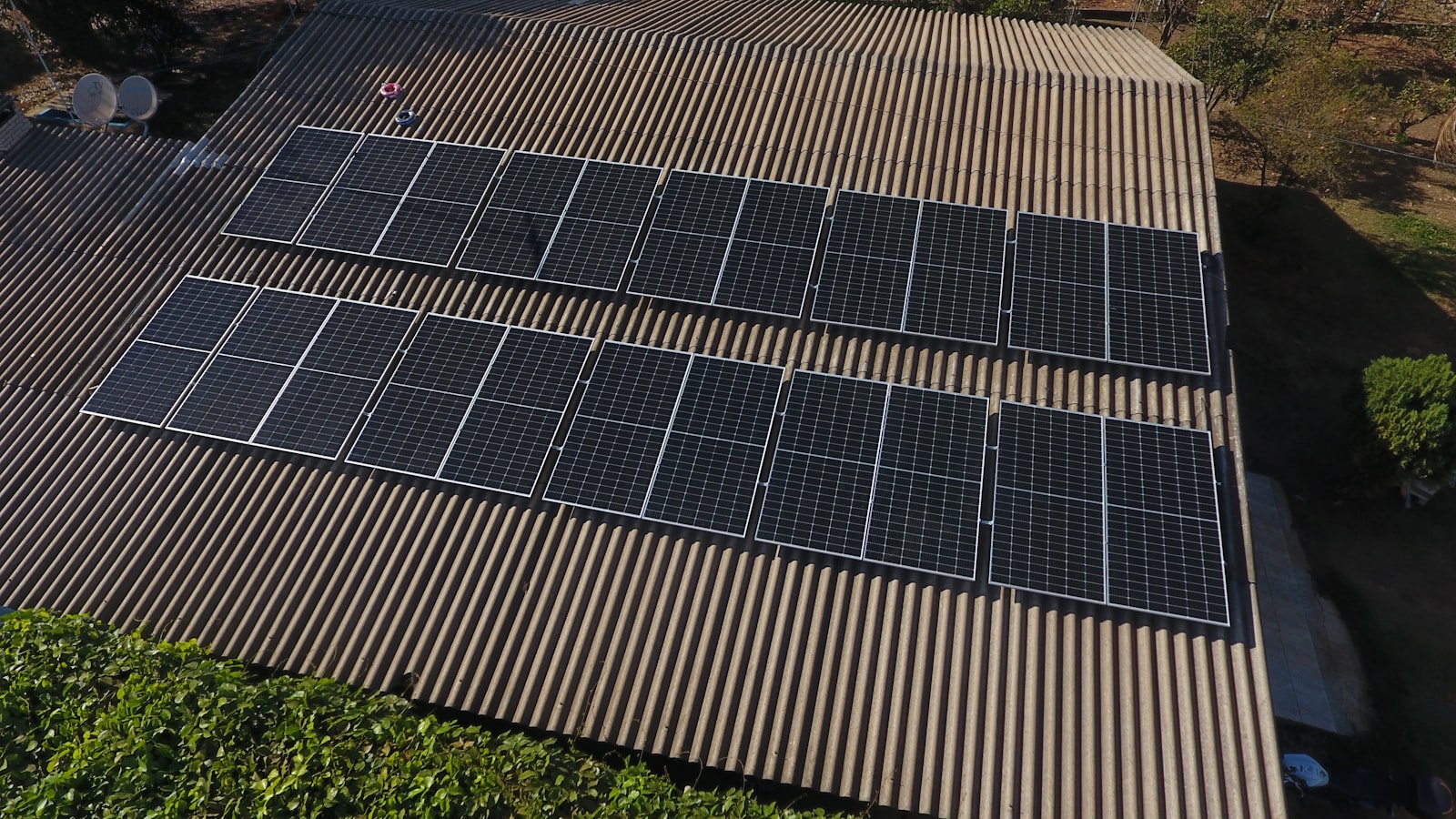
The best solar panels UK installers are fitting in 2026 are Maxeon (formerly SunPower), REC Alpha Pure-R, Trina Solar Vertex S+, JA Solar DeepBlue 4.0 Pro, Jinko Tiger Neo, and Q CELLS Q.TRON — each suited to a different roof, budget, and priority. One name that has quietly dropped off the shortlist is Panasonic EverVolt: Panasonic exited the solar and battery storage business entirely in April 2025, and MCS-certified installers no longer offer it on new quotes. This guide replaces that outdated pick, expands the lineup with verified 2026 specs, and explains which panel suits which type of UK home.
With UK electricity prices remaining elevated and the Smart Export Guarantee (SEG) paying homeowners for surplus energy exported to the grid, a well-chosen solar array can still pay for itself well within its warranty period. The problem is that panels vary enormously in efficiency, warranty terms, and price — and not every installer defaults to the best option for your roof.
⭐ Best Overall Pick
REC Alpha Pure-R
The best balance of efficiency, warranty coverage and UK installer availability. Heterojunction (HJT) cells hold output well in cloudy conditions, and it's the closest thing on the market to a direct successor for Panasonic's discontinued EverVolt line.
| Maxeon (SunPower) | REC Alpha Pure-R | Trina Vertex S+ | JA Solar DeepBlue 4.0 Pro | Jinko Tiger Neo | Q CELLS Q.TRON | |
|---|---|---|---|---|---|---|
| Efficiency | up to ~24% | 22.3% | up to 22.8% | 22.4–22.8% | up to 22% (54-cell) | ~22.5% |
| Product warranty | 40 years | 20–25 years (ProTrust) | 25 years | 25 years (varies by retailer) | 25 years | 25 years |
| Performance warranty | 40 years | 25 years, ~92% at yr 25 | 25–30 years | 30 years, ~87.4% at yr 30 | 30 years, ~87.4% at yr 30 | 25 years, ~90.6% at yr 25 |
| Cell technology | IBC (copper backed) | HJT (heterojunction) | N-type TOPCon | N-type TOPCon | N-type TOPCon | N-type TOPCon |
| Approx. UK price/panel | £280–£420 installed | £200–£330 installed | £150–£250 supplied | £80–£225 supplied | £45–£67 supplied (trade) | £170–£300 installed |
| Best for | Max output, small roof | Best all-rounder | Mid-range value | Budget-conscious | Lowest cost per watt | Premium mainstream |
Prices vary significantly by retailer, wattage and whether the figure is a supplied (trade) price or fully installed price — always get multiple MCS-certified installer quotes. See our solar panel installation cost guide for full system pricing.
What Makes a Solar Panel Good for the UK?
The UK receives significantly less direct sunlight than southern Europe, which means efficiency and low-light performance matter more here than almost anywhere else. A panel rated 22% efficiency will generate roughly a fifth more electricity from the same roof area than a panel rated 18% — valuable when you have a limited south-facing roof.
N-type vs P-type cells. Most premium panels launched since 2024 use N-type silicon (TOPCon or heterojunction/HJT), which degrades more slowly and performs better in diffuse light than older P-type PERC cells. All six panels in this guide use N-type technology except the Maxeon range, which uses its own interdigitated back contact (IBC) design.
Half-cell and multi-busbar construction splits each solar cell into smaller segments, reducing resistive losses and improving shade tolerance — useful if part of your roof is shaded by a chimney or dormer. Every panel below uses half-cell or full-cell multi-busbar layouts.
For a detailed breakdown of what a full installation costs, including scaffolding, inverters and battery storage, see our guide to solar panel installation costs in the UK.
Best Solar Panels UK: Our Top Picks
1. Maxeon (SunPower) — Best Efficiency
Efficiency: up to ~24% | Warranty: 40 years | Price: approx. £280–£420 per panel installed
Maxeon (the company that now makes the panels formerly sold under the SunPower brand) consistently tops efficiency charts. Its interdigitated back contact (IBC) cell design moves all the electrical contacts to the rear of the cell and uses a solid copper backing, which eliminates several of the degradation and cracking points found in conventional cells. The flagship Maxeon 7 reaches close to 24% module efficiency — around two percentage points ahead of most premium N-type rivals.
The standout feature is the warranty: Maxeon backs its panels with a 40-year product and performance warranty, effective from May 2026, roughly double the 20–25 years offered by most competitors. For UK homeowners with limited south-facing roof space who want the most electricity per square metre and the longest possible warranty, Maxeon remains the benchmark — but it is also the most expensive panel on this list.
2. REC Alpha Pure-R — Best All-Rounder
Efficiency: 22.3% | Warranty: up to 25 years product / performance | Price: approx. £200–£330 per panel installed
The REC Alpha Pure-R uses heterojunction (HJT) cell technology, which combines crystalline silicon with thin amorphous silicon layers to improve temperature performance and reduce degradation. REC's own datasheet lists 22.3% module efficiency and 0.25% warranted annual degradation, meaning the panel is guaranteed to retain around 92% of its original output at year 25.
REC's ProTrust programme extends coverage to 25 years across product, performance and labour warranties when installed by an REC Certified Solar Professional — worth confirming with your installer, since the standard product warranty is shorter without that accreditation. REC panels are notable for another reason: from 2021, Panasonic's now-discontinued EverVolt panels were manufactured by REC using the same HJT cell technology in the same factory, making the Alpha Pure-R the closest like-for-like replacement for anyone who was specifically shopping for EverVolt's low-light performance.
3. Trina Solar Vertex S+ — Best Mid-Range Value
Efficiency: up to 22.8% | Warranty: 15–25 years product, 25–30 years performance | Price: approx. £150–£250 per panel
Trina Solar is one of the world's largest panel manufacturers, and the Vertex S+ is its current N-type TOPCon residential range, reaching up to 22.8% module efficiency on the higher-wattage variants. UK retailer pricing for the 400W Vertex S model runs from around £152 (ex-VAT) to £182 (inc-VAT) per panel supplied, though warranty terms vary noticeably by exact model — some UK-listed variants carry a 15-year product warranty paired with a 25-year linear performance warranty, so it is worth checking the specific datasheet your installer quotes rather than assuming the longer figures quoted for other regions apply.
It is widely stocked by UK solar wholesalers and installers and delivers strong performance per pound spent, making it a sensible mid-range choice for homeowners who want N-type efficiency without paying premium-brand prices.
4. JA Solar DeepBlue 4.0 Pro — Best Budget Pick
Efficiency: 22.4–22.8% | Warranty: 25-year product / 30-year performance (terms vary by retailer) | Price: approx. £80–£225 per panel supplied
JA Solar is a Bloomberg Tier 1 manufacturer and one of the most widely installed panel brands in the UK. The DeepBlue 4.0 Pro is its current N-type TOPCon flagship, using JA Solar's Bycium+ cell technology to reach module efficiency "exceeding 22.5%" according to the manufacturer, with some higher-wattage variants listed up to 22.8%.
Warranty terms differ noticeably by UK retailer and specific model — some list a 25-year product warranty with a 30-year linear performance warranty (guaranteeing around 87.4% of output at year 30), while others advertise a shorter 12-year product warranty on older SKUs. Always confirm the exact warranty document for the specific panel your installer is quoting. On price, JA Solar is consistently one of the cheapest Tier 1 panels available through UK trade suppliers, making it a strong choice for homeowners prioritising fast payback over maximum yield per panel.
5. Jinko Tiger Neo — Lowest Cost Per Watt
Efficiency: up to 22% (mainstream 54-cell format) | Warranty: 25-year product / 30-year performance | Price: approx. £45–£67 per panel supplied (trade)
Jinko is the best-selling N-type TOPCon panel brand in the UK by installer volume. The Tiger Neo range is supplied with a 25-year product warranty and a 30-year linear power warranty guaranteeing roughly 87.4% retained output at year 30, with a claimed first-year degradation of around 1% and 0.4% annually thereafter.
UK trade pricing for the mainstream 54-cell residential format (JKM440-445N-54HL4R-B and similar) runs as low as £45–£67 per panel ex-VAT from wholesale suppliers, making it the lowest cost-per-watt panel in this guide. As with any budget-leaning pick, get your installer to confirm the exact model and datasheet, since Jinko's range spans multiple efficiency tiers.
6. Q CELLS Q.TRON — Best Premium Mainstream
Efficiency: ~22.5% | Warranty: 25-year product / 25-year performance | Price: approx. £170–£300 per panel installed
Hanwha Q CELLS' Q.TRON series uses N-type TOPCon cells with the company's Q.ANTUM NEO cell layout, reaching around 22.5% module efficiency. The 25-year performance warranty guarantees roughly 90.6% of nominal power retained at year 25, and Q CELLS backs the range with hail-impact testing to a 45mm diameter — well beyond the industry-standard test.
Q CELLS sits between the ultra-premium Maxeon/REC tier and the mainstream Chinese brands on price, making it a popular choice for homeowners who want a well-known, German-engineered brand without paying Maxeon-level prices.
How Many Solar Panels Do You Need?
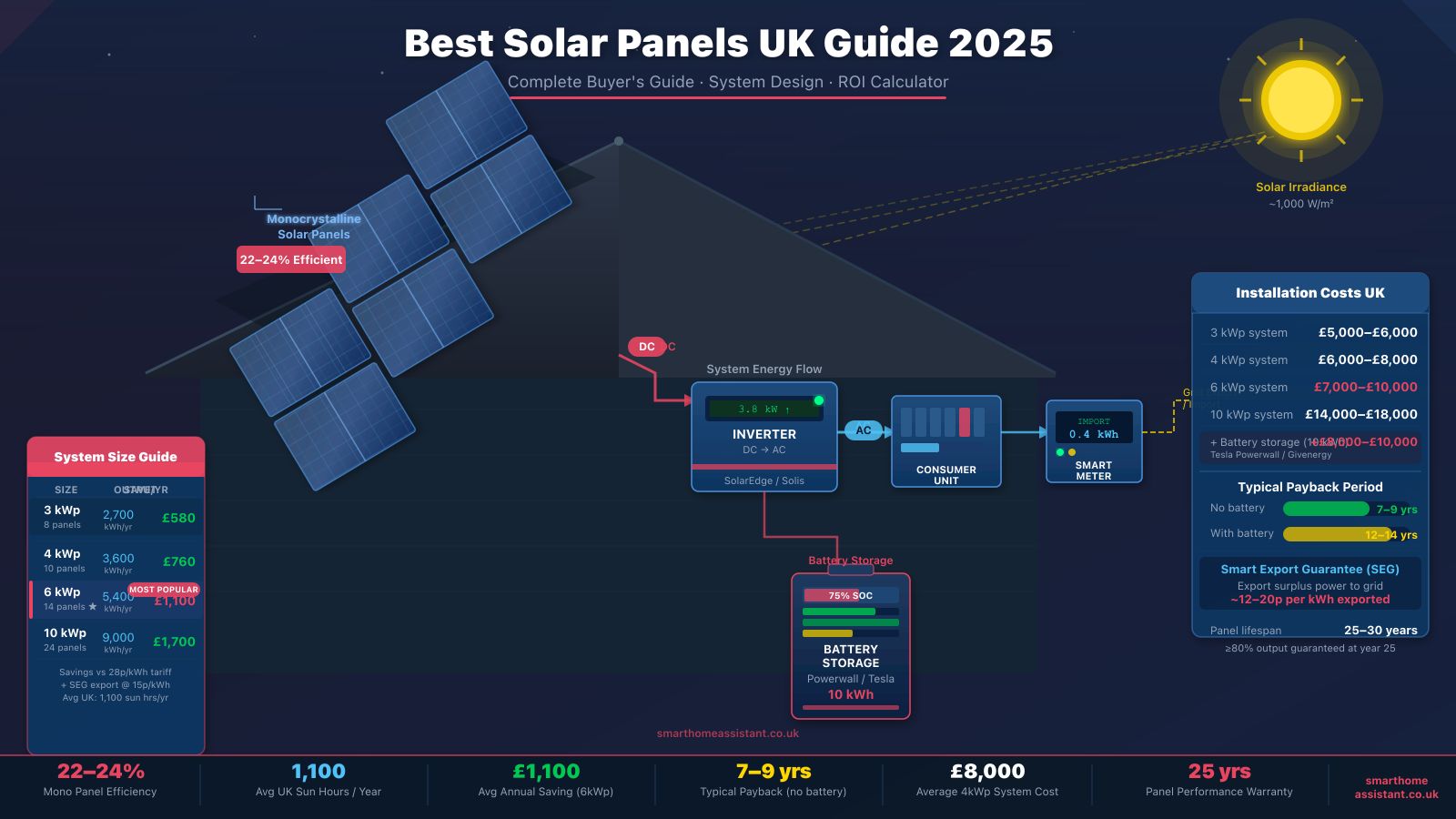
A typical three-bedroom UK home uses around 3,500–4,000 kWh of electricity per year, according to the Energy Saving Trust. With modern panels producing 400–480W each, a system of roughly 10–14 panels (4–5.5 kWp) is enough to cover a substantial share of that usage for most south-facing roofs, though the right number depends heavily on roof orientation, pitch, shading and your household's actual consumption pattern.
Higher-efficiency panels such as Maxeon or REC Alpha Pure-R let you hit a given kWp target with fewer panels — useful on a smaller roof or one with dormers, chimneys or roof windows eating into usable space. Budget-oriented panels such as Jinko Tiger Neo or JA Solar DeepBlue 4.0 Pro cost less per panel but may require slightly more roof area for the same output. The Energy Saving Trust recommends getting at least three quotes from MCS-certified installers, each of whom should size your system based on a site survey rather than a generic rule of thumb.
Degradation and Long-Term Output
All solar panels lose a small amount of output every year — this is normal and is what the performance warranty figures in the comparison table above actually guarantee. Older P-type PERC panels typically degrade by around 0.5–0.7% annually after an initial first-year drop of 1–2%. The N-type TOPCon and HJT panels that dominate this guide's lineup degrade more slowly: Jinko, for example, states around 1% first-year degradation followed by roughly 0.4% annually, and REC's Alpha Pure-R is warranted at 0.25% annual degradation — both notably better than older cell technology.
In practical terms, a panel warranted to retain 87–92% of its original output at year 25–30 will still be generating meaningful electricity well beyond its warranty period; panels rarely fail outright, they simply produce gradually less. This is worth weighing against price: a cheaper panel with a slightly higher degradation rate may still work out better value over a 25-year horizon than paying a large premium for marginally slower degradation, unless roof space is genuinely constrained.
Key Certifications to Look For
Before accepting any panel from an installer, confirm it carries both IEC 61215 (design qualification and type approval) and IEC 61730 (safety qualification) — the minimum international standards for PV modules. For MCS-certified installations, which are required to access the Smart Export Guarantee, panels must also appear on the official MCS product list. You can search approved products and find MCS-certified installers on the MCS website.
MCS certification also matters for buildings insurance and, if you ever sell your home, for mortgage lenders who increasingly ask to see MCS paperwork before completing a sale on a property with solar panels. Ask your installer for the MCS certificate, the panel and inverter datasheets, and the Deemed Export or SEG meter-reading confirmation as part of your handover pack — these documents are far easier to request at installation time than to chase down years later.
How to Choose: Quick Decision Guide
Limited roof space? Prioritise efficiency. Maxeon or REC Alpha Pure-R will generate more from fewer square metres.
Overcast or partially shaded roof? REC's HJT cells and the N-type TOPCon panels from Trina, JA Solar, Jinko and Q CELLS all hold output better in diffuse light than older PERC designs.
Maximising budget? Jinko Tiger Neo or JA Solar DeepBlue 4.0 Pro offer the lowest cost per watt while still meeting Tier 1 quality benchmarks.
Long-term peace of mind? Maxeon's 40-year warranty is unmatched; REC, Trina, JA Solar, Jinko and Q CELLS all offer solid 25–30-year performance coverage, though exact product-warranty lengths vary by specific model — always check the datasheet.
Whichever panel you choose, pairing it with a home battery meaningfully changes the economics — see our guide to solar battery storage in the UK for current pricing and payback estimates.
Pairing Solar Panels with a Smart Home
Modern solar arrays work best when integrated with a home energy management system. If you run Home Assistant, you can monitor your solar generation, battery state, and grid import/export in real time, and use that data to automatically shift high-draw appliances to your sunniest hours. Our guide to Home Assistant solar monitoring walks through the best integrations for UK inverter brands including SolarEdge, Solis, and Fronius, plus hardware options like the Shelly EM for CT-clamp measurement.
If you want to go further and automate your whole-home energy use — shifting dishwasher and washing machine cycles to solar generation peaks, or scheduling an EV charger around your export tariff — see our Home Assistant energy monitoring guide for UK setups. This smart-home layer is what turns a solar array from a passive generator into an actively managed part of your home — and it is the piece most generic solar-install guides skip entirely.
The Smart Export Guarantee in 2026
Since the Feed-in Tariff closed to new applicants in 2019, the Smart Export Guarantee (SEG) is the scheme requiring energy suppliers with 150,000-plus customers to pay UK homeowners for surplus solar electricity exported to the grid. Rates are set by individual suppliers rather than government, and vary widely: as of mid-2026, the best available fixed SEG rate is around 15p per kWh (offered by suppliers including Octopus Energy Outgoing, OVO and E.ON Next), while flat-rate deals such as Good Energy's Solar Savings Exclusive pay around 25p per kWh with no battery required. Time-of-export tariffs paired with a home battery, such as Octopus Intelligent Flux, can pay significantly more — up to around 32p per kWh — at peak grid-demand periods. Average households on an export tariff earned around 13p per kWh in 2024–25.
To qualify for any SEG tariff, your installation must be MCS-certified and your panels must appear on the MCS approved product list. Use the Ofgem Smart Export Guarantee overview to check which suppliers must offer you a tariff, and compare current rates before signing up with your installer's default option — the difference between the cheapest and most generous SEG tariff can be worth well over £100 a year on a typical 4kWp system.