Do any ceiling fans sold in the UK come with built-in Wi-Fi control?
No — not from any retailer that ships to UK addresses with UK pricing and warranty support. Fantasia, the UK's most established ceiling-fan brand and a regular stock item at Screwfix and specialist fan retailers, sells its M3 Remote Control System as the standard control layer across its Mayfair, Capri, Gemini and Belaire ranges — three fan speeds plus light dimming and a timer, entirely over RF, with no app, Alexa or Google Home support mentioned anywhere in its documentation. Budget models such as the MiniSun ranges commonly found on Amazon UK follow the same pattern: a bundled remote, no smartphone app. Genuinely Wi-Fi-native fans from Westinghouse Lighting, Carro, Modern Forms and Big Ass Fans' Haiku line do exist and do support Alexa, Google Home and (for Haiku) Matter/HomeKit — but every one of them is sold through US storefronts, and the only UK access found is via cross-border resellers like Ubuy, without a confirmed UK price or standard warranty. Dyson is worth ruling out explicitly too: Dyson has never made a ceiling-mounted fan — its Cool and Purifier ranges are floor and pedestal units, so a "Dyson ceiling fan" listing is not a genuine Dyson product.
How do you add Alexa, Google Home or Home Assistant control to an existing fan?
You retrofit the control layer rather than replacing the fan. There are three practical approaches, and which one fits depends on whether you want full speed control, local (cloud-free) operation, or the simplest possible install.
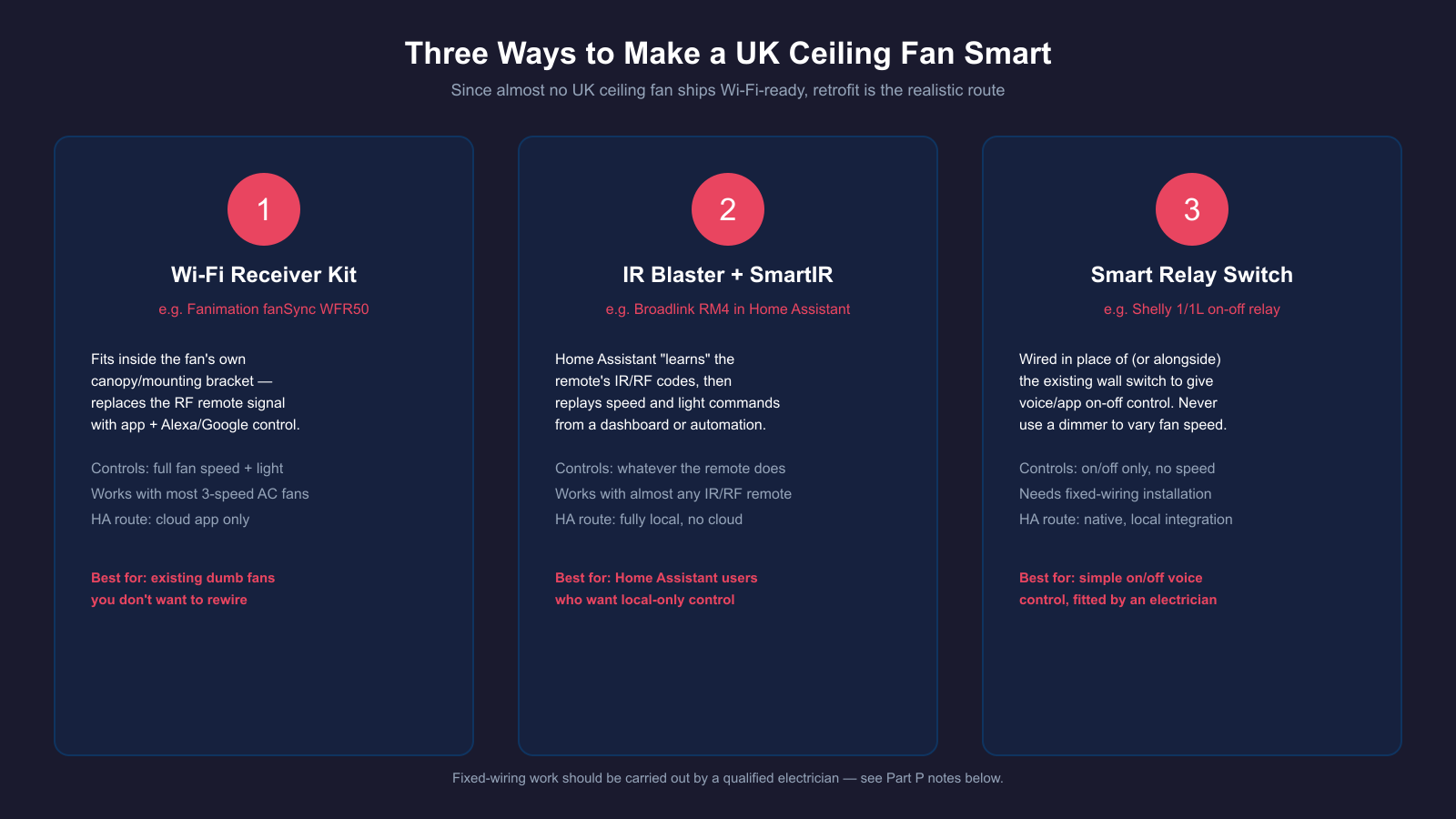
A universal Wi-Fi receiver kit — the best-documented example is Fanimation's fanSync WFR50 — fits inside the fan's existing canopy or mounting bracket and intercepts the same signal path the remote used, adding app and voice control without any rewiring of the motor itself. It's designed to work with most three-speed AC ceiling fans regardless of brand, which makes it the least invasive option for a fan you like and don't want to replace. The trade-off is that these kits are US-centric products, so check the voltage rating and UK plug/wiring compatibility of any specific SKU before buying.
An IR blaster paired with Home Assistant is the option most home-automation enthusiasts land on, because Home Assistant already has a native fan entity type (on/off, speed percentage, oscillation, presets) waiting to be filled. A Broadlink RM4 or similar IR/RF blaster "learns" the exact codes your existing remote sends for each speed and the light, then the community SmartIR integration lets Home Assistant replay them from a dashboard or an automation — entirely locally, with no cloud dependency. This is the option we'd point most Home Assistant users already comfortable with smart switches toward, since it reuses infrastructure most already have.
A smart relay switch, such as a Shelly 1 or 1L, wired in place of (or alongside) the existing wall control, gives simple on/off voice and app control. It cannot vary fan speed on its own — Shelly's own support documentation is explicit that a plain relay switches the fan on or off only, and getting discrete speed control usually means wiring it to trigger the fan's own remote receiver rather than the motor directly. Tuya-based all-in-one fan-and-light switches (marketed under names like MOES and Meross) do offer full speed control through an app, but the specific units checked for this guide — including Meross's MFC100HK — are explicitly built and rated for US/Canada 110–120V wiring, not the UK's 230V supply, so don't assume a UK-safe variant exists without checking the exact product page first.
Can you use a smart dimmer to control ceiling fan speed?
No — don't fit a standard lighting dimmer to a fan motor. A fan motor is an inductive load, not the resistive or LED load a dimmer like a Fibaro Dimmer 2 is designed for, and installer discussion on Fibaro's own community forum confirms that dimming a fan this way risks overheating and burning out the motor over time, especially if the fan and a light are wired through the same dimmed channel. If you want variable speed from a retrofit, use one of the three methods above instead: a purpose-built Wi-Fi receiver kit, an IR-code-replay setup, or a Tuya fan-and-light switch confirmed as UK/230V rated — never a generic light dimmer.
Do you need an electrician to fit a smart fan switch in the UK?
For a bathroom or other wet-zone extractor-style ceiling fan, yes: this is fixed-wiring alteration work, and UK bathroom electrical guidance under Part P and BS 7671 zone rules requires notifiable work to be carried out or certified by a registered electrician, with switches either sited outside the room or operated by an insulated pull cord. For a living-room or bedroom ceiling fan in a dry area, the Part P notification threshold is generally lower, but you're still working with fixed 230V wiring rather than a plug-in appliance — UK ceiling fans wire into a ceiling rose and switch plate, they don't plug into a socket, so the common "just add a smart plug" advice used for lamps and heaters doesn't apply here. Given the motor-damage risk of getting the wiring wrong (see above), having a qualified electrician fit or check any in-wall smart fan switch is the safer default even where it isn't strictly mandatory.
Why has demand for cooling and fans risen in the UK?
UK search interest in fans generally has climbed sharply through 2026's heatwaves, which is useful context even though it isn't ceiling-fan-specific data. Cumulative UK search interest for mini and portable fans in the first half of 2026 had already passed the full-year total of any previous year on record, with one retail analytics report tracking a 456% year-on-year jump in June "mini fan" searches and an estimated 7.9 million mini fans forecast to sell in the UK across 2026. Separate retailer data recorded "fan" search terms up over 1,000% and air conditioning searches up over 4,000% year-on-year across the same June–July heatwave window. None of this confirms ceiling-fan-specific sales, but it shows UK households are actively looking for cooling options — and a retrofitted ceiling fan, run from an automation that switches it on when a temperature sensor crosses a threshold, is one of the cheaper ways to answer that demand compared with buying a dedicated air conditioning unit.
| Retrofit method | Controls | Home Assistant route | Installation |
|---|---|---|---|
| Wi-Fi receiver kit (e.g. Fanimation fanSync) | Full speed + light | Cloud app only | Fits inside existing fan canopy |
| IR blaster + SmartIR | Whatever the remote does | Fully local | No fan rewiring; blaster placed in room |
| Smart relay switch (e.g. Shelly 1/1L) | On/off only | Native, local | Fixed wiring — electrician recommended |
Whichever route you choose, verify the specific product's UK voltage rating before buying, and treat any fixed-wiring installation as a job for a qualified electrician rather than a weekend DIY project — the motor-damage and Part P risks above apply regardless of how straightforward the listing makes it look.