
Smart Home Assistant

Best Temperature and Humidity Sensor UK (2026): 4 Picks for Home Assistant

SepehrBy Sepehr· 26 September 2026· Updated 26 September 2026· 6 min read
✓ Independent — no paid placements✓ UK-tested in real homes✓ Cited sources
Close-up of a vintage hygrometer dial with a black needle pointing across the humidity percentage scale

Key takeaways

  • The Aqara T1 is our best temperature and humidity sensor UK pick, at £15.98 with Zigbee 3.0 and a two-year CR2032 battery.
  • The SONOFF SNZB-02D adds an LCD screen to a Zigbee sensor, but one review found humidity readings about 5% out until calibrated.
  • The SwitchBot Indoor/Outdoor sensor is IP65-rated at £14.99, and Home Assistant supports it over Bluetooth without a SwitchBot Hub.
  • The Shelly H&T Gen3 costs £36.40, uses Wi-Fi and four AA batteries for about a year, and is specified for 0°C to 40°C.
On this page[tap to expand]

The best temperature and humidity sensor UK smart homes can buy for most rooms is the Aqara T1: a Zigbee sensor with a Sensirion element that reports temperature, humidity and pressure for about £16. Pick the SONOFF SNZB-02D for a built-in display, or the SwitchBot Indoor/Outdoor Thermo-Hygrometer for outdoors.

A good sensor tells you why a room feels damp before mould appears, and gives Home Assistant a trigger for heating, fans and dehumidifiers. This roundup compares four battery-powered sensors on how they connect, what they measure and how they reach Home Assistant, using each maker's specification pages, the integration docs and independent reviews.

ModelBest forPrice bandConnectionPower
Aqara Temperature and Humidity Sensor T1Overall, most rooms£ (£15.98 at Aqara UK Shop)Zigbee 3.0CR2032, about 2 years
SONOFF SNZB-02DZigbee with a built-in display£ (about €16 in Europe)Zigbee 3.0CR2450, about 2 years
SwitchBot Indoor/Outdoor Thermo-HygrometerOutdoors, greenhouses, fridges£ (£14.99)Bluetooth2 x AAA, up to 2 years
Shelly H&T Gen3Wi-Fi with no hub or dongle££ (£36.40 at The Pi Hut)Wi-Fi, Bluetooth4 x AA, about 1 year
Buy the picks in this guide

Recommended for Home Automation

See all devices →

How we chose these sensors

We ranked sensors by how easily they reach Home Assistant without a cloud account, then by accuracy, battery life and price. Every pick here has a documented Home Assistant or Zigbee2MQTT route. We left out Wi-Fi sensors that only work through a manufacturer cloud, and anything that needs a proprietary hub to be useful, because a cheap sensor stops being cheap once you buy a bridge for it.

We also did not lab-test accuracy ourselves. The accuracy figures below are manufacturer claims, and where an independent reviewer measured a sensor against a reference we say so. If you want a room-by-room picture of air quality rather than just temperature and humidity, see our indoor air quality monitor roundup.

The best temperature and humidity sensors for UK homes

1. Aqara Temperature and Humidity Sensor T1 — best overall

Who it's for: anyone building a Zigbee network who wants a small, cheap sensor for every room. Aqara lists Zigbee 3.0, a CR2032 coin cell with roughly two years of life, accuracy of ±0.3°C and ±3% RH, and an operating range of -20°C to 50°C. It also measures air pressure, which is handy for a simple weather trend in a dashboard.

Zigbee2MQTT supports the T1 (model WSDCGQ12LM), exposing temperature, humidity, pressure, battery and voltage, with calibration offsets and adjustable decimal precision. The catch: Aqara's own shop page says the sensor needs an Aqara hub, which is true for the Aqara app, but with a Zigbee coordinator running Zigbee2MQTT or ZHA you do not need one. Zigbee2MQTT's notes warn that Xiaomi and Aqara devices can drop off if the link quality is poor or the parent router is incompatible, so place a mains-powered Zigbee router nearby. Our Zigbee stick roundup covers the coordinator side.

View at Aqara UK Shop

2. SONOFF SNZB-02D — best Zigbee sensor with a display

Who it's for: anyone who wants to glance at a reading on the wall without opening an app, for a nursery, spare room or cellar. It has an LCD showing temperature, humidity, battery and comfort icons, runs on a CR2450 cell, and SONOFF quotes ±0.2°C and ±2% RH accuracy.

The raspberry.tips review found readings only a few tenths of a degree off calibrated reference sensors, with humidity about 5% out, which you can correct with the calibration setting in either ZHA or Zigbee2MQTT. It reports on a change of 0.2°C or 5% RH, and at least every 30 minutes, and worked with both platforms without extra quirks. The catch: the reviewer noted the display is hard to read from the side, and that the sensor occasionally stops updating in Home Assistant until it is re-paired. It sells for about €16 in Europe, so check current UK retailer pricing.

View at SONOFF

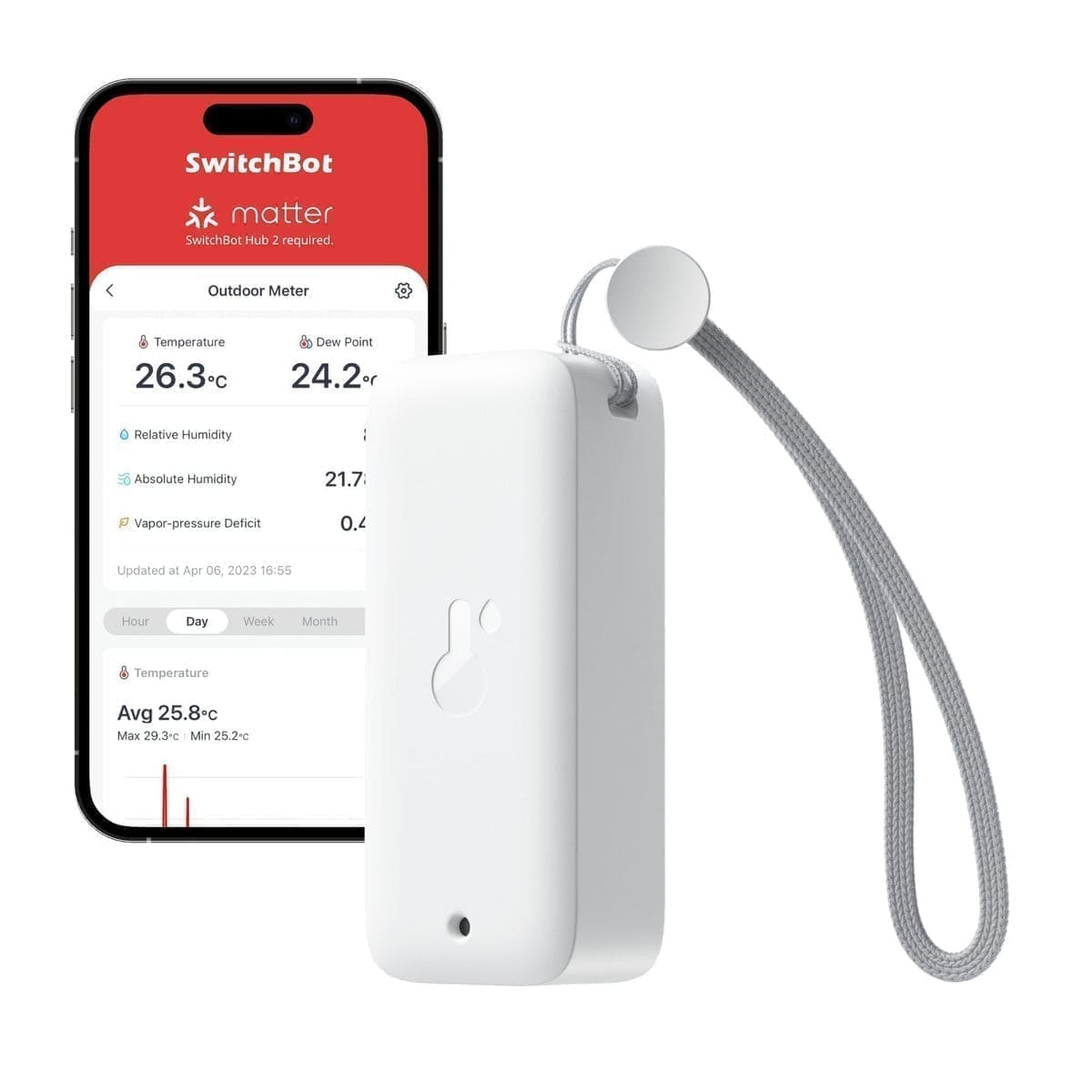
3. SwitchBot Indoor/Outdoor Thermo-Hygrometer — best for outdoors

Who it's for: greenhouses, sheds, garden walls and fridges, where a coin-cell Zigbee sensor would struggle. It is IP65 dust and waterproof, uses two AAA batteries for up to two years, and quotes ±0.2°C and ±1.8% RH. Mighty Gadget lists it at £14.99, with a Bluetooth range of 100 metres in the open.

Home Assistant's SwitchBot integration lists the Indoor/Outdoor Meter among the supported Bluetooth devices and states that a SwitchBot Hub is not required. Mighty Gadget notes the meter stores 68 days of data locally, and that cloud history and push alerts need a hub. The catch: Bluetooth only reaches your server if Home Assistant has a working Bluetooth adapter or a nearby Bluetooth proxy, so check the range from the mounting spot before you commit. Outdoors, standard alkaline cells will struggle in a hard frost, and the reviewer had not tested a winter.
View at SwitchBot UK

Editor’s PickSwitchBot Indoor/Outdoor Thermo-Hygrometer (Outdoor Meter)
SwitchBotSwitchBot Indoor/Outdoor Thermo-Hygrometer (Outdoor Meter)✓ Local control, no cloud required★ 4.3 (10,119)£15at Amazon UKCheck price at Amazon UK →

4. Shelly H&T Gen3 — best Wi-Fi sensor with no hub

Who it's for: homes without a Zigbee network or a Bluetooth adapter that still want a good-looking display. It connects over Wi-Fi (802.11 b/g/n) and Bluetooth 4.2, has an e-paper screen with a clock, and takes four AA batteries for about a year. The Pi Hut lists it at £36.40, and Shelly's documentation covers Home Assistant through the Shelly integration.

The catch: it is the priciest of the four, and it is specified for 0°C to 40°C, so it is an indoor sensor. Home Assistant's docs explain that battery-powered Shelly devices spend most of their time asleep, so you must wake one with its button during setup, and firmware updates cannot be triggered from Home Assistant while it sleeps. A USB-C port can power the sensor continuously but does not charge the batteries.

View at The Pi Hut

Which connection is best for Home Assistant: Zigbee, Bluetooth or Wi-Fi?

Zigbee is the best choice if you already run a coordinator, because the sensors are cheap, sleep most of the time and sip power. Each Zigbee sensor also strengthens the mesh only if it routes, which coin-cell sensors do not, so add a mains-powered plug or bulb to keep them connected. If you have no coordinator yet, our Zigbee2MQTT vs ZHA comparison explains the two software routes.

Bluetooth is the cheapest way in when Home Assistant already has a Bluetooth adapter, but the range is limited by walls, so plan a proxy for anything beyond one floor. Wi-Fi needs no extra hardware, but battery Wi-Fi sensors drain faster, which is why the Shelly is quoted at one year against two for the others.

Where should you put a temperature and humidity sensor?

Put it at head height on an internal wall, away from windows, radiators, direct sun and kettles, because all of these skew a reading. In a bathroom, place it outside the shower's direct spray, and for damp problems place one in the coldest corner of the room, where condensation forms first. Then let Home Assistant do the work: trigger an extractor fan or a smart dehumidifier above a humidity threshold, and pair the readings with a humidifier in dry winter bedrooms. For heating, a room sensor can also feed a smart radiator valve setup instead of relying on the valve's own reading.

Who should skip a standalone sensor?

Skip it if you already own devices that report the same readings. Many Zigbee motion sensors, presence sensors and air quality monitors include temperature and humidity, so a dedicated sensor adds little in those rooms. Also skip cheap sensors for anything safety-critical, such as vulnerable-person monitoring or frost protection for a boiler, and use a certified device for those jobs.

Frequently asked questions

What is the best temperature and humidity sensor UK homeowners can use with Home Assistant?
The best temperature and humidity sensor UK homeowners can use with Home Assistant is the Aqara T1 for most rooms. It costs £15.98 at the Aqara UK Shop, uses Zigbee 3.0, runs on one CR2032 coin cell for roughly two years and is supported by Zigbee2MQTT. If you want a screen on the sensor itself, the SONOFF SNZB-02D is the better Zigbee choice, and the SwitchBot Indoor/Outdoor model is better outdoors. The caveat is that Zigbee sensors need a coordinator such as a USB stick, so if you have no Zigbee network, a Bluetooth SwitchBot or a Wi-Fi Shelly H&T Gen3 is the easier way to start, though the Shelly costs more.
Do I need a hub for a smart temperature and humidity sensor?
You do not need a manufacturer hub if you use Home Assistant. Zigbee sensors like the Aqara T1 and SONOFF SNZB-02D pair directly with a Zigbee coordinator running ZHA or Zigbee2MQTT, even though Aqara's shop page says an Aqara hub is required for its own app. Home Assistant's SwitchBot documentation states that a SwitchBot Hub is not required for Bluetooth meters, and the Shelly H&T Gen3 connects over Wi-Fi. The caveat is that something must still bridge the radio: a Zigbee stick, a Bluetooth adapter or proxy, or your Wi-Fi network. SwitchBot's own cloud history and push notifications do need a SwitchBot Hub, but Home Assistant records its own history anyway.
How accurate are cheap smart temperature and humidity sensors?
Cheap sensors are usually accurate enough for comfort and damp monitoring, but not for anything precise. The Aqara T1 claims ±0.3°C and ±3% RH, SONOFF quotes ±0.2°C and ±2% RH, and SwitchBot quotes ±0.2°C and ±1.8% RH. Those are manufacturer claims. In independent testing, raspberry.tips found the SNZB-02D within a few tenths of a degree of calibrated reference sensors, but around 5% out on humidity. The practical fix is to compare each sensor against a trusted thermo-hygrometer and enter a calibration offset in Home Assistant, ZHA or Zigbee2MQTT. Humidity readings drift with age and exposure, so recheck them occasionally rather than trusting them for years.

Sources

Sources verified 2026-09-26

  1. Aqara — Aqara Temperature and Humidity Sensor T1 (UK Shop)
  2. Zigbee2MQTT — Aqara WSDCGQ12LM (T1) device page
  3. SONOFF — SONOFF SNZB-02D Zigbee LCD Smart Temperature Humidity Sensor
  4. Zigbee2MQTT — SONOFF SNZB-02D device page
  5. raspberry.tips — Sonoff SNZB-02D & SNZB-02WD Review
  6. Mighty Gadget — SwitchBot Indoor/Outdoor Thermo-Hygrometer Review
  7. Home Assistant — SwitchBot integration
  8. The Pi Hut — Shelly H&T Gen3
  9. Home Assistant — Shelly integration
›How we researched this

Claims in this article are checked against primary sources — manufacturer specifications, official documentation, Which? research, Ofgem guidance, or gov.uk — rather than forum threads or video reviews. Where the author has direct hands-on experience with a product (most Home Assistant, Zigbee, and home-networking gear is running in his own homelab), that is stated explicitly in the text.

For categories outside that personal setup — such as boilers, heat pumps, and other areas that are traditionally a heating engineer's domain — verdicts are built from cross-referenced manufacturer data, published lab results, and vetted expert and owner reviews rather than a claim of personal hands-on testing. See the editorial policy for the full methodology.

Sepehr

Written by

Sepehr

10+ years hands-on with Home Assistant & networking · Research-backed elsewhere · No brand deals

Smart home specialist with 10+ years running a self-hosted Home Assistant setup — Zigbee2MQTT, Frigate NVR, and local-first automations. Independent coverage for UK homes, no brand deals.

LinkedIn →

Citing this page? Please use a dofollow link back to the original article — it helps us keep the data on this page accurate and up to date.

Related reading