What actually changed on 27 August 2026?
Until this date, UK law effectively banned plug-in solar: the British plug and socket standard, BS 1363, didn't permit a standard 13A plug to carry power out from a generating device, and separate electrical safety regulations required any grid-connected generator to comply with the full BS 7671 wiring regulations — a bar that assumes a qualified installer. Two statutory instruments remove those blockers. SI 2026/848 amends the Plugs and Sockets etc. (Safety) Regulations 1994 and the Electricity Safety, Quality and Continuity Regulations 2002, so a compliant plug-in microgenerator can use a standard plug and follow a new Plug-in Solar Device Interim Product Specification instead of BS 7671. SI 2026/896 separately amends permitted development rules in England so most balcony, wall and garden installations no longer need planning permission. Both came into force on 27 August 2026, following a government consultation that closed on 30 June 2026.
Do plug-in solar panels need planning permission?
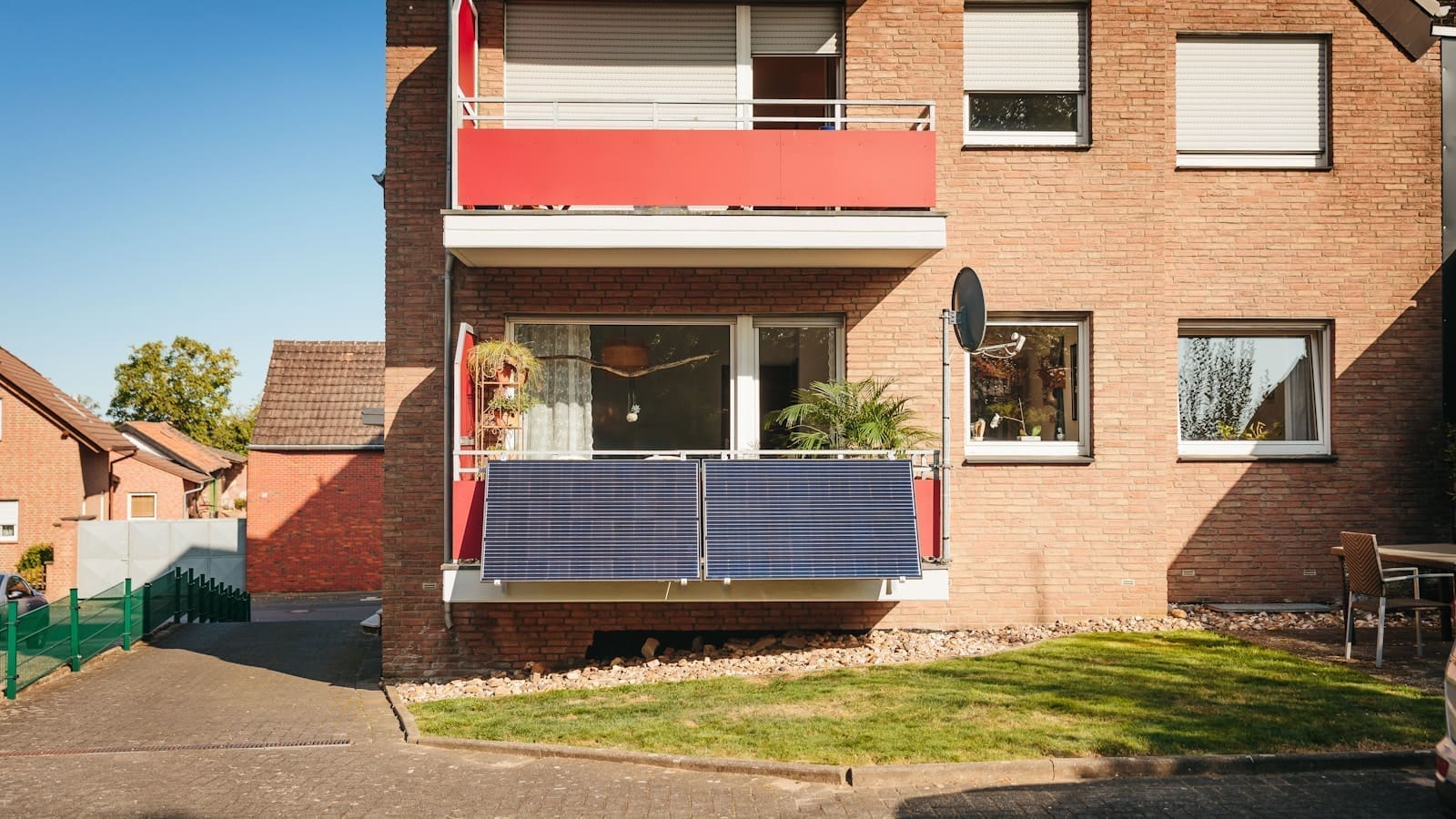
In most cases, no — as of 27 August 2026, plug-in solar became permitted development in England, meaning you can install one without applying to your local council. Balcony-mounted panels are covered as long as the balcony structure itself isn't timber. For houses, wall-mounted panels can now protrude further from the wall than before (0.4m on non-road-facing walls, 0.2m on walls facing a road), and garden panels can be sited closer to boundaries than the old 5-metre rule, subject to height limits. Permission is still required if your property is listed, in a conservation area facing a road, within a National Park, the Broads or a World Heritage Site, or if the panel would be fixed to a timber-clad wall, fence or gate.
What's the power limit for plug-in solar in the UK?
The legal cap is 800 watts of rated AC output per property — that's the ceiling written into SI 2026/848's amendment to the electricity safety regulations. A compliant kit also needs an approved plug and must meet the government's Interim Product Specification (version 2), which covers fire performance, cable design and electrical safety, not just wattage. Crucially, the specification only covers plug-in solar generation — the government has explicitly excluded plug-in battery storage from this route, stating it does not extend to other plug-in technologies, such as plug-in batteries, because they raise safety questions that haven't yet been assessed.
| Rule | Detail |
|---|---|
| Effective date | 27 August 2026 (England; devolved nations may vary on planning law) |
| Output cap | 800W rated AC output per kit |
| Planning permission | Not required in most cases (permitted development) — still required for listed buildings, conservation areas facing a road, timber-mounted panels |
| Mounting surface | No timber — no wooden balconies, fences, gates or timber-clad walls |
| Battery storage | Excluded — plug-in batteries and battery-integrated kits are not covered by this simplified route |
| Network operator notification | Still required, via the G98 route, within 28 days of installation |
Do I still need to notify my electricity network operator?
Yes — legalising plug-in solar didn't remove the notification step, it just moved it after the fact. Under Energy Networks Association Engineering Recommendation G98, any grid-connected microgenerator under 3.68kW per phase — which covers every legal 800W plug-in kit — must be notified to your local Distribution Network Operator (DNO), and you must do this within 28 days of installing it. This is a notify-after-install process, not a permission-first one: your plug-in kit's inverter needs to be listed on the ENA's G98 Type Test Register, and you submit a short online form to your DNO afterwards. It typically takes a few minutes and doesn't require you to wait for approval before switching the panel on. See our guide to solar panel installation costs in the UK for how the traditional installed route compares on price and process.
What can you actually buy at launch?
Expect the market to be thin in the first weeks. Because compliant kits need their inverter listed on the ENA's G98 Type Test Register against the new Interim Product Specification, and DESNZ only published the finalised specification on 16 July 2026, manufacturers have had a matter of weeks — not months — to get products certified before the law takes effect. Simple microinverter-plus-panel kits, like EcoFlow's 800W STREAM balcony solar system, sit in the class of product this route is designed for — no onboard battery, output capped at 800W. What you should specifically avoid assuming is covered: battery-integrated products such as EcoFlow's STREAM Ultra or Anker's SOLIX Solarbank range pair solar input with a built-in battery, which places them outside the plug-in solar Interim Product Specification entirely — they still fall under the older, stricter rules that generally require a qualified installer — that's the category EcoFlow's Stream 5000 home battery, launched in the UK in August 2026, falls into. Before buying anything, check the specific model against the G98 Type Test Register rather than trusting marketing copy alone.
Can I monitor a plug-in solar kit in Home Assistant?
Yes, if the inverter exposes its output — most plug-in microinverters aimed at this market report generation data over Wi-Fi or Bluetooth via a manufacturer app, and several already have community-maintained Home Assistant integrations. Even without a native integration, you can track a plug-in kit's contribution indirectly with a smart plug that measures energy passing through it, or a clamp-style energy monitor on the circuit it feeds. For the fuller picture — combining generation, home consumption and any battery state — see our Home Assistant solar monitoring guide, which covers dashboard setup and the main inverter integrations in more detail. If you're comparing whether battery storage is worth adding once your plug-in system is up and running, our solar battery storage guide breaks down current UK pricing.
Renters and leaseholders: what to check first
Removing the planning permission requirement doesn't remove anyone else's say over your property. Leaseholders in flats typically still need freeholder or management company consent to fix anything to an external wall or balcony, regardless of what planning law now allows — check your lease before buying. Renters need landlord permission for the same reason, and should also confirm the property's consumer unit (fuse board) and wiring are in good condition, since a plug-in kit still relies on the property's existing electrics being safe. None of this is covered by the new statutory instruments, which only remove the planning and electrical-safety-standard barriers at a national level — private agreements sit on top.
If you want a fully installed, larger system rather than a plug-in top-up, that route is unchanged by this law and still needs a qualified installer — see our guide to the best solar panels available in the UK for a comparison of full rooftop systems.